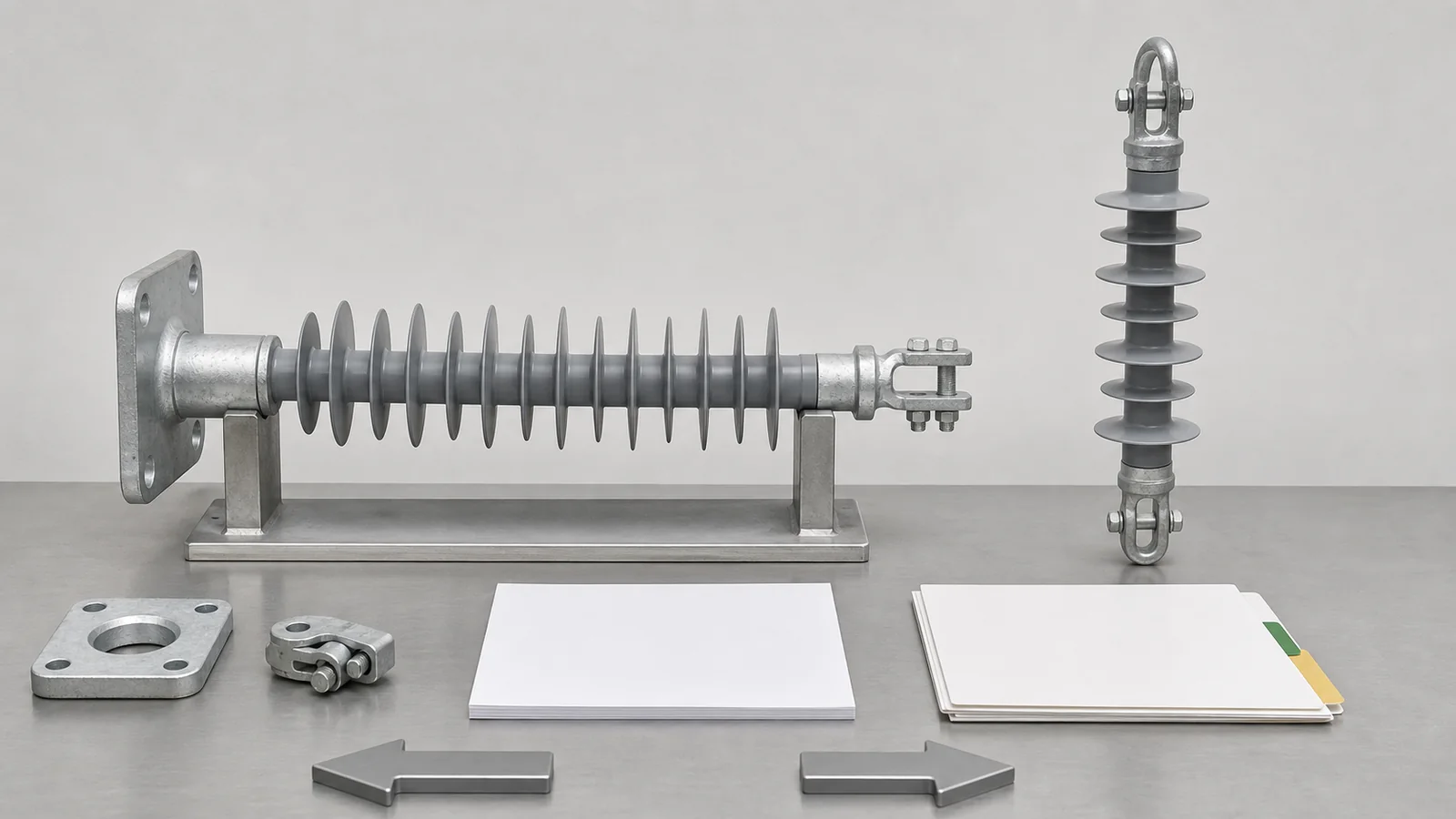
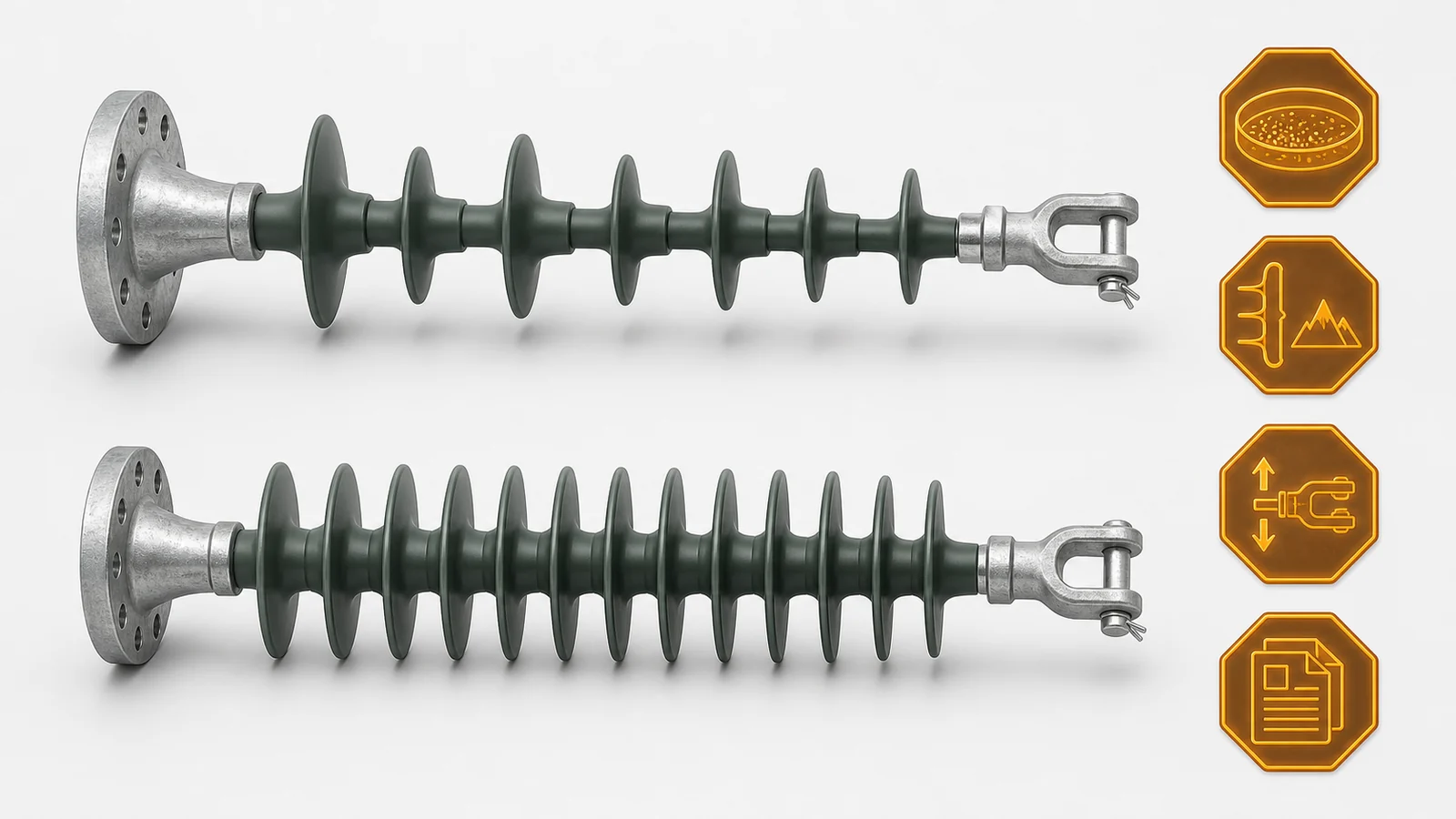
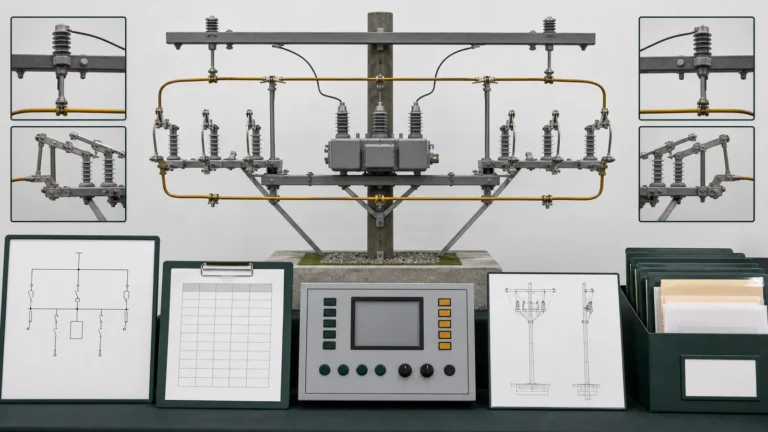
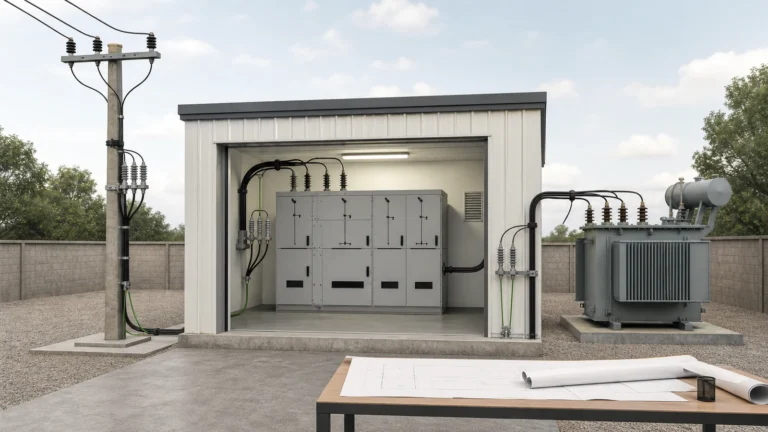
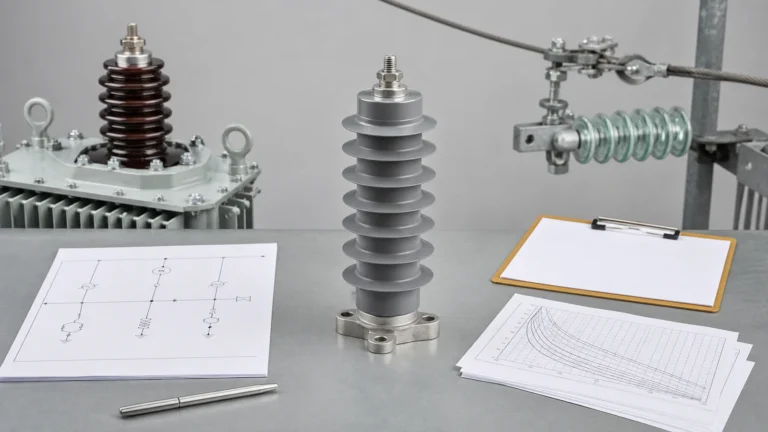
Illustrative technical visualization: application, site pollution, profile geometry, mechanical loads, fittings, and candidate records are reviewed together.
All images are generated illustrative technical visualizations, not XIYA POWER product, customer, factory, order, drawing, calculation, measurement, inspection, test, installation, commissioning, maintenance, failure, outage, or field photographs.
Composite insulator selection polluted environment decisions must connect the exact insulator function and load path to site-pollution evidence, candidate creepage and shed geometry, applicable corrections, mechanical-load definitions, fittings, and traceable records. A longer creepage number, a silicone rubber label, or a voltage match cannot release a candidate by itself.
This guide covers initial selection. It does not provide universal creepage values or diagnose contamination, tracking, erosion, hydrophobicity condition, or fitting aging in service.
Start with the Insulator Function and Load Path
Choose the route before comparing rating rows. The live composite insulator selector starts with the installation interface, then asks for insulation duty, mechanical load, fitting interface, and dimensions. Its crossarm, horizontal-line, pin, post, suspension, bushing, accessory, and material routes are not interchangeable.
Insulator route
Primary mechanical boundary
Interface to control
Häufiger Auswahlfehler
Pin
Compression and bending at the spindle
Thread, bracket and conductor support
Reusing a post or suspension row
Post
Cantilever or bending at the base
Flange, top clamp and load point
Applying a rating without its lever arm
Crossarm or horizontal line
Combined structural actions
End fittings, clamp and support geometry
Selecting from voltage and profile alone
Suspension or tension
Axial tensile string duty
End fittings, section length and string geometry
Treating SML as post cantilever capacity
Hollow or bushing
Apparatus-specific mechanical and electrical interfaces
Flanges, conductor and enclosure boundary
Mixing hollow, wall or CT-integrated routes
Use the wider Säule für Verteilungsschaltanlagen to confirm the device family and duty. Then apply a five-gate selection matrix to one identified insulator candidate.
Selektionstor
Erforderliche Eingaben
Nachweise des Kandidaten
Decision or hold
Anwendung
Position, AC system basis, insulation input, function and orientation
Controlled application and interface drawing
Route confirmed or hold
Site pollution
Adopted method, deposits, wetting, sheltering, altitude and maintenance basis
Approved site worksheet and project specification
Site basis usable or hold
Belästigung und Profil
Total creepage, dry-arc geometry, diameter, shed profile and applicable corrections
Candidate drawing and correction worksheet
Geometry reconciled or hold
Mechanical and fittings
Load modes, directions, combinations, application point, core and fittings
Mechanical review and fitting drawings
Load path supported or hold
Beweismittel und Freigabe
Materials, applicable design/type evidence, revisions and deviations
Reconciled data pack and named technical release
Candidate released or hold
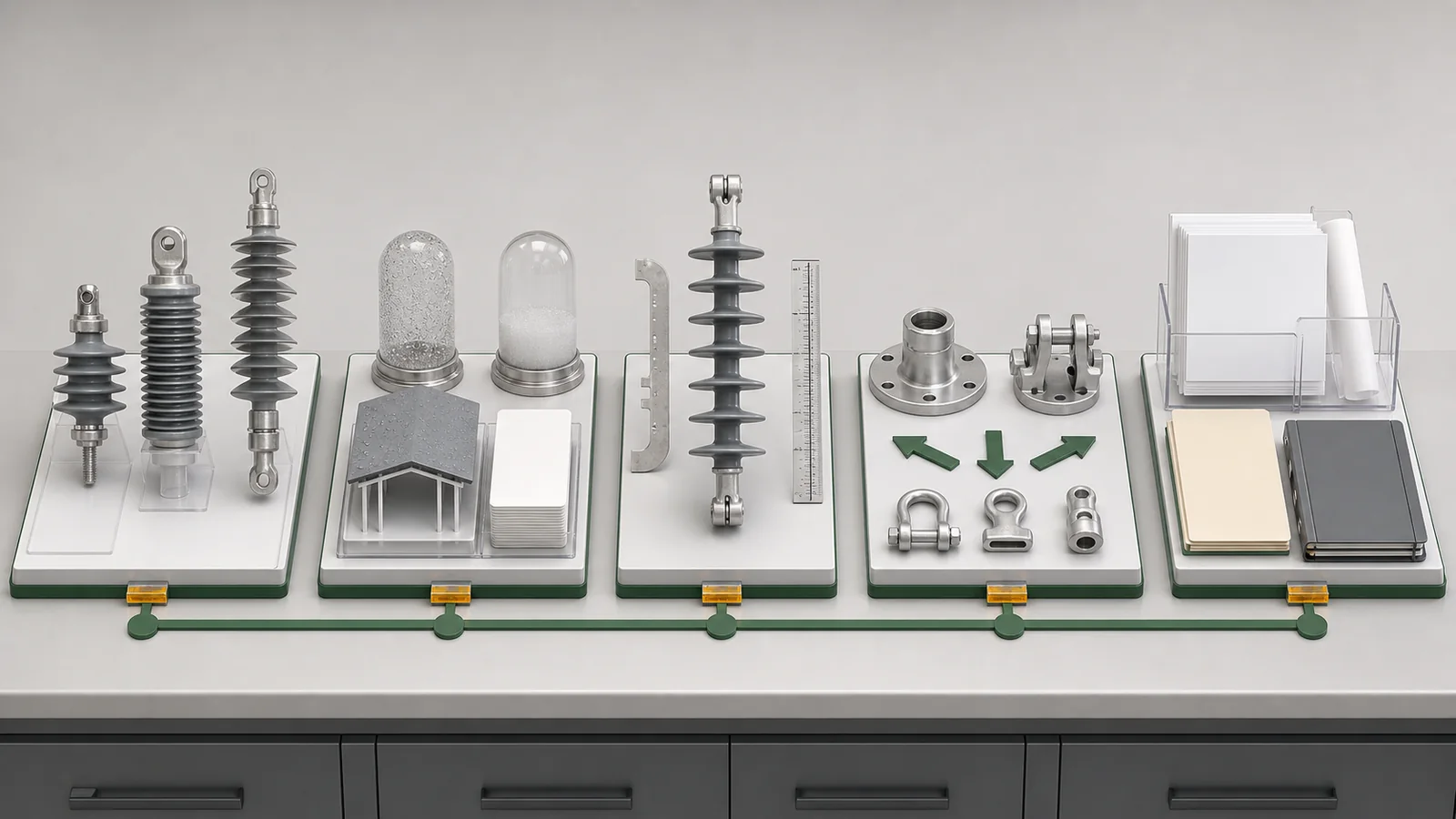
Illustrative technical visualization: application, pollution basis, creepage and profile, mechanical interfaces, and release evidence remain independent selection gates.
Each gate is independent. Correct flange holes cannot close a missing pollution worksheet, and a stated cantilever value cannot close an undefined load application point.
Translate Pollution Evidence into Candidate Geometry
Coastal, industrial und heavy pollution are prompts for site data, not completed specifications. Record the deposit sources, soluble or non-soluble character where the adopted method requires it, fog or condensation wetting, rain washing, drying periods, orientation, shielding, prevailing exposure, altitude, and maintenance assumptions. Distinguish exposed and sheltered surfaces rather than assigning one climate label to the whole insulator.
The official public scope of IEC TS 60815-3:2025 covers selection and relevant dimensioning of polymeric insulators for AC outdoor high-voltage systems with respect to pollution. Its public objectives include moving from site pollution severity to a reference creepage basis, choosing profiles, and applying candidate corrections for altitude, shape, size, position, diameter, shed profile, and parallel-insulator number. The summary also identifies material guidance and hydrophobicity-transfer concepts; snow and ice effects on polluted insulators are outside its scope.
That page does not supply a universal creepage value, formula, correction factor, profile limit, test criterion, or selected product. It also does not prove that a housing has hydrophobicity-transfer material behavior. Record the adopted edition, applicable family part, source worksheet, and candidate-specific calculation without reproducing paid content.
Use this chain:
Establish site pollution severity by the adopted method and evidence.
Identify deposit and wetting patterns for the actual position and orientation.
Select an initial polymer candidate and controlled drawing.
Record total creepage, dry-arc geometry, diameter, shed arrangement and orientation.
Apply only the corrections relevant to that candidate and project.
Reconcile the result, manufacturer data and any mitigation with the same drawing revision.
Der komplette outdoor disconnect polluted-environment review also covers frames, coatings, mechanisms, moving joints, drainage and access. This article uses its site inputs but does not release the complete switch assembly.
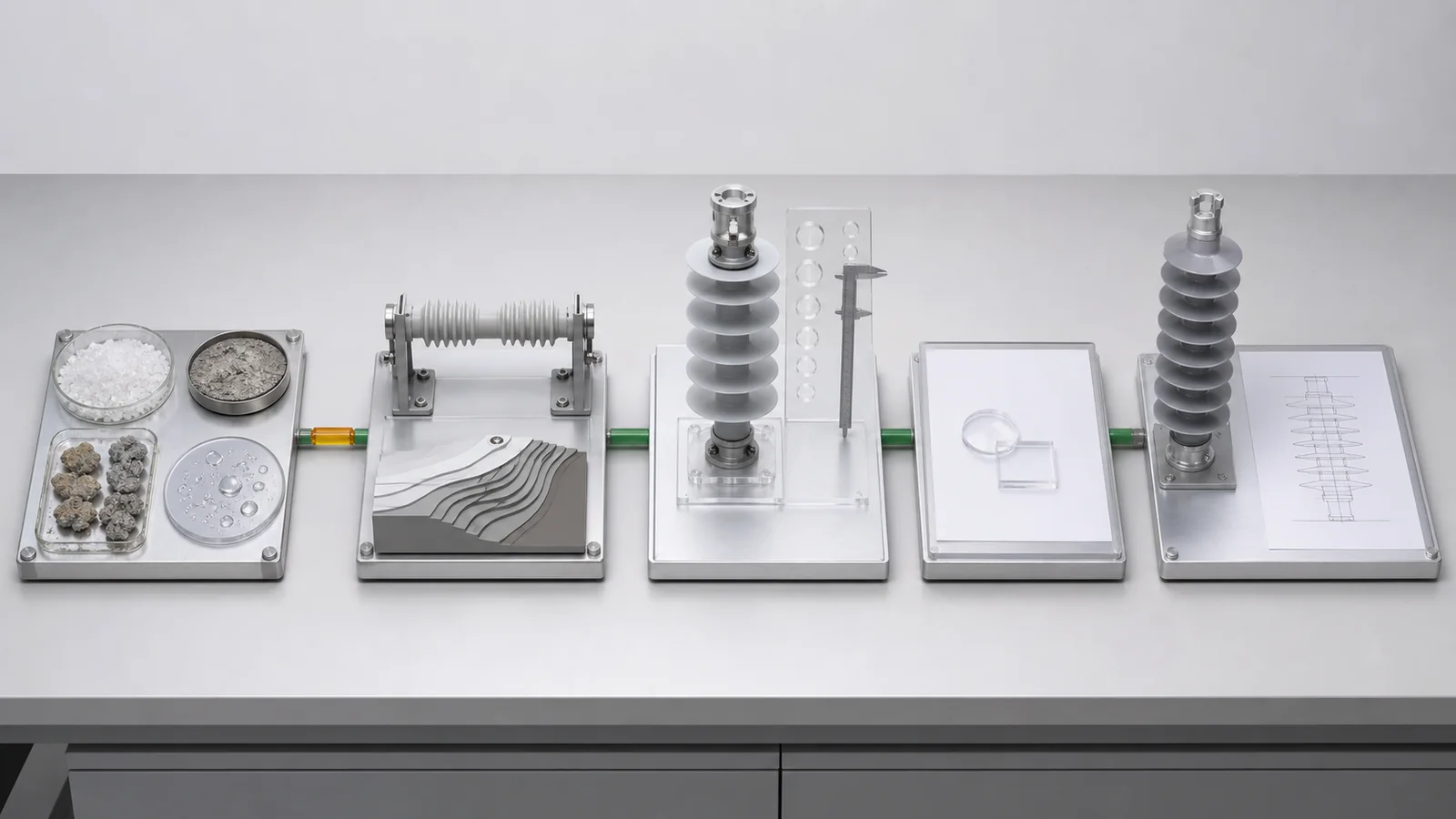
Illustrative technical visualization: deposits and wetting, orientation and altitude, profile geometry, corrections, and one candidate drawing form a traceable chain.
Compare Creepage, Sheds, Materials, and Interfaces Together
Total creepage is a drawing-controlled surface path, not a standalone quality score. Compare it with dry-arc geometry, profile, shed spacing, diameter, orientation, parallel arrangements where used, and the applicable correction record. More stated creepage does not automatically make one candidate better when the profile, orientation, diameter, or correction basis differs.
Shed profile influences how the candidate presents surfaces to deposits, wetting, sheltering, and washing. Do not publish a universal ranking of uniform and alternating sheds. Require the manufacturer to identify the actual profile and explain its applicability to the project method and orientation. The drawing should also preserve dimensions needed to verify the installed envelope and adjacent clearances.
Material names need the same discipline. Silicone rubber alone does not identify the exact housing family, core, end fittings, core-to-fitting boundary, or evidence applicability. If the supplier claims hydrophobicity-transfer material behavior, require its controlled material identity and applicable evidence. Do not convert that claim into a field hydrophobicity condition or service-life promise.
Confirm flanges, pins, threads, clamps, hole patterns, conductor interfaces, support geometry and installation envelope. A matching lower flange cannot compensate for a wrong top clamp or an unsupported load path. The surge arrester selection guide likewise keeps housing pollution and mechanical site inputs candidate-specific, but its electrical arrester selection does not supply composite-insulator data.
Resolve Mechanical Loads at the Actual Connection Point
Define load modes, directions, combinations and application points before comparing capacities. A post or horizontal support develops cantilever and bending effects about its base. A suspension or tension unit carries axial string duty. A pin interface and an insulated crossarm have their own combined paths. Never transfer suspension SML to post cantilever duty merely because voltage and housing appear similar.
The mechanical schedule should identify:
vertical, transverse and longitudinal actions and which act together;
load application point and lever arm from the controlled mounting datum;
separate moment, torsion, compression or tensile inputs where applicable;
service, exceptional and other project-defined load categories without inventing margins;
conductor clamp, top fitting, core, end fitting, lower flange and support interfaces;
applicable candidate rating definition and evidence.
A short-circuit study may provide conductor reactions for the mechanical schedule, but it does not prove the candidate’s capacity. Map those reactions to the actual connection point, then review the candidate drawing and applicable evidence. Keep the calculation basis, load definitions, combinations and named approval traceable.
Reconcile the complete fitting chain. The lower flange pattern, fasteners and structure must match, but so must the upper clamp, conductor position, orientation, fitting material, core-to-fitting construction and installation envelope. Record deviations instead of modifying a hole, clamp or lever arm without an approved review.
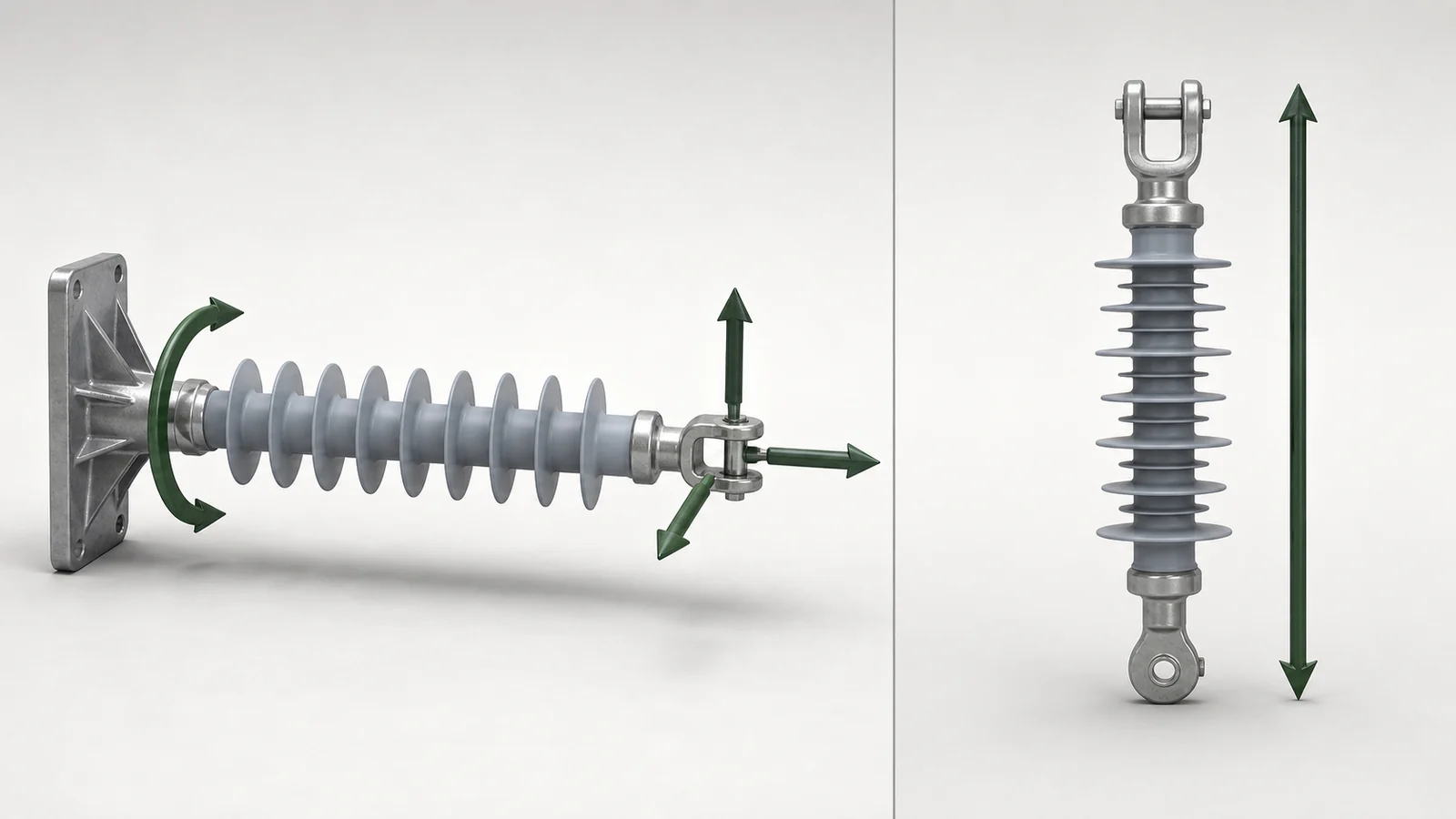
Illustrative technical visualization: post cantilever duty and suspension tensile duty use different load paths, application points, and fittings.
Build the RFQ Data Pack and Technical Release
A useful RFQ checklist separates project inputs from supplier returns.
Projekteingabe
Candidate return required
Application, AC voltage basis, insulation coordination and position
Exact candidate identity and controlled drawing revision
Site worksheet, deposits, wetting, orientation, sheltering and altitude
Creepage/profile calculation and applicable correction record
Insulator route and load schedule
Rating definitions, load point and combined-load review
Structure, flange, clamp and conductor drawings
Reconciled fitting and envelope drawings
Material and evidence requirements
Housing, core, fitting and boundary declarations with applicable evidence
Approval and deviation procedure
Deviation schedule, data-pack index and named technical release
Ask for total creepage, dry-arc distance, diameter, shed geometry, orientation, material identity, any HTM claim basis, core and end fittings, flange and clamp dimensions, load application point, applicable mechanical rows, design/type evidence, drawing applicability, and manufacturing or routine records only where the project requires them. Missing evidence means the candidate data pack is incomplete; it does not prove that the component failed or that an activity did not occur.
Send the site data, structure drawing, load schedule, candidate requirements and open deviations through the XIYA POWER Kontaktseite for a project-specific quotation. Keep technical release separate from price comparison: the lowest quotation or longest creepage row cannot close an unresolved gate.
Keep Both Synthetic Candidates at Four Holds
Representative engineering review, entirely synthetic, illustrative, and non-universal. This is not a XIYA POWER customer, supplier, factory, product, quotation, order, design, calculation, drawing approval, measurement, inspection, test, installation, commissioning, maintenance, failure, outage, or field case. No compatibility, compliance, acceptance, safety, hydrophobicity, pollution performance, mechanical capacity, service life, or result is claimed.
The synthetic application is one 36 kV-class AC outdoor horizontal line-support position on a coastal industrial feeder structure. The site file identifies salt aerosol plus industrial deposits, frequent fog wetting, partially sheltered lower surfaces, 1,450 m altitude and horizontal installation. The project route cites IEC TS 60815-1 and IEC TS 60815-3 editions but lacks the approved site-pollution worksheet.
Synthetic structure inputs are 2.2 kN vertical, 3.6 kN transverse and 1.1 kN longitudinal service actions at the conductor centerline, plus a separate 0.9 kN m interface moment. These are inputs, not allowable capacities or design factors. The mounting interface requires a synthetic 140 mm square four-hole lower flange and a controlled top-clamp drawing.
Kandidat
Zurückgegebene Daten
Open evidence
A, drawing A2
1,050 mm total creepage, alternating sheds, 4 kN cantilever row, 140 mm square flange
No dry-arc distance, diameter, horizontal-orientation assessment, altitude/profile correction worksheet, load point, combined-load review, material/HTM declaration or top-clamp drawing
B, drawing B4
1,250 mm total creepage, uniform sheds, 5 kN cantilever row, 140 mm square flange
Worksheet is for vertical installation at 0 m; no reconciliation to horizontal 1,450 m duty, exact material/HTM applicability, core/fitting declaration, load point, combined-load review or controlled top-clamp drawing
Hold 1: site and method. Return the approved pollution-severity basis, adopted editions, deposit and wetting evidence, horizontal orientation, sheltering, altitude and applicability route.
Hold 2: creepage and profile. Tie total creepage, dry-arc geometry, diameter, shed profile, horizontal orientation, 1,450 m altitude and every applicable correction to each candidate drawing.
Hold 3: mechanical and fittings. Reconcile all three service actions, the 0.9 kN m synthetic moment, load definitions and point, combined-load review, 140 mm flange, top clamp, core and end fittings.
Hold 4: material, evidence and release. Identify exact housing, core and fitting materials, any HTM claim basis, applicable design/type evidence, drawing revisions, deviations and named approval.
Illustrative technical visualization: site method, creepage and profile, mechanical fittings, and material evidence remain four independent synthetic holds.
Neither candidate is selected or release-ready. All four holds remain open.
Häufig gestellte Fragen
What site data is needed to select a composite insulator for pollution?
Provide the adopted site-pollution method and evidence, deposit types and sources, wetting and drying patterns, rain washing, orientation, sheltering, altitude, relevant site conditions and maintenance assumptions. Record uncertainties instead of replacing them with coastal or heavy pollution.
Is a longer creepage distance always better in coastal service?
No. Compare total creepage with the candidate’s dry-arc geometry, diameter, shed profile, orientation, applicable corrections and site basis. A longer catalogue value with an unreconciled drawing or correction route is not a stronger selection.
How does shed profile affect composite-insulator selection?
Profile changes exposed and sheltered geometry, deposit collection, wetting and washing behavior. The choice must be assessed for the actual candidate, orientation and adopted project method. Do not assume uniform or alternating sheds are universally superior.
Can a suspension-insulator SML be used for post-insulator cantilever duty?
No. SML describes an axial tensile boundary for the applicable suspension route. Post duty depends on cantilever or bending capacity at a defined load application point and lever arm. Use the rating definition and evidence for the actual route.
What mechanical and fitting data belongs in the RFQ?
Include load modes, directions, magnitudes, combinations, application point, lever arm and any interface moment. Add controlled lower-flange, top-clamp, conductor, support and envelope drawings, plus core and end-fitting requirements and the applicable evidence basis.
Which records should close before technical release?
Close the site worksheet, adopted standards and editions, candidate drawing, creepage/profile and correction record, material and fitting declarations, combined-load review, interface drawings, applicable design/type evidence, deviations, data-pack index and named approval. Any missing item remains an open gate.
Candy Zhao
Candy Zhao ist Vertriebsleiterin bei XIYA POWER und koordiniert technische Angebotsanfragen für Mittelspannungsschaltanlagen, Lasttrennschalter, Trennschalter, Sicherungsauslöser, Überspannungsableiter und zugehörige Verteilungsanlagen. Sie unterstützt die Kommunikation bei Angeboten, Zeichnungen, Prüfberichtsanforderungen, Lieferbedingungen und Exportaufträgen für Energieversorger, Generalunternehmer, Schaltschrankbauer und Distributoren.