Quotation form
Send an inquiry
Start with the basics. Our team can follow up for missing drawings, standards or packing details.
Submitted details are used only for quotation, technical review and project communication.

Use this selector to separate indoor AIS, SF6, puffer, outdoor air, fuse-combination, manual IACM, horn-gap, accessory, PGS, indoor vacuum and outdoor vacuum load break switch options before confirming ratings and drawings.
Choose by installation point, interruption medium, fuse or controller requirement, mounting interface and available rating data.
Indoor high-voltage load switch path for cabinet switching, line protection and fuse-combination review where the FN7-12 indoor LBS series is identified.
Gas-insulated load break switch path for compact distribution equipment, with 12 / 24 / 36 kV voltage classes confirmed before quotation.
Indoor three-pole puffer load isolator path where the puffer mechanism and indoor cabinet fit are the first selection questions.
Outdoor air load break switch option for 12 / 24 / 36 kV line switching where visible arc-chute hardware, pole mounting and operating linkage drive the choice.
Medium-voltage air load break switch with fuse path for 12 / 24 / 36 kV projects where switching duty and fuse protection are selected together.
Three-pole outdoor air-break load isolator path for 12 / 24 / 36 kV projects where product identity is clear and current or withstand duty still needs confirmation.
Manual outdoor IACM load break switch path with arcing-horn structure, polymer insulation and rod operation for overhead-line switching.
Horn-gap fuse switch option for adjacent fuse switching material where the visual selection option is useful but full rating rows are not present.
Accessory and replacement-parts option for load break switch mechanisms, contacts, linkage parts and support hardware.
Pole-mounted SF6 PGS path for smart-grid or feeder automation projects where LBS duty crosses into distribution automation scope.
Indoor vacuum load break switch path for FZN/FZRN style switchgear applications where vacuum interruption and cabinet fit need to be checked together.
Outdoor vacuum load break switch path for FZW32 12 kV and 40.5 kV feeder switching with visible disconnecting fracture and pole mounting.
The application question comes first: indoor cabinet, outdoor feeder, ring network, fuse protection, manual overhead operation, automation or accessory replacement.
Separate load switching from visible no-load isolation. If the equipment is only for isolation, compare disconnect switch pages instead.
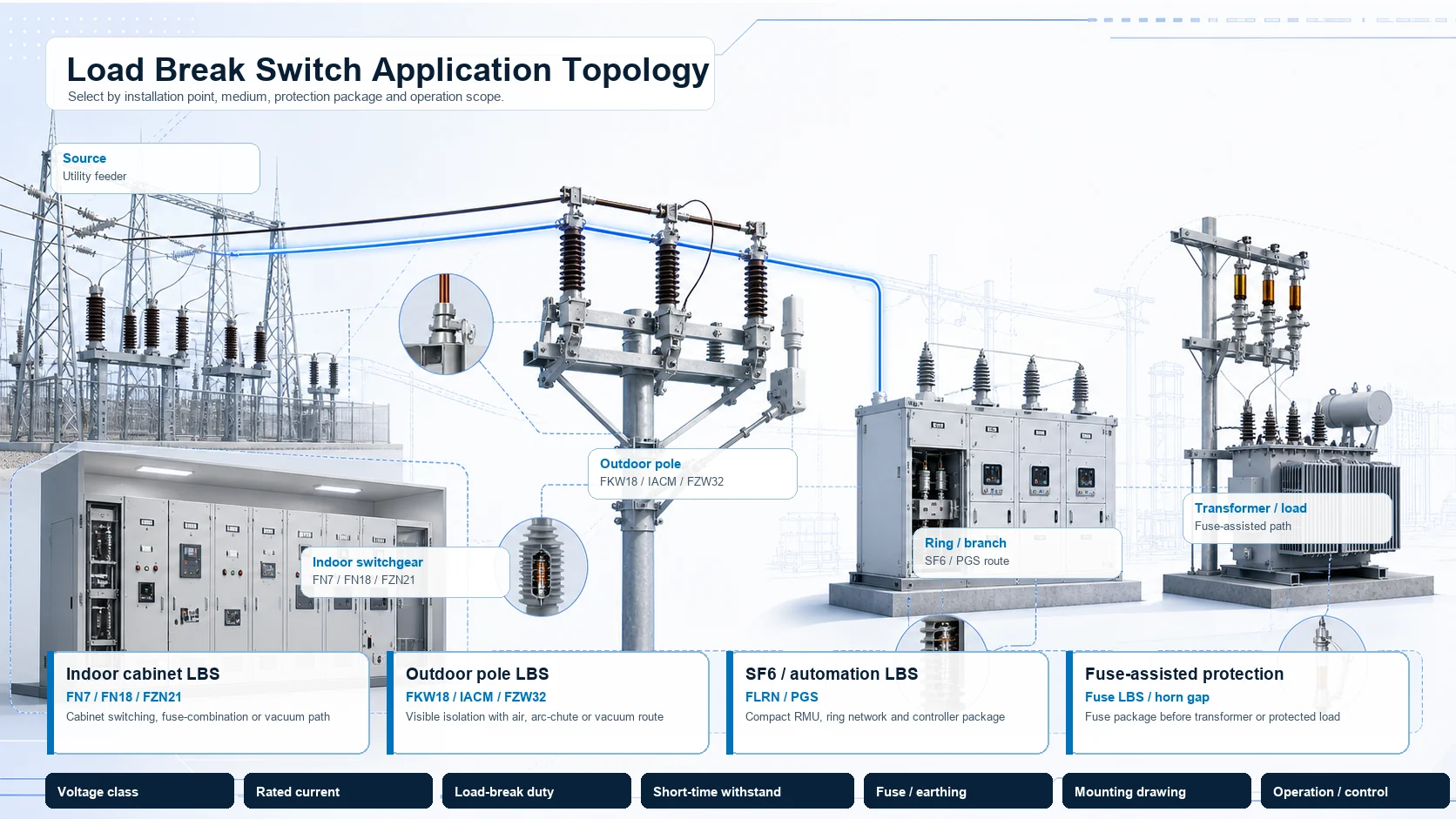
Use FN7, FN18 or FZN21 when the switch sits inside a panel or switchgear cabinet.
Use FKW18, IACM, FZW32 or three-pole outdoor air options when the site is an overhead feeder.
Use fused or horn-gap options only when the project needs switching plus fuse protection review.
Compare the product type, interruption medium and rating data before quotation.
After the product type is selected, check the switching chamber, contact path, operating drive and mounting interface from the matching technical documents.
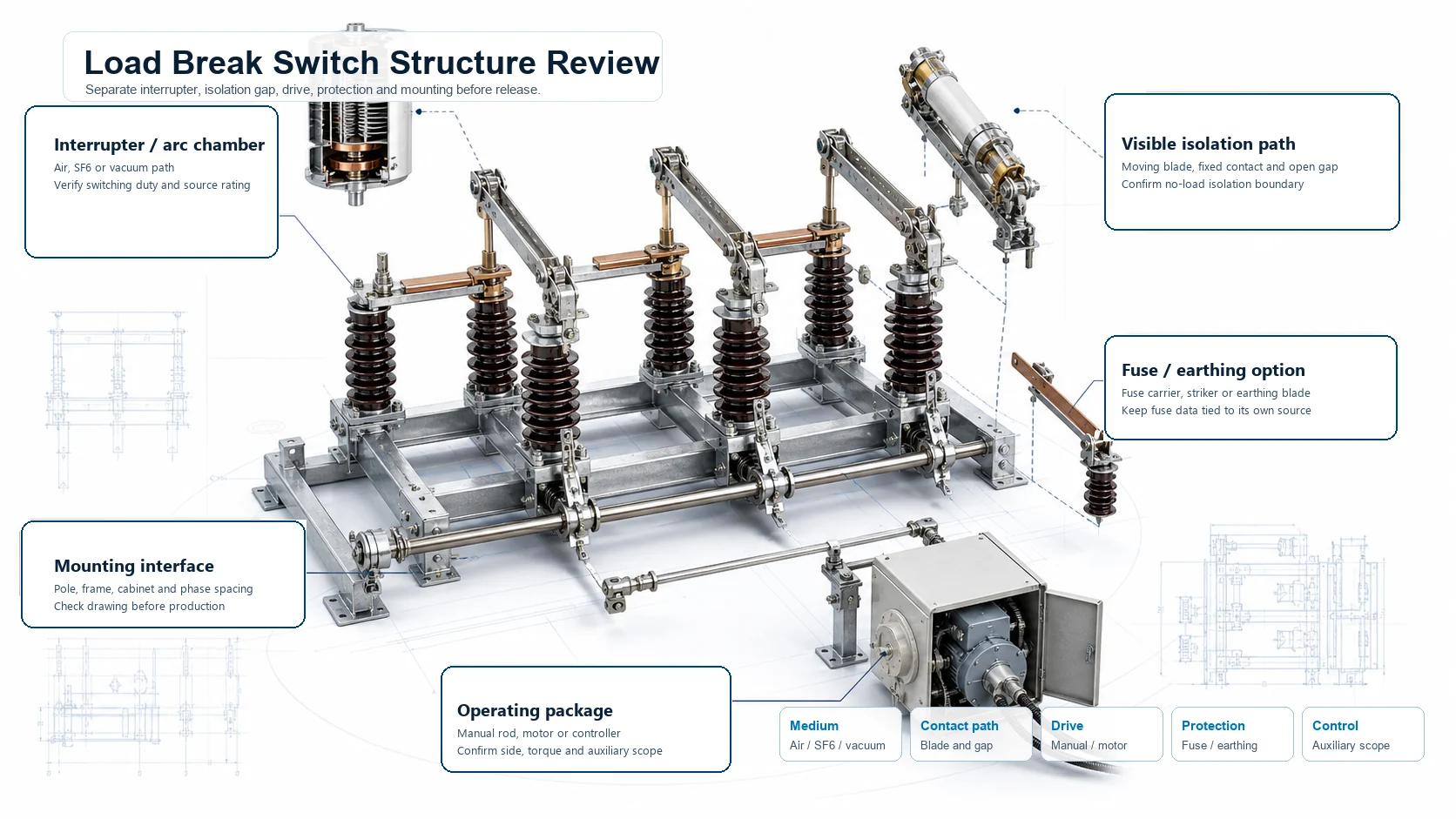
Use these checks before the product type is selected.
The category does not reuse one product table across all options. Each product detail states the supported rating range and what must be confirmed from the order sheet.
Do not mix puffer, fuse-combination and vacuum values unless the order sheet names the same model series.
Pole spacing, support height, operation side and drawing status decide the quotation package.
White-background product views are used for configuration recognition. Scanned pages, French sheets and Chinese drawings remain internal unless they can be processed into a usable English or clean drawing view; teams can also download load break switch catalog PDFs before final model review.
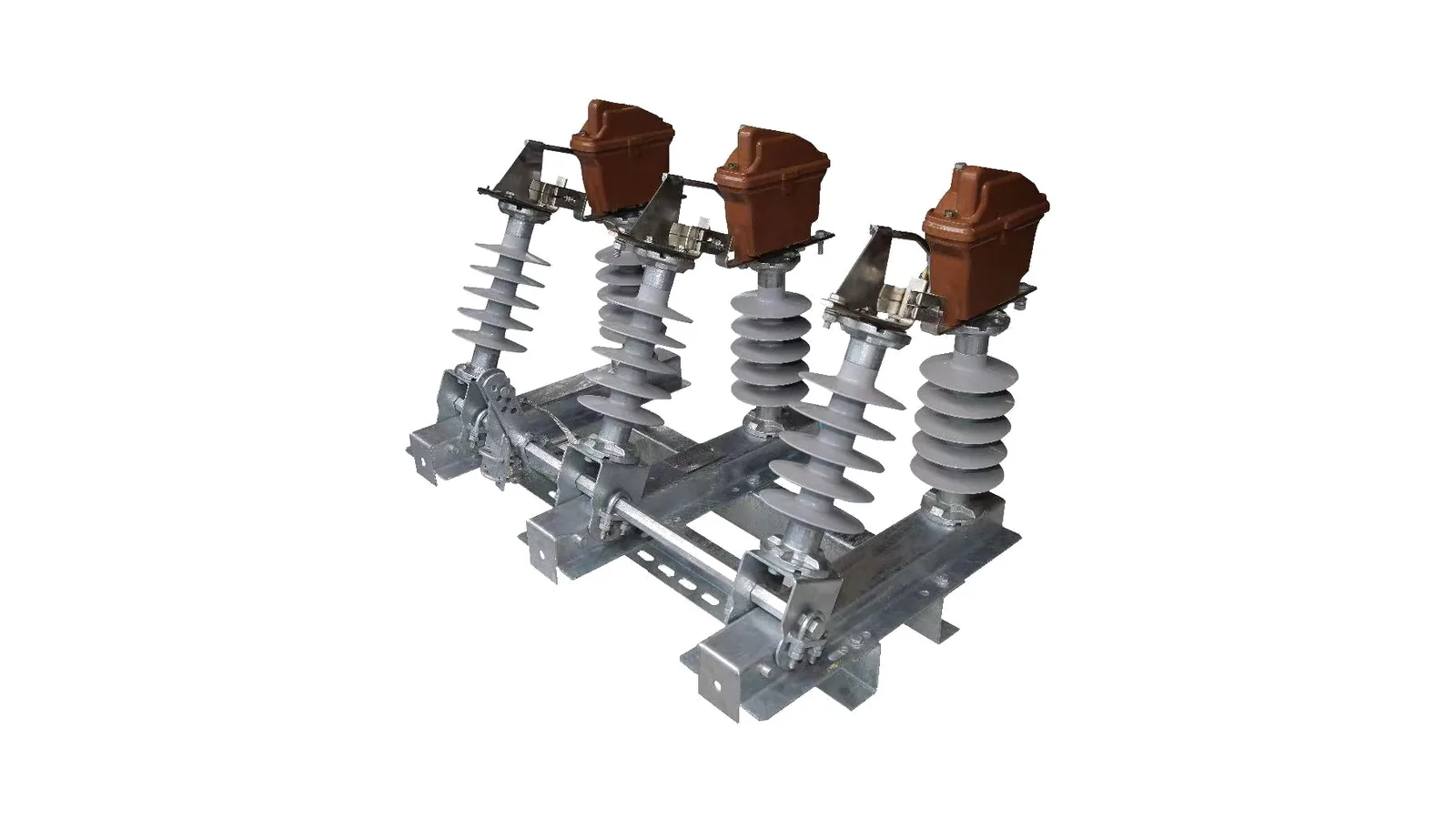
Product cards avoid scan pages and scanned document screenshots.
Image-supported options do not receive invented voltage or current rows.
FN7, FN18, FKW18, FZN21 and FZW32 include Drawing tabs. IACM stays SPEC-only because the available drawing-like documents are French.
These options are not moved under disconnect switches, even when a reference name includes isolator or disconnecting fracture.
Send the product type and the switching duty first, then match the medium, rating row, operation method and mounting interface, or check certificates, test reports and RFQ forms when project files need review.
Indoor, outdoor, SF6, vacuum, fused, horn-gap, accessory or PGS option.
Air, puffer, SF6 or vacuum must match the feeder application.
Do not copy values across unrelated product types.
Cabinet, pole, cross-arm, support height, operation side and controller scope decide the package.
Send the product type, system voltage, rated current, interruption medium, switching duty, fuse or controller requirement, mounting interface, operation side, drawing status, quantity and destination standard.
Use a load break switch on indoor cabinets, ring networks, outdoor feeders, transformer branches or automation points where the circuit must open and close load current.
Choose the product type first when the project still needs to compare indoor cabinet, outdoor feeder, SF6, vacuum, fused, horn-gap, accessory or PGS options. The exact model row should follow the installation point, interruption medium and mounting interface.
Drawing tabs are shown only where a clean drawing or a cleanly cropped English drawing view is available. French, Chinese, scanned or poster-style pages stay internal and the modal remains SPEC-only.
No. Accessories and parts support compatibility review only. Voltage, current and withstand duty must come from the matching switch model or project order sheet.
Start from the installation point and interruption medium. Indoor cabinets use indoor AIS or vacuum options, outdoor pole feeders use air, IACM or vacuum options, and compact or automation projects may use SF6 or PGS options.
Send the product type, system voltage, rated current, interruption medium, switching duty, fuse or controller requirement, mounting interface, operation side, available drawing and destination standard. XIYA will return the suitable load break switch option, drawing check and required document list.