Quotation form
Send an inquiry
Start with the basics. Our team can follow up for missing drawings, standards or packing details.
Submitted details are used only for quotation, technical review and project communication.

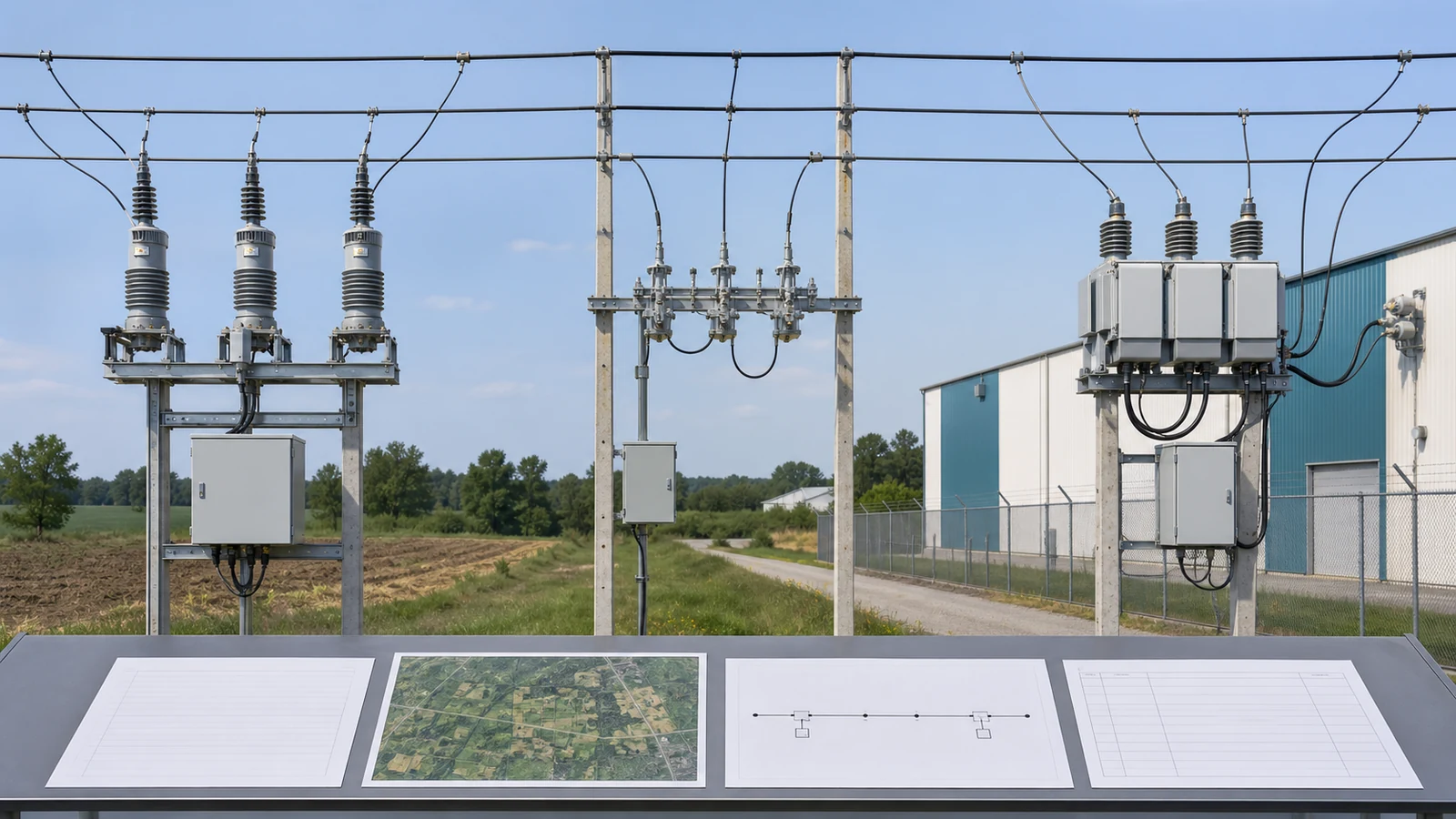
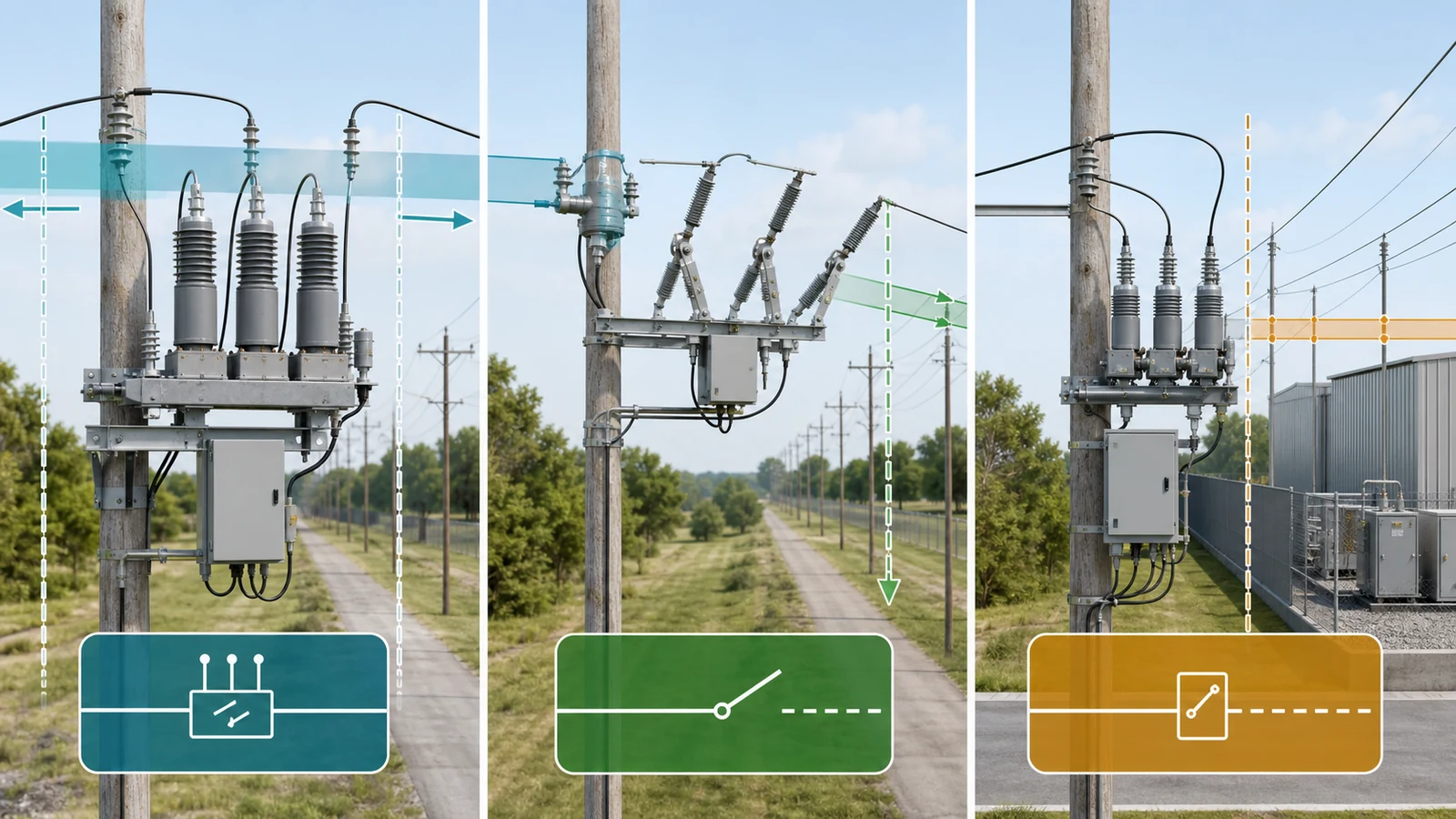
A recloser vs sectionalizer vs boundary switch decision starts with the fault scenario and protection-zone owner, not with three product names. Use a recloser where the assigned feeder point must interrupt fault current and execute approved reclosing behavior. Use a sectionalizer role to isolate a selected section in coordination with an upstream interrupting device. Use a boundary switch where the central requirement is customer-side protection and utility/customer demarcation.
The Smart Grid equipment hub separates these positions because similar controllers, sensing, and remote commands do not make their primary duties equivalent.
Complete the system inputs before assigning equipment. The broader feeder automation design-input framework owns topology states, protection boundaries, control-power continuity, communication, and fallback requirements. This article converts those inputs into a position-by-position role decision.
Use a selection matrix so each required input produces a decision, release evidence, or a visible hold:
| Feeder question | Required input | Role decision | Release evidence | Hold condition |
|---|---|---|---|---|
| Which zone owns the fault? | One-line, fault scenarios, protection boundaries | Main-feeder, selected section, or customer zone | Approved zone drawing and responsibility matrix | Zone ownership is implied |
| Who interrupts fault current? | Short-circuit and coordination basis | Recloser, upstream device, or boundary breaker as assigned | Study-linked duty schedule | Interruption owner is unclear |
| Who isolates the selected section? | Upstream sequence and permitted opening state | Sectionalizer implementation and position | Sequence narrative and implementation declaration | Opening state is undefined |
| What happens at the customer handoff? | Demarcation, user-side scenarios, trip/reset authority | Boundary-switch role and package | Ownership and operating-authority record | Utility/customer responsibilities remain open |
| What must each body switch? | Fault, load-breaking, making, and withstand duties as applicable | Switching-body selection | Manufacturer data tied to offered configuration | Controller features substitute for primary duty |
| Which interfaces remain available? | Sensing, control power, commands, status, communication, local fallback | Package and ownership boundaries | Approved interface schedule | Any required interface lacks an owner |
| What proves project fit? | Adopted standards, project specification, evidence and deviations | Technical release | Compliance and evidence register | Evidence does not match the offered revision |
Remote operation alone proves none of the three roles. The matrix must also state normal, contingency, maintenance, and degraded conditions so a device location is not mistaken for an approved operating sequence.
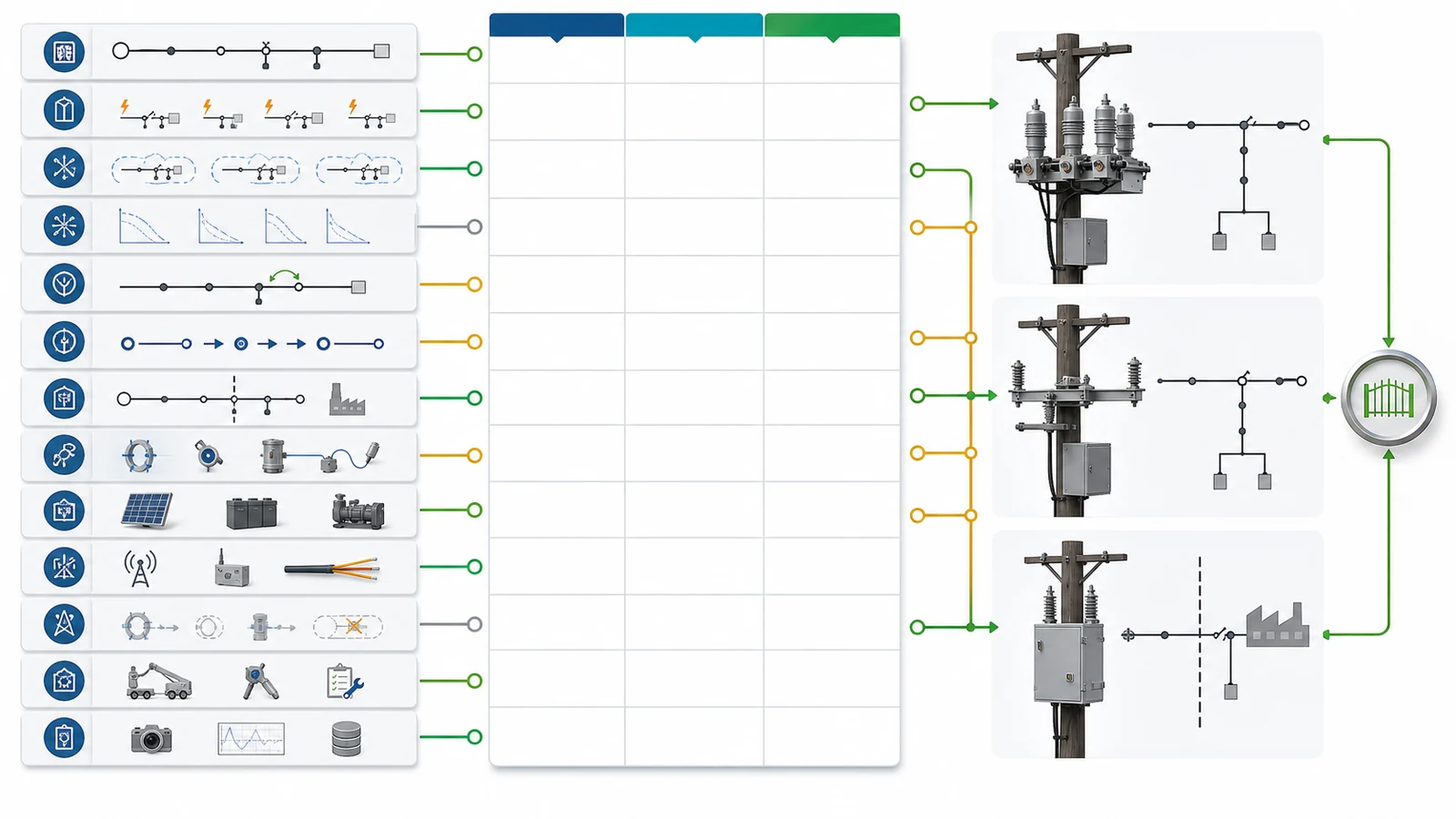
The automatic vacuum circuit recloser illustrates the recloser boundary: its switching body provides fault-current interruption, while the controller provides protection logic, reclosing, lockout, records, and communication. Assign this role where the project requires both interruption and an approved trip-reclose-next-state sequence at that feeder point.
A sectionalizer coordinates with an upstream protective device to isolate a defined section. The project must declare whether the offer is an automatic line sectionalizer, a load-break switch with automation, or another controlled implementation. XIYA’s pole-mounted SF6 load-break switch can serve a load-switching or sectionalizing point with optional sensing and control, but its controller does not turn it into a vacuum recloser. It should not be represented as an automatic line sectionalizer unless the required logic, operating window, duties, and evidence are established.
The user boundary switch owns a different decision: protection and responsibility at the utility/customer handoff. Its package may use a vacuum breaker, phase and residual sensing, a PT supply, and a boundary controller. The role is defined by the customer-side zone, trip/lockout behavior, and operating authority, not by the presence of a breaker or controller alone.
| Comparison point | Recloser | Sectionalizer role | User boundary switch |
|---|---|---|---|
| Primary job | Interrupt assigned feeder faults and follow approved reclosing behavior | Isolate a selected section in coordination with upstream interruption | Isolate the assigned customer-side zone and enforce demarcation |
| Fault interruption owner | Recloser at its assigned point | Normally the coordinated upstream device; do not infer interruption capability | Offered boundary breaker where specified and coordinated |
| Operating trigger/window | Protection decision and approved sequence | Declared sensing/command logic and a permitted de-energized or switching state | User-side protection decision and boundary operating rules |
| Restoration responsibility | Reclose, hold open, or lock out as approved | Remain open or return according to the restoration sequence | Reset, reclose, or remain open according to boundary ownership |
| Evidence focus | Interrupting duty, sequence, controller/body match | Implementation, upstream coordination, switching duty, operating window | Zone ownership, breaker duty, sensing, trip logic, operating authority |
No route is universally superior. One feeder can use all three roles at different positions, provided their zones and sequences do not conflict.
The official IEEE C37.63-2024 page identifies an active standard covering definitions, ratings, design and production tests, construction, and application considerations for overhead, pad-mounted, dry-vault, and submersible automatic line sectionalizers for AC systems up to and including 38 kV. The project must name its adopted standard and edition and confirm that the offered implementation falls within the declared scope.
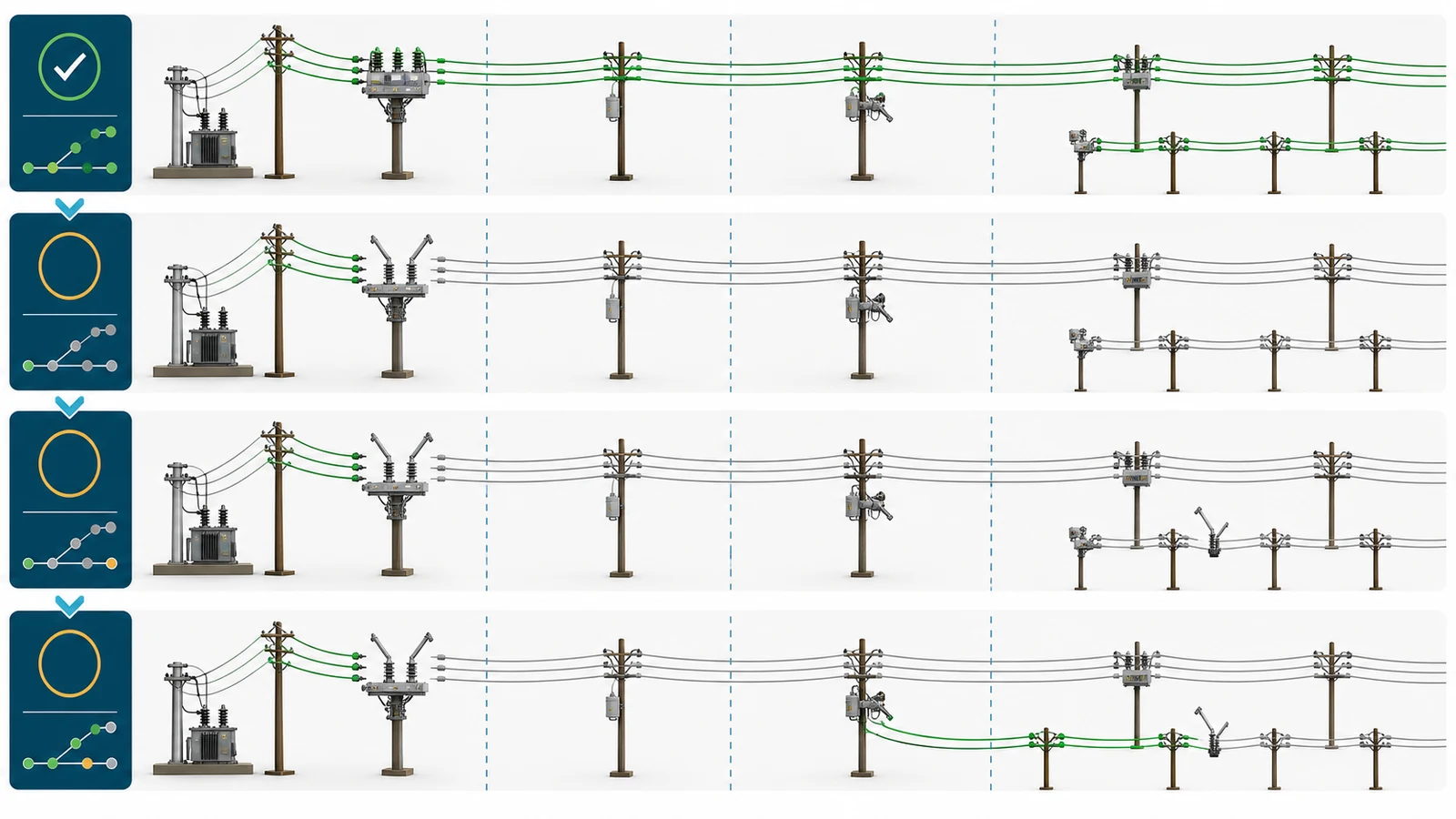
A generic coordination concept is useful, but it is not a universal sequence. A fault occurs; the assigned upstream protective device interrupts current; the downstream sectionalizing point determines whether its zone should open during the permitted state; the upstream device then follows the approved next action. Detection basis, opening permission, restoration, reset, and lockout all come from the project coordination design.
| Scenario | Interrupting-device responsibility | Sectionalizer responsibility | Boundary responsibility | Required evidence | Hold when |
|---|---|---|---|---|---|
| Transient main-feeder fault | Interrupt and follow approved reclosing state | Do not isolate a healthy section unless logic requires it | No action outside its zone | Fault scenarios and coordination narrative | Device actions are assumed from labels |
| Permanent fault in selected downstream section | Interrupt and provide the permitted operating state | Isolate its assigned section using the declared implementation | No action outside its zone | Zone map, opening logic, body duties, sequence | Opening window or zone is unclear |
| User-side fault | Coordinate as backup according to the study | No action unless separately assigned | Detect and interrupt/isolate the customer zone as specified | Boundary study, ownership, trip/reset rules | Backup and boundary actions conflict |
| Communication or control-power loss | Enter the declared degraded state | Retain a defined local/fallback state | Retain a defined boundary-protection state | Degraded-state design and test basis | Remote loss creates an undefined position |
By role, the sectionalizer relies on coordinated upstream interruption. Its offered body may have load-breaking, making, withstand, or other declared capability, but none should be promoted to fault-interruption capability without applicable ratings and evidence. Likewise, a remotely controlled switch is not a sectionalizer until its zone, logic, window, and upstream relationship are approved.
Similar control cabinets can support different primary roles. Keep the comparison at interface-ownership level; detailed controller I/O and settings belong in the controller specification.
| Interface | Recloser ownership | Sectionalizer ownership | Boundary-switch ownership |
|---|---|---|---|
| Sensing | Fault and operating inputs required by its protection role | Inputs required to determine the assigned section response | Phase/residual and other inputs required for the customer zone |
| Commands | Local logic plus approved remote authority | Declared automatic or remote opening/closing authority | Boundary protection plus approved utility/customer authority |
| Control power | Trip, close, controller, communication, and fallback energy basis | Availability through the required operating state | Availability for boundary detection, trip, status, and recovery |
| Status/events | Feeder interruption, position, lockout, alarms | Section position, operation, alarms | Boundary position, trip cause, alarms |
| Local/manual mode | Safe local authority, automation inhibit, recovery | Safe local authority and restoration control | Utility/customer local authority and reset boundary |
| Degraded state | Approved state after loss of power, sensing, or communications | Approved section state and local fallback | Protection and ownership behavior preserved or explicitly held |
| Maintenance | Isolation, bypass, testing, and return-to-service rules | Upstream coordination disabled or controlled as specified | Demarcation and customer isolation preserved |
Define the owner through design, factory configuration, site integration, operation, and maintenance. A protocol name or remote-control feature does not close the point list, event timing, command authority, cybersecurity responsibility, or failure behavior.
Three offers may include different switching bodies, sensors, CT/PT arrangements, controllers, communications, spares, and documents. Normalize them to one feeder basis before comparing price or delivery:
The project specification defines the required behavior; the short-circuit study and coordination work define the electrical and sequence basis; manufacturer data describes the offered package. None substitutes for the others. A controller sheet cannot prove primary switching duty, and a generic test record cannot prove another configuration or role.
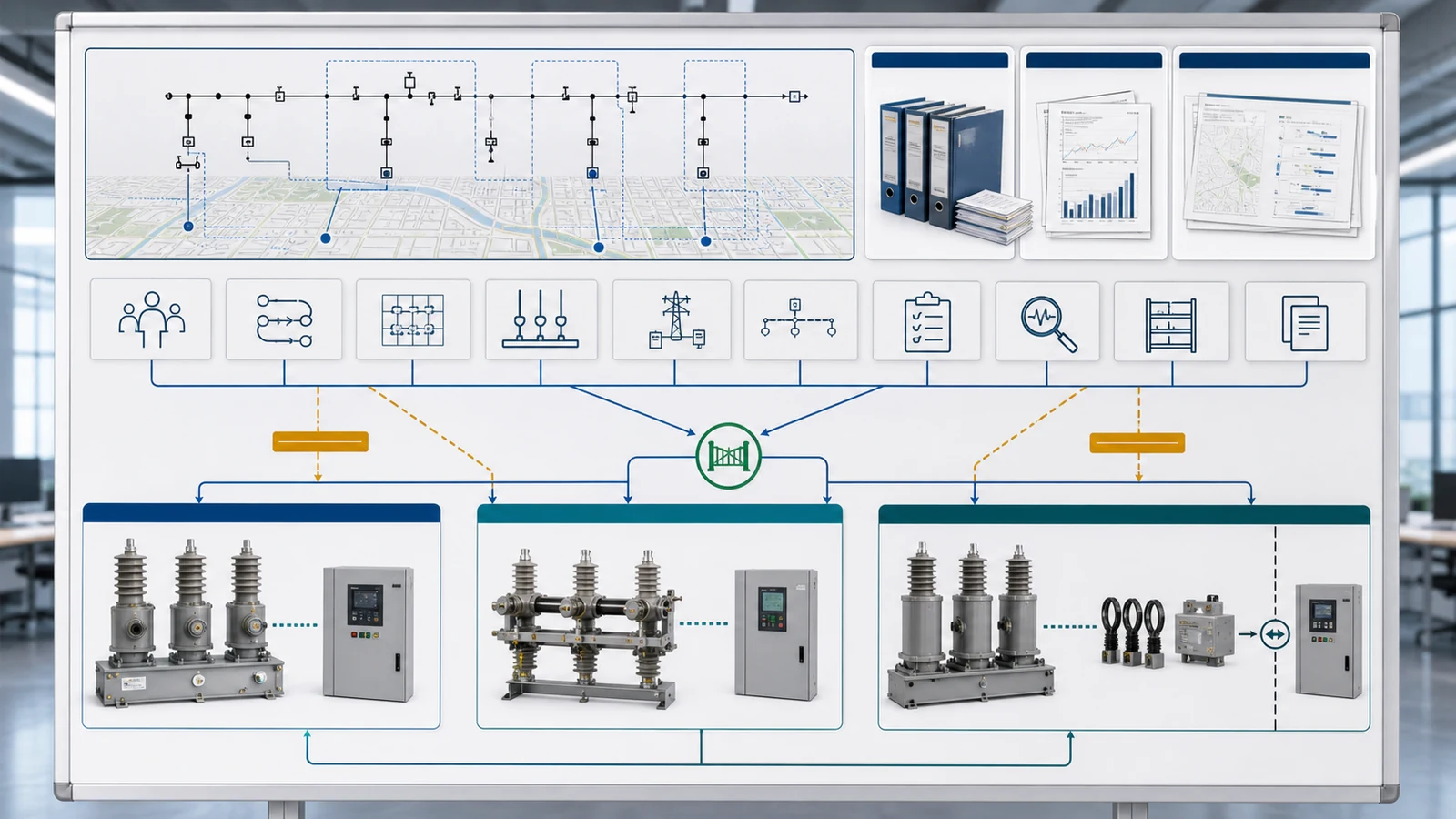
Representative engineering review, not a XIYA POWER customer project, factory case, field record, commissioned installation, outage result, or service result.
A radial overhead feeder has an upstream protective interrupting device, one proposed mid-feeder automation point, two downstream branches, and one customer boundary point. The one-line labels three proposed devices as recloser, sectionalizer, and boundary switch, but the role matrix and fault scenarios are not approved.
The transient main-feeder response, permanent branch isolation, user-side fault boundary, upstream reclosing behavior, sectionalizer operating window, and restoration authority are not coordinated. The sectionalizing offer may be a load-break switch plus controller, but its primary duty, sensing logic, control-power continuity, and evidence are unclear. The boundary package includes current/residual sensing and a controller, but trip ownership, reset/reclose responsibility, and communication authority remain open. Each offer also assumes different commands, records, fallback, spares, and documents.
Decision: hold role assignment and technical release. Reconcile:
No model, setting, fault value, timing, operation count, price, saving, outage duration, restored load, reliability result, test result, commissioning result, or field outcome is assigned. To begin a role review, provide the one-line, fault and coordination basis, role/zone matrix, sequence narrative, switching duties, interface schedules, site arrangement, quantity, destination, evidence requirements, and deviations.
A recloser interrupts fault current at its assigned point and follows approved reclosing behavior. A sectionalizer isolates a selected section in coordination with an upstream interrupting device. Their switching duties, operating decisions, and evidence are different.
Not by role. The coordinated upstream protective device normally interrupts the fault before the sectionalizer opens. Confirm the offered body’s declared load-breaking, making, withstand, or other capabilities, but never infer fault interruption from sensing or remote control.
Yes, when its switching duty, sensing/control implementation, operating window, upstream coordination, and evidence satisfy the project. That does not automatically make it an IEEE automatic line sectionalizer or a recloser.
No. A boundary switch owns a customer-side protection and responsibility handoff. A feeder recloser owns interruption and reclosing at its assigned feeder position. A breaker-based boundary package does not automatically assume feeder-wide restoration.
Use topology states, fault scenarios, zone ownership, required interruption and switching duties, operating sequence, boundary authority, sensing, control power, communications, fallback, maintenance, and evidence requirements.
Close the approved one-line and zone drawings, studies, role and sequence matrices, duty and interface schedules, configuration-specific manufacturer data, applicable evidence, routine/FAT plan, deviations, spares, installation documents, and controlled final register.