Quotation form
Send an inquiry
Start with the basics. Our team can follow up for missing drawings, standards or packing details.
Submitted details are used only for quotation, technical review and project communication.

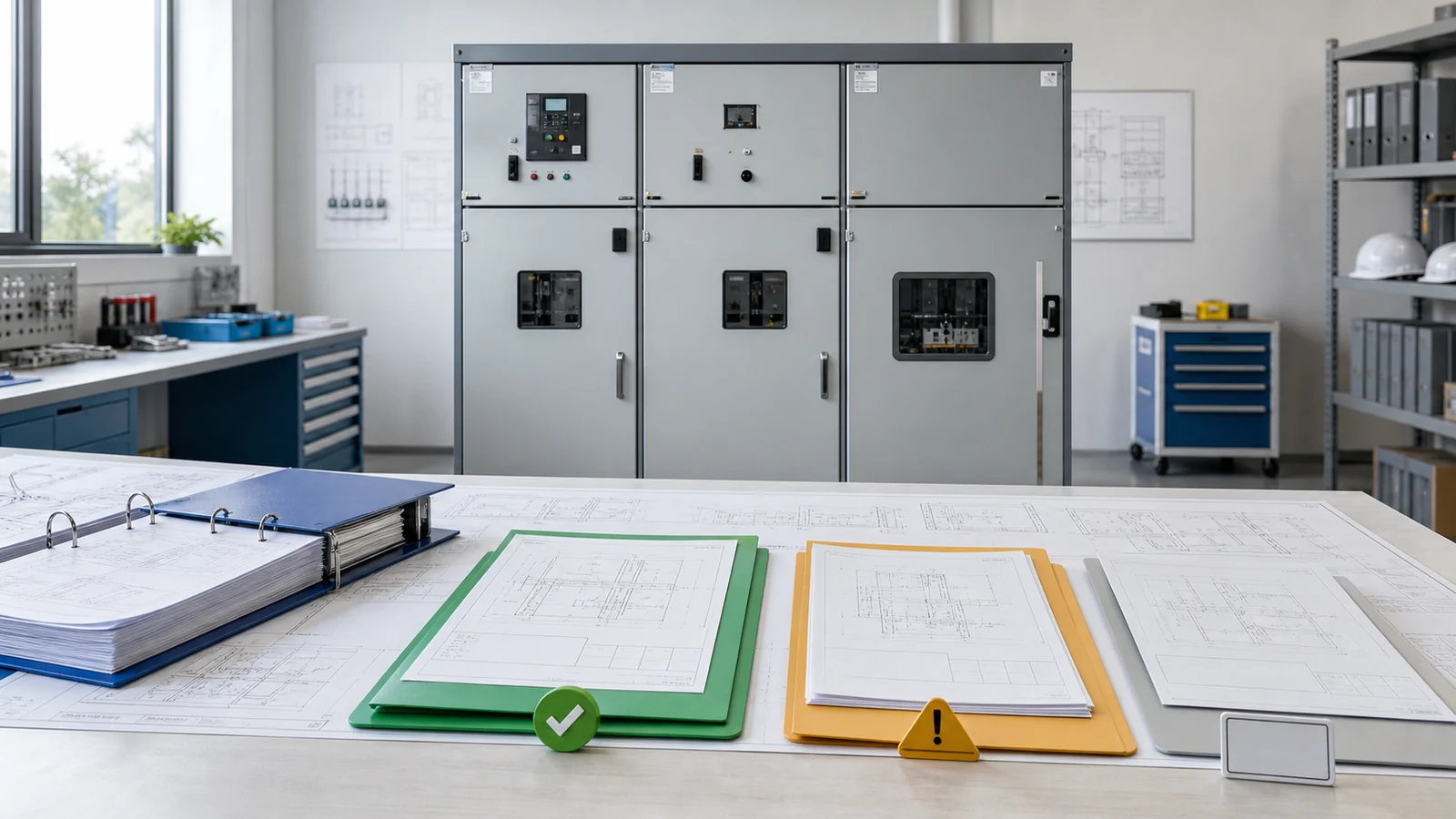
Effective switchgear drawing revision control separates five things that are often confused: document identity, revision identifier, issue purpose, review disposition, and manufacturing-release status. A higher revision letter, an email approval, or a stamped PDF may contribute evidence, but none authorizes manufacture by itself.
Use one master revision register to identify the current package, close comments, review dependent records, control distribution, and record the release owner. The XIYA POWER OEM/ODM service provides the commercial context; the control method below focuses only on drawing status inside that order process.
A drawing number answers “which document?” A revision answers “which technical state?” An issue purpose answers “why was it sent?” A review disposition records the receiver’s decision. A production-release entry answers the operational question: “may the affected scope be manufactured against this revision?”
The responsibility split should also be explicit. The OEM versus ODM responsibility guide helps establish who originates, reviews, approves, and releases each document, but either commercial model still needs one controlled register.
Use a stage gate matrix rather than inferring one field from another:
| Controlled field | Required input | Gate owner | Decision or release evidence | Hold condition |
|---|---|---|---|---|
| Project and equipment identity | Order reference, equipment/tag, drawing title/type | Project engineering | Agreed document schedule | Identity or scope is ambiguous |
| Document numbers | Supplier and customer numbers where applicable | Document control | Registered cross-reference | Duplicate or mismatched numbers |
| Current revision | Revision identifier, issue date, superseded revision | Originator/checker | Drawing history and revision register | More than one version appears current |
| Issue purpose | Project-defined status for the transmittal | Issuing party | Controlled transmittal | Permitted use is unclear |
| Review disposition | Returned decision and conditions | Reviewer | Registered return record | Review is missing or conditional items are open |
| Comment status | Unique comments, responses, closure | Engineering/document control | Closed comment register | Affected comments lack disposition |
| Configuration impact | Affected equipment and dependent records | Responsible disciplines | Impact-review record | Consequences are not reconciled |
| Manufacturing release | Specific package, revision, owner, date | Release gate owner | Signed or system-logged release record | No explicit authorization exists |
| Distribution and as-built | Recipients, supersession action, final requirement | Document control | Distribution and final document register | Obsolete copies or final status are unresolved |
The exact fields, codes, signatures, and workflow are project-defined. The matrix is a control model, not a universal coding standard. A current drawing can still be “for review” and therefore unavailable for manufacture; an older drawing can remain historically released while being superseded for new work.
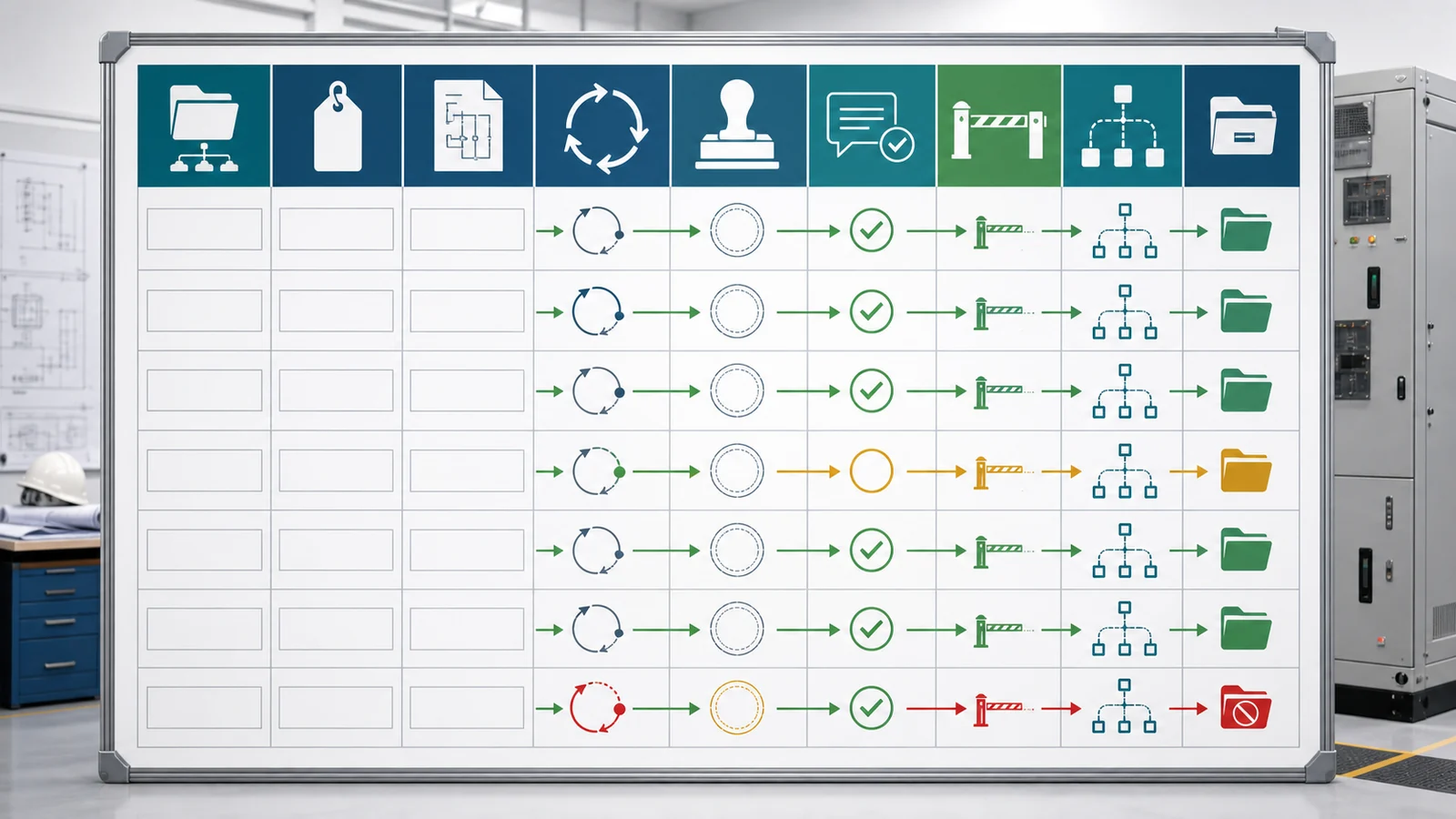
Projects commonly use states such as tender/reference, for information, for review or approval, returned with comments, approved, released for manufacture, superseded/withdrawn, and as-built. These labels are examples. The project document procedure must define their meaning and permitted use.
| Project-defined state | Permitted use | Required control evidence | Typical hold |
|---|---|---|---|
| Tender/reference or information | Evaluation or awareness | Issue record and transmittal | No manufacturing authority |
| For review/approval | Formal technical or contractual review | Submission registered against a revision | Response is outstanding |
| Returned with comments | Comment response and resubmittal | Returned markup plus comment register | Conditions affecting manufacture remain open |
| Approved or approved with comments | Review disposition where defined | Registered reviewer decision | Residual conditions or impacts are unresolved |
| Released for manufacture | Production, procurement, and inspection for named scope | Explicit release record tied to a package | Any prerequisite gate remains open |
| Superseded/withdrawn | Historical reference only | Supersession and distribution record | Obsolete copy remains available for use |
| As-built | Final configuration record and handover | Reconciled drawing and document register | Supplied configuration is not reflected |
The parent high-voltage equipment manufacturing workflow shows where this drawing release sits within the wider order. It does not make a purchase order, sample decision, or test release a substitute for drawing control.
The official ISO 10007:2017 page says the standard provides configuration-management guidance for products and services from concept to disposal. ISO lists the edition as published and current after confirmation in 2023, while also noting revision work. It is not a switchgear product standard and does not prescribe the status labels above; its public scope supports the need to maintain configuration identity and status through the lifecycle.
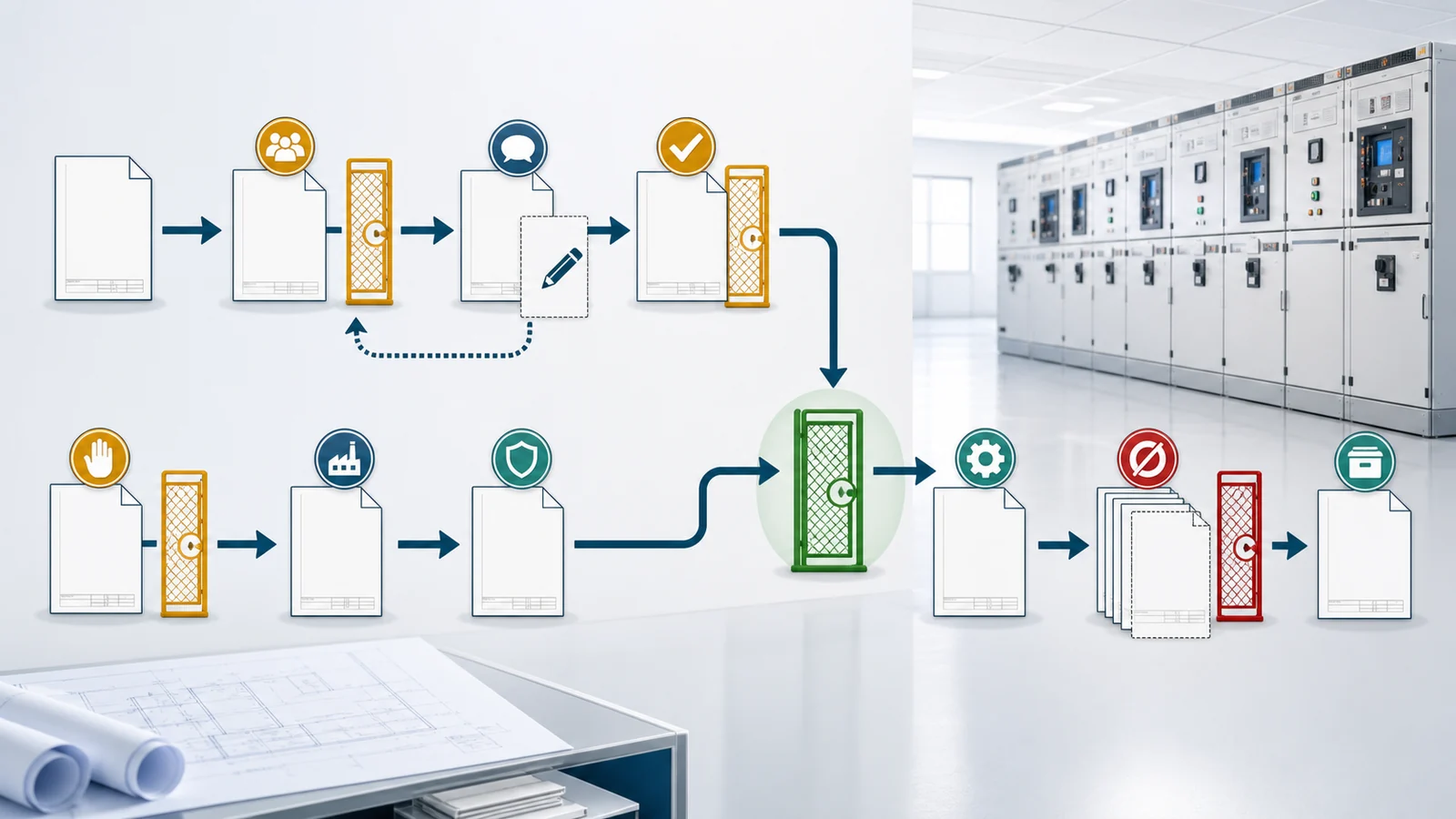
A review cycle is not closed because the supplier uploaded a new file. Each customer or engineer comment should have a unique reference, affected drawing/item, source, supplier disposition, incorporated revision where applicable, residual action, owner, response, closure evidence, and transmittal reference.
Line-by-line responses make closure easy to audit. A consolidated response can also work if the project procedure preserves each comment’s identity and disposition. The important controls are traceability and closure, not a universal template.
Email may communicate a decision, but the decision should be captured in the controlled register. If an email says “approved,” record which document and revision it covers, whether conditions apply, who accepted the disposition, and the transmittal or release entry that makes it actionable. Do not allow a recipient to infer production authority from an attachment in a shared folder.
For conditional approval, separate comments that block manufacture from comments that can remain open under an accepted disposition. The affected scope stays on hold until the gate owner records that decision. Revision clouds, triangles, color marks, and title-block signatures can help show changes, but only when the project requires those conventions; they are not universally mandatory.
An approved drawing change can affect engineering, procurement, inspection, labeling, and handover records. Run a bounded impact review and record either the required update or the reason no update is needed.
| Dependent record | What may be affected | Owner decision | Closure evidence |
|---|---|---|---|
| Single-line diagram and general arrangement | Ratings, arrangement, interfaces, dimensions | Revise or confirm unchanged | Reviewed revision/impact entry |
| Schematics, wiring, terminals, and cable interfaces | Secondary circuit, interlock logic, terminal references | Update before affected assembly/wiring | Released dependent drawing |
| Bill of materials and manufacturer data sheet | Component identity and configuration | Align with the approved drawing | Controlled BOM/data reference |
| Model and nameplate information | Product identity, rated voltage/current fields, marking basis | Reconcile applicable fields | Approved data record |
| Inspection and test plan and test record templates | Referenced configuration and acceptance basis | Update references before inspection/testing | Controlled ITP/template revision |
| Manuals, packing identification, and document register | Diagrams, tags, item identity, final revision | Track through final release | Handover register entry |
This is configuration applicability, not a material-substitution or detailed test procedure. The project specification, applicable product standards, and agreed technical evidence still govern whether the equipment is acceptable. Drawing control only ensures that those controls refer to the intended configuration.
The impact record should state the affected artifact, owner, action, release dependency, and evidence. A dependent document can remain unchanged, but that conclusion must be reviewed rather than assumed. This prevents a new general arrangement from coexisting with an old bill of materials, nameplate layout, or inspection reference without explanation.
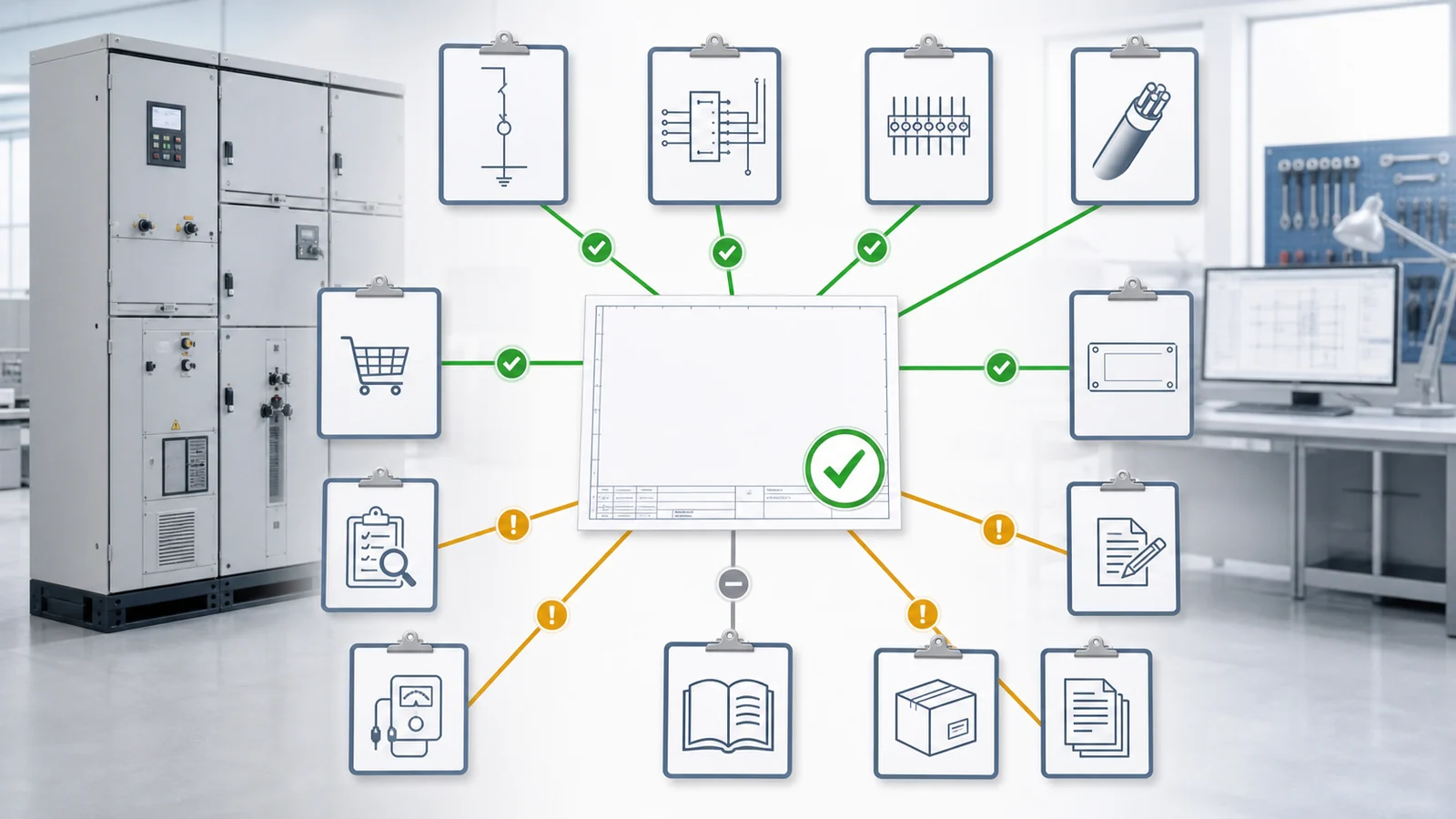
A release package should be small enough to verify and complete enough to recover later. Before authorizing affected work, confirm:
The XIYA POWER resources page can support catalog and document review, but a public catalog is not the authoritative project copy. Use the agreed document system or controlled location as the single release source. Recipients should acknowledge the current package and know how obsolete copies are handled.
At handover, reconcile the actual supplied configuration to the final drawings, test record references, accepted deviations, release note where required, and document register. The as-built package should preserve the revision history and final transmittal rather than appearing as an unrelated clean set. A complete chain shows why the configuration changed, who accepted it, which package entered manufacture, and which final revision describes the supplied equipment.
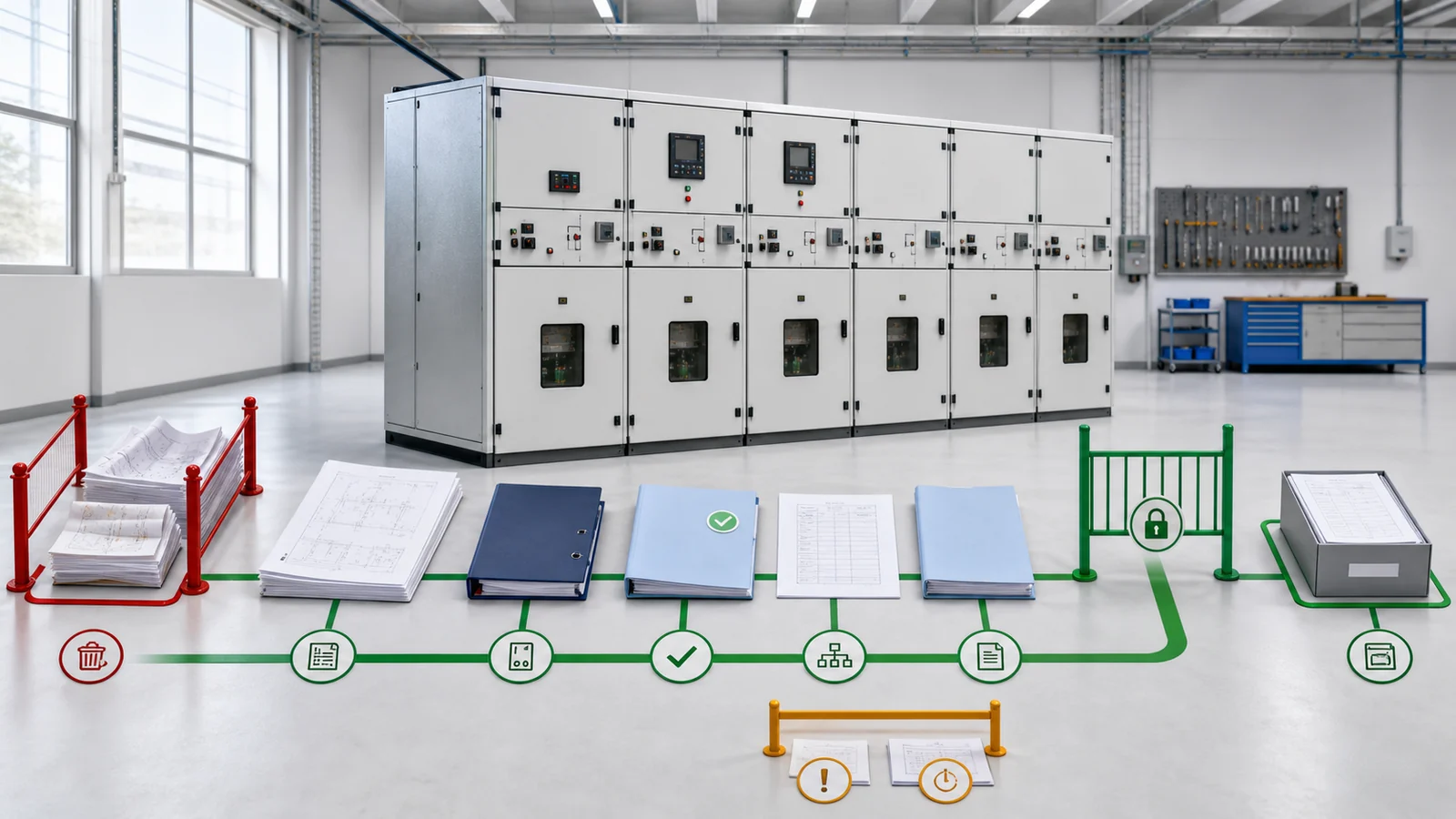
Representative engineering review, not a XIYA POWER customer project, factory case, field record, commissioned installation, export record, or service result.
An export switchgear drawing register lists a general arrangement at Rev B for customer review. Customer comments have been returned, but the approval status is not entered in the register. A wiring drawing at Rev C is marked for manufacture, while its title block, bill of materials, nameplate layout, and one test-record template still refer to the older general-arrangement basis. A project email says the package is approved, but no controlled transmittal or registered disposition identifies what was released.
Decision: hold the affected manufacturing release. Do not assume either that Rev C is valid for all records or that the email covers the complete package. Reconcile:
This review does not assign a customer, country, supplier, quantity, rating, test result, production outcome, or delivery result. It demonstrates why matching revision letters are insufficient when status and dependencies remain unresolved.
For a project-specific review, send the document schedule, responsibility matrix, latest register, returned comments, transmittals, applicable project specification, and required release milestones through the XIYA POWER contact page.
Record the project and equipment identity, supplier/customer document numbers, title/type, current and prior revisions, issue dates and purposes, submission/return dates, review disposition, comment status, supersession, affected configuration, manufacturing-release status, as-built requirement, owners, and transmittal references. Adapt the fields and status codes to the agreed project procedure.
No. The prior release remains a historical authorization for its identified scope, while the new revision requires its own review, impact assessment, and release decision. Evaluate work already performed against the change, then record how the new revision supersedes the prior package.
Approved is a review disposition where the project uses that term. Released for manufacture is the separate authorization that allows named recipients to act on a specific package. An approved drawing can remain on hold because comments, dependent records, or distribution controls are incomplete.
Give each comment a unique reference and record the affected item, reviewer, response, disposition, incorporated revision, residual action, owner, and closure evidence. Capture email decisions in the controlled comment/transmittal record before treating them as closed.
Check every applicable record that uses the changed configuration: SLD, general arrangement, schematics, wiring and terminals, cable interfaces, bill of materials, model/nameplate data, inspection and test plan, test templates, manuals, packing identification, and the final register. Record why an item changes or remains unchanged.
Include the final controlled drawings, reconciled revision and document registers, final transmittal, closed comments, approved departures, release history, and applicable records that identify the supplied configuration. The exact contractual deliverables remain project-specific.