Quotation form
Send an inquiry
Start with the basics. Our team can follow up for missing drawings, standards or packing details.
Submitted details are used only for quotation, technical review and project communication.


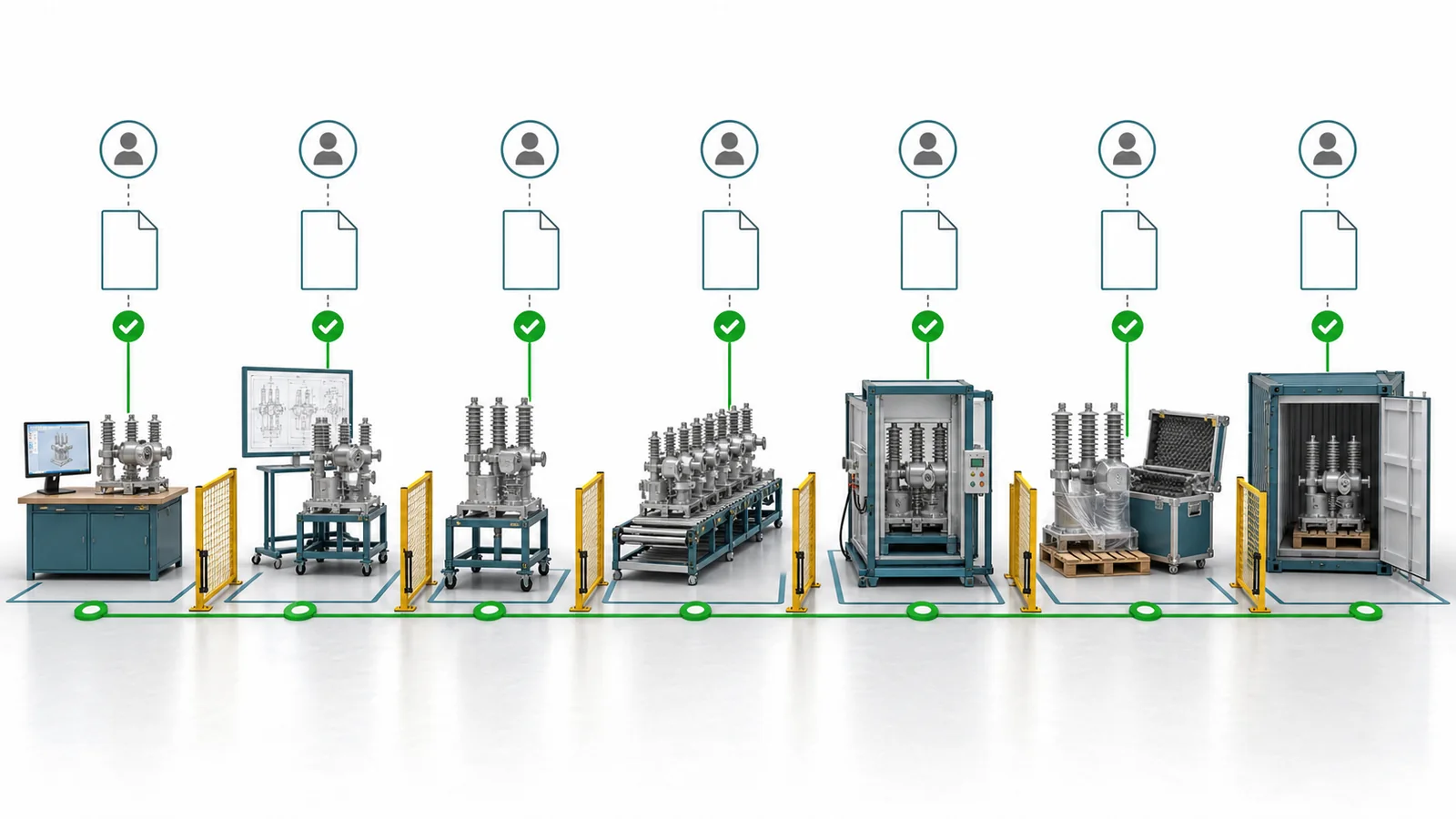
A high voltage equipment manufacturing workflow should keep the accepted order basis, engineering release, sample or first article, series production, inspection, tests, markings, packing, and document handover tied to the same configuration. A purchase order, approved drawing, accepted sample, passed test, or completed packing list closes only its own control point; none of them independently proves that the finished order is ready for shipment.
For a custom order, the practical objective is one traceable release path. The XIYA POWER OEM/ODM overview identifies drawing checks, sample confirmation, private-label items, packing, documents, production confirmation, and testing as review areas. The project still has to define which records apply, who approves them, and what condition holds the order at each stage.
Start with a controlled order basis rather than a chain of disconnected emails. It should identify the accepted quotation or purchase order, product configuration, ratings and interfaces, applicable standards, approved deviations, quantity, destination, approval owners, inspection and test scope, marking language, packing basis, required documents, and planned witness or release points. Manufacturer data and the project specification should be listed with their revision or issue status when they form part of the acceptance basis. The OEM-versus-ODM guide helps define the commercial model; the high-voltage equipment RFQ checklist covers the inputs that should be clarified before an order becomes the engineering baseline.
A stage-gate matrix then turns those inputs into controlled decisions:
| Stage gate | Controlled input | Gate owner or approver | Required output | Typical hold condition |
|---|---|---|---|---|
| Order basis | Accepted commercial and technical scope | Buyer and supplier order owners | Controlled order register | Ratings, scope, deviation, or document requirement unresolved |
| Engineering release | Buyer inputs, interface data, drawing comments | Authorized engineering reviewers | Approved drawing and revision register | Open comments or unclear approval status |
| Sample or first article | Released configuration and inspection basis | Named technical/quality approver | Sample approval or recorded disposition | Difference from drawing or open conditional approval |
| Series production | Approved BOM, work instruction, material controls | Production and quality owners | Traceable series records | Unapproved substitution or configuration mismatch |
| Inspection and test | Inspection and test plan, methods, witness scope | Authorized inspection/test parties | Closed inspection and test record package | Failed check, open punch item, invalid instrument status, or wrong revision |
| Marking and handover | Nameplate file, packing specification, document register | Order, quality, and logistics owners | Reconciled release package | Identity mismatch or missing approved document |
| Shipment release | Closed preceding gates and approved disposition | Defined release authority | Recorded authorization to ship | Any applicable hold remains open |
The names and number of gates can change by project. The control principle does not: record the input, affected configuration, gate owner, output, and hold condition. A status such as “drawing approved” is useful only when it points to the approved revision and the scope that approval releases.
Engineering release needs more than a stamped PDF. Keep a drawing register with document number, title, revision, issue purpose, issue date, review status, comments, approver, and the revision currently released for manufacture. Buyer-supplied interface drawings, schematics, layout limits, terminal details, accessory schedules, nameplate content, and communication requirements should be linked where applicable. Superseded files must remain identifiable but unavailable for uncontrolled production use.
Use clear status definitions such as “for review,” “approved with comments,” and “approved for manufacture,” then define what each status permits. An approval with an unresolved condition should not silently become a full production release. Where a late comment affects an already released item, record the change, identify affected units or materials, evaluate rework and retest needs, and obtain the authorized disposition before work continues.
A sample or first article is a configuration checkpoint, not a substitute for batch control. Its review should identify the unit, drawing revision, materials or components checked, interfaces, markings, workmanship criteria, inspections performed, deviations, and final disposition. If the sample is conditionally accepted, the record must state whether the condition applies only to that unit, to the series design, or to both. Series production should reference the resulting controlled configuration rather than a photograph or an unlabeled “approved sample.”
| Engineering-release record | Decision it supports | Hold when |
|---|---|---|
| Drawing and revision register | Which configuration is current | Status, revision, or approver is unclear |
| Comment and deviation log | Whether technical exceptions are closed | Open item affects manufacture or conformity |
| Sample approval record | Whether the first article supports series release | Identity, scope, or disposition is incomplete |
| Released BOM/work instruction | What production may use | It does not match the approved configuration |

After engineering release, the production package should carry the approved BOM or equivalent configuration list, critical material and component requirements, buyer-furnished items, applicable traceability level, current work instructions, in-process inspection points, and the route for substitutions or nonconformities. The project decides the required depth of material certificates, lot records, serial tracking, and supplier evidence; it should not be invented after production is complete.
An approved sample proves only what its recorded scope demonstrates. Each series unit still needs the production and inspection evidence required by the order. Unit travelers, batch or lot references, component identities, torque or assembly records where specified, in-process checks, and deviation status should connect the physical item to the released configuration. If a material or component changes, the change record should identify why, who approved it, which units are affected, and whether drawing updates, sample re-evaluation, reinspection, or retest are required.
Production progress and configuration release are separate facts. “Assembled” does not mean “accepted,” and “tested” does not mean that markings, packing, or documents are correct. Keeping these states separate prevents a schedule update from being treated as technical authorization.
The inspection and test plan should map ordered requirements to methods, stages, responsible parties, witness or hold points, record forms, and acceptance sources. Before a test starts, verify equipment identity, serial or batch reference, drawing revision, test procedure, applicable ratings, instrument identification and status, and any approved deviation. A valid result belongs to the unit and configuration identified by that record.
Routine, project-specific, and witnessed activities should be distinguished. The switchgear factory acceptance test guide explains how to control FAT scope and evidence without confusing it with every routine or type-test obligation. The official IEC 62271-1 publication page identifies the common-specification standard for applicable AC high-voltage switchgear and controlgear product standards; the adopted edition and product-specific requirements still need to be stated by the project.
Use one evidence chain:
| Evidence step | Required link | Release risk if missing |
|---|---|---|
| Item identification | Serial, batch, or other approved traceability | Result cannot be assigned to the ordered item |
| Configuration check | Approved drawing/BOM revision and deviations | Correct method may be applied to the wrong build |
| Method and instrument | Approved procedure and valid instrument status | Result cannot be evaluated or repeated reliably |
| Inspection/test record | Actual scope, observations, result, reviewer | Verbal completion replaces controlled evidence |
| Punch/deviation closure | Disposition plus reinspection or retest where required | Open condition is hidden by a general “passed” status |
| Authorization | Named gate owner and release record | Completion is mistaken for permission to proceed |
A passed test should not override an identity mismatch, an open deviation, or a result tied to another revision. Likewise, a technical test package does not close nameplate, packing, language, or document-register discrepancies.
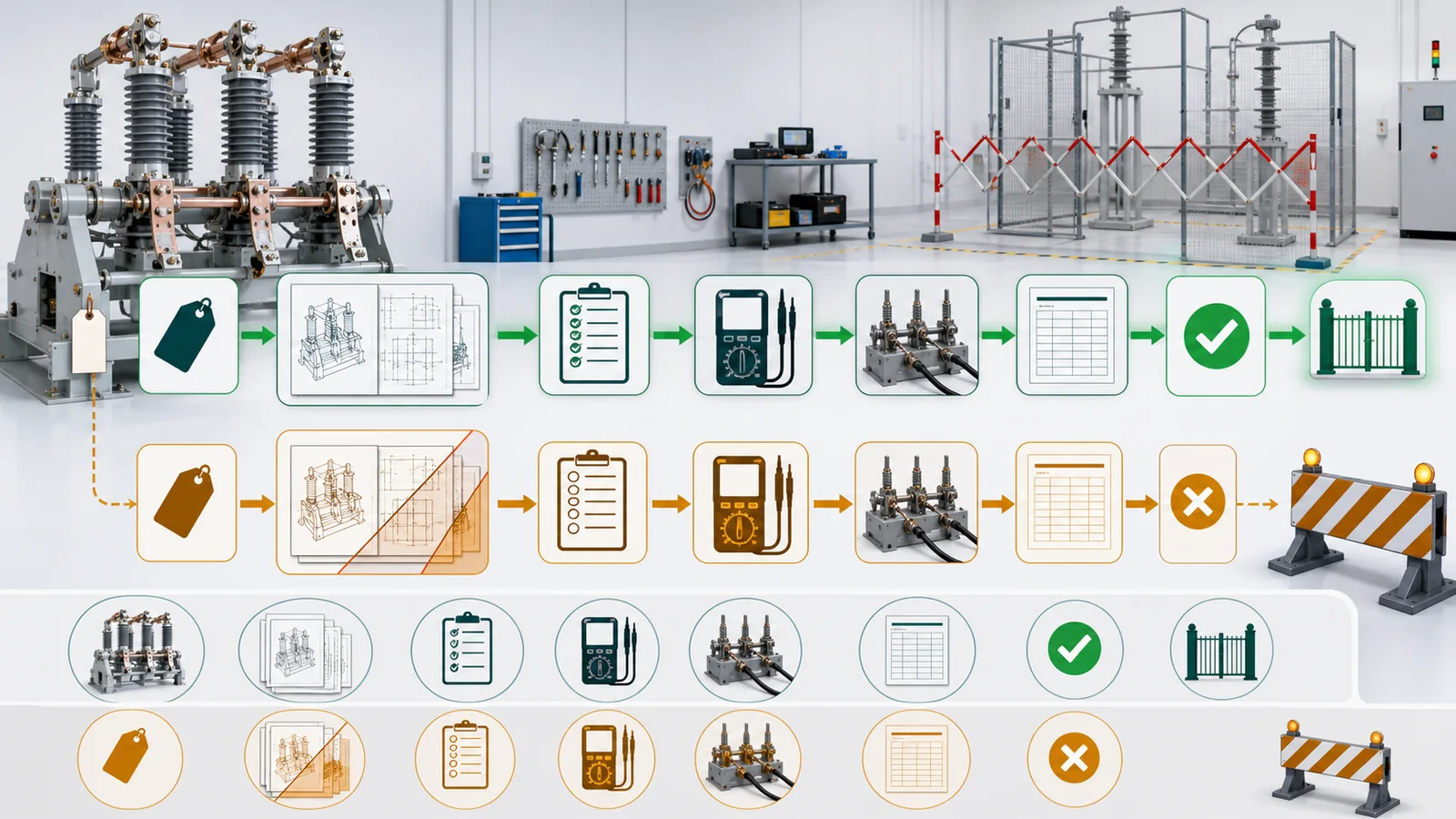
Final release starts before the crate is closed. Freeze nameplate artwork, product model string, rating data, serial range, required warning and language content, package labels, packing specification, preservation basis, and destination-specific marks against the approved configuration. Preparation can run in parallel with production, but printing or final use should follow the project’s approval rule. A later configuration change triggers an applicability review of every affected marking and handover record.
Packing inspection should verify the physical equipment and accessories against the approved packing basis, not only count boxes against a draft list. Record package identity, included loose parts, accessories, operating tools, separately packed items, protection or preservation required by the order, package labels, and the relationship between package and equipment serials where required.
The document register is the final reconciliation tool. It can include as-built drawings, test records, manuals, certificates required by the order, packing list, deviation closure, and release note. Do not assume every project needs the same documents; define applicability in the order basis and show each item as required, supplied, reviewed, approved where necessary, or not applicable.
| Final-release field | Physical source | Record to reconcile | Hold example |
|---|---|---|---|
| Equipment identity | Product and serial marking | Approved configuration and test record | Model or serial mismatch |
| Nameplate and label | Installed plate and package label | Approved artwork and marking register | Superseded text or language |
| Packed content | Equipment, accessories, loose items | Approved packing list | Missing or unidentified item |
| Technical handover | As-built state and completed checks | Document register | Missing, wrong-revision, or open document |
| Exceptions | Reworked or conditionally accepted item | Deviation and reinspection evidence | Disposition not closed for affected units |
| Shipment authority | Reconciled physical and record package | Release note or authorized status | Earlier release gate still open |

Representative engineering review, not a XIYA POWER customer project, factory result, or delivered-order claim.
Consider an order for 24 custom outdoor switching-equipment assemblies: one first-article unit and 23 series units. The approved engineering basis is Drawing Rev C. During first-article review, the approved product model string is changed. The controlled drawing reflects the new string, but the nameplate artwork and packing list still carry the previous model string when final release is reviewed.
Hold the affected series and shipment release. The mismatch does not prove that the equipment is electrically nonconforming, but it prevents the records and physical identity from demonstrating one consistent configuration. The review should:
If a physical plate carries the previous string, apply only an approved replacement or correction method and reinspect it. If a test record identifies the previous string, the authorized technical party must determine its applicability to the Rev C unit and control any correction or supplemental record. Revise and reapprove the packing list before it becomes the release document. Authorization follows only after the handover register reconciles the equipment, markings, test-report identity, package records, and controlled documents.
For a project-specific workflow review, send the accepted order basis, drawings and revision status, sample record, inspection/test scope, marking files, packing requirements, document list, deviations, quantity, destination, and required release milestones through the XIYA POWER contact page. Review of those inputs precedes any production or shipment commitment.
The usual control path covers order-basis confirmation, engineering release, sample or first-article review, controlled series production, inspection and testing, marking and packing review, document reconciliation, and shipment authorization. The project should define the owner, required evidence, and hold condition for each applicable release gate.
Not by itself. A purchase order establishes the ordered commercial and technical basis, while production release depends on the project’s approved engineering inputs, drawing status, resolved deviations, and any required sample approval. The exact authorization route must be defined for the order.
No. A sample or first article supports only the design and workmanship scope recorded in its approval. Series units still require the production traceability, in-process checks, routine tests, project inspections, and deviation closure specified for the order.
Record the change and its reason, approve the new revision, identify affected material and units, and assess whether rework, reinspection, retest, sample re-evaluation, or document updates are required. Do not continue affected work from an informal email or an uncontrolled marked-up drawing.
They should be approved for use only after the configuration fields they carry are controlled. Preparation may begin earlier, but any later change to the model, rating, serial range, accessories, language, or destination markings requires an applicability review and reapproval before final use.
Close the records defined by the order, which can include production traceability, inspection and test records, FAT or witness records, punch items, deviations, reinspection or retest evidence, approved nameplates and labels, packing list, as-built drawings, manuals, required certificates, document register, and the final authorization record.