Quotation form
Send an inquiry
Start with the basics. Our team can follow up for missing drawings, standards or packing details.
Submitted details are used only for quotation, technical review and project communication.

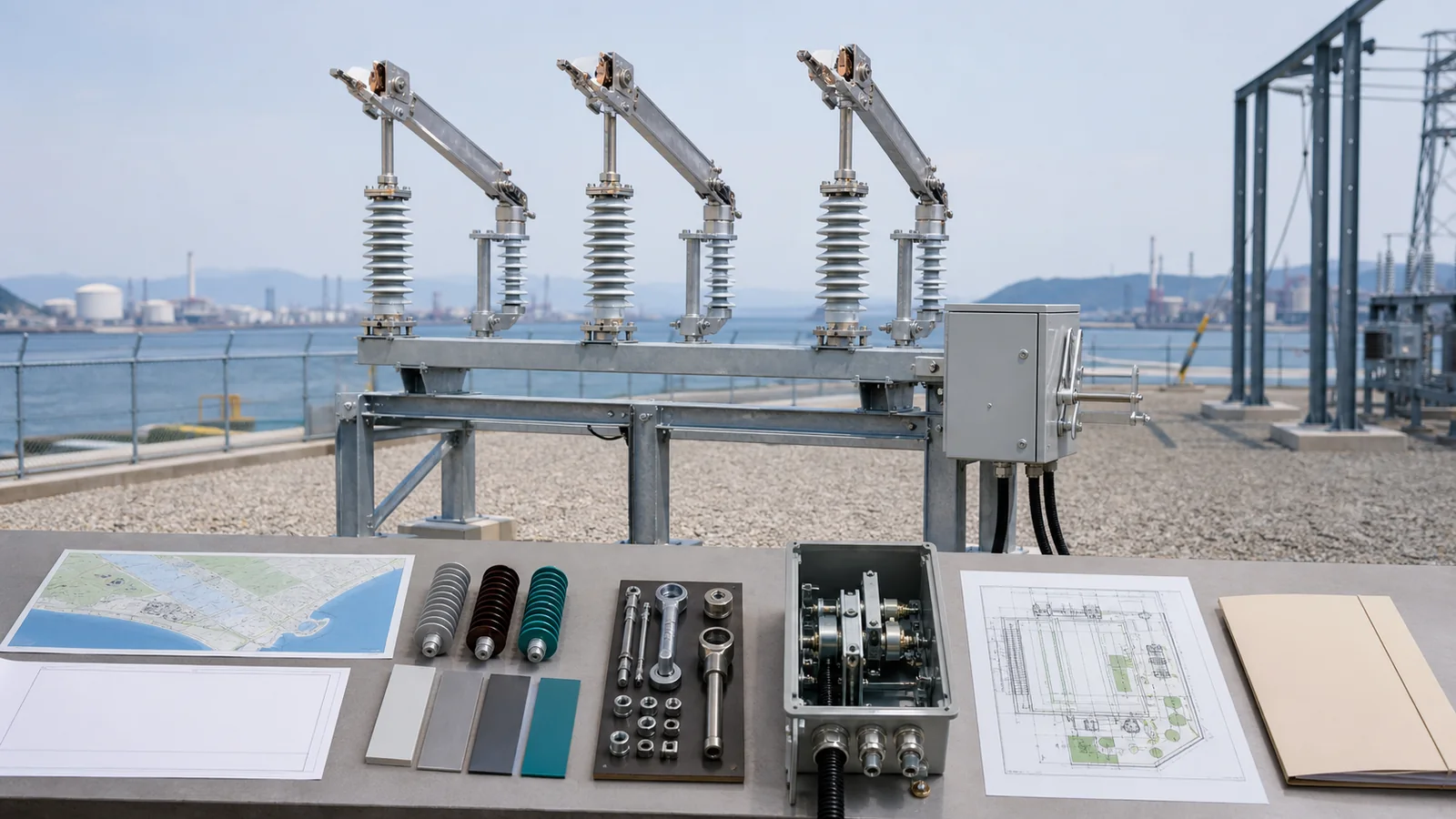
A disconnect switch for polluted environment service should be released from a site-to-assembly evidence chain, not from a “coastal,” “heavy pollution,” or “anti-pollution” label. Site pollution and wetting evidence must align with the actual external-insulation arrangement, materials and coatings, operating mechanism, exposed joints, maintenance access, drawings, and applicable test or design records.
The outdoor disconnect switch range includes different structures, insulator arrangements, mechanisms, frames, and interfaces. That variety is useful only after the project identifies the environment and proves which complete configuration is being offered.
Environmental adaptation starts after the isolation duty, rated voltage, rated current, fault-withstand basis, and outdoor installation decision are controlled. It does not replace the short-circuit study, insulation coordination, or switching-duty review. The wider distribution switching equipment architecture should therefore remain the source for device-family and duty boundaries.
Climate labels are incomplete because sites described by the same word can expose equipment differently. Salt aerosol can combine with industrial deposits; dust can remain dry for long periods and then be wetted by fog; rainfall can wash one surface while a sheltered surface retains contamination. Wind direction, shielding, elevation, equipment orientation, condensation, and access for cleaning can change the actual application.
Use a selection matrix to make each required input and decision explicit:
| Site or exposure question | Required input | Assembly decision affected | Release evidence | Hold condition |
|---|---|---|---|---|
| How is pollution severity established? | Adopted method, site data, owner/utility basis | Insulation review route and candidate arrangement | Site assessment and project specification | Only a descriptive label is supplied |
| What deposits are present? | Salt, soluble industrial contamination, dust, mixed deposits, or other identified exposure | Material, profile, coating, and cleaning review | Site/environmental record | Type or source is unknown |
| How are surfaces wetted and dried? | Rain, fog, condensation, spray, sheltering, seasonal pattern | Shed/profile applicability, drainage, enclosure review | Exposure description or site record | Wetting pattern is assumed |
| Where does exposure arrive? | Prevailing wind, source orientation, shielding, elevation | Switch orientation, sheltered surfaces, water traps | Layout and site plan | GA cannot be related to exposure |
| Which other site loads apply? | Ambient, humidity, UV, altitude, wind, ice, seismic, corrosive media | Insulation, frame, terminal, mechanism, and mounting checks | Approved site schedule | Exceptional condition remains open |
| How will the asset be maintained? | Cleaning method, outage limits, inspection access, responsibility | Maintainability and mitigation | Maintenance philosophy and access review | Required surfaces or joints are inaccessible |
Existing nearby equipment condition can support the review when its material, age, orientation, loading, and maintenance history are known. It should not be transferred as a universal performance claim. The environmental RFQ should record uncertainties as open items rather than fill them from another project.

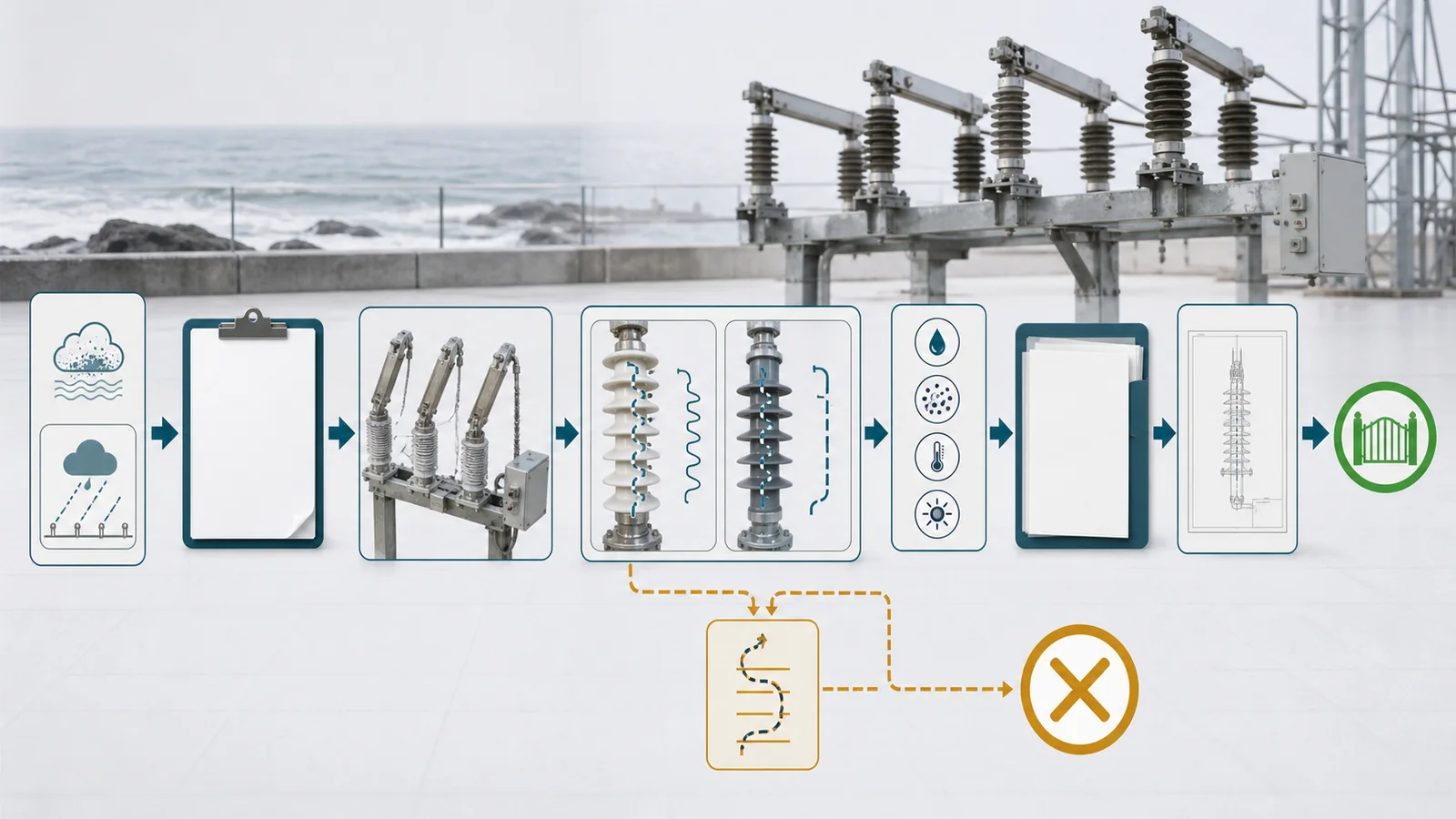
External-insulation review follows a controlled sequence: confirm the system and equipment voltage basis, adopted standard and edition, site pollution severity and pollution type, wetting conditions, actual candidate insulator arrangement, total creepage, profile and geometry applicability, required corrections, and supporting evidence. Every result must point to the drawing revision and insulator family used in the offered assembly.
The official scope of IEC TS 60815-1:2025 covers general principles for evaluating site pollution severity and selecting and dimensioning candidate external insulation for polluted outdoor high-voltage systems. It also points to separate parts for ceramic/glass, polymer, and DC applications. The public scope does not provide a one-line value that can be copied into every disconnector RFQ.
| Review element | Project input | Offered-configuration evidence | Hold when |
|---|---|---|---|
| System basis | Equipment voltage, AC/DC application, adopted hierarchy | Declared insulation basis | Voltage or standard edition is unclear |
| Site severity | Approved method and site evidence | Recorded severity/classification basis | “Coastal” is the only input |
| Pollution and wetting | Deposit type, fog/rain/condensation, dry intervals, orientation | Applicability statement | Candidate arrangement assumes another exposure |
| Insulator arrangement | Material family, units, diameter, orientation, parallel paths | Controlled drawing and manufacturer data | Offered geometry is not identified |
| Creepage and profile | Total path plus relevant shed/profile and geometry information | Calculation/schedule tied to drawing | A bare creepage number has no configuration |
| Corrections and mitigation | Applicable altitude, diameter, profile, arrangement, or site measures | Reviewed calculation and controlled measures | Applicability is not demonstrated |
| Evidence | Relevant design/type evidence and project acceptance basis | Traceable record for the offered arrangement | Generic certificate cannot be linked |
Longer total creepage can be part of the solution, but it does not by itself establish performance under a particular deposit and wetting pattern. Material behavior, shed/profile geometry, diameter, orientation, parallel insulators, sheltered surfaces, and site mitigation can affect the assessment. Polymer is not automatically superior to porcelain, and porcelain is not automatically more durable; compare the actual candidate arrangement under the adopted method. DSE-06 stops at this complete-assembly release requirement, while the planned DSE-16 spoke owns detailed composite-insulator selection.
Corrosion protection is a system across the frame, welds, cut edges, terminals, blades, flexible connections, plated surfaces, shafts, pins, springs, bearings, bushings, bolts, washers, grounding paths, mechanism supports, and foundation interface. A stainless fastener or galvanized frame does not establish compatibility at every joint.
| Assembly zone | Exposure or degradation route | Required controlled detail | Hold condition |
|---|---|---|---|
| Frame, base, welds, and edges | Coating discontinuity, retained water, damaged finish | Base metal, preparation, coating/galvanizing, drainage, repair method | Schedule omits weld/edge or repair treatment |
| Terminals, blades, and flexible links | Deposits, moisture, plating damage, dissimilar-metal contact | Material/plating schedule, interface design, cleaning method | Evidence applies to another contact arrangement |
| Fasteners and structural interfaces | Crevice retention, incompatible material pair, assembly damage | Material pair, isolation where required, torque/assembly and replacement control | Material code or interface is unresolved |
| Shafts, pins, bearings, and bushings | Exposed joint contamination, trapped moisture, lubricant incompatibility | Materials, seals/shields, drainage, lubricant, access | Mechanism BOM and GA disagree |
| Grounding and bonding paths | Coating or corrosion interrupts intended continuity | Bonding detail and inspection point | Current path cannot be verified after coating |
| Site repair points | Cut, drilled, or damaged protected surface | Approved repair system and inspection record | Field repair method is undefined |
A coating certificate supports only its stated substrate, preparation, process, geometry, and acceptance boundary. A salt-spray record likewise does not prove assembled crevices, damaged edges, dissimilar-metal interfaces, or a field repair. The drawing, material schedule, process evidence, and inspection plan must describe the same switch.
Avoid water traps through the actual installed orientation, not only the catalog view. Check horizontal ledges, hollow sections, enclosure lips, bolt pockets, terminal interfaces, cable routes, and foundation connections for drainage and inspection access. Where exposure cannot be removed, the project should define the controlled material/protection and how it will be inspected or repaired.
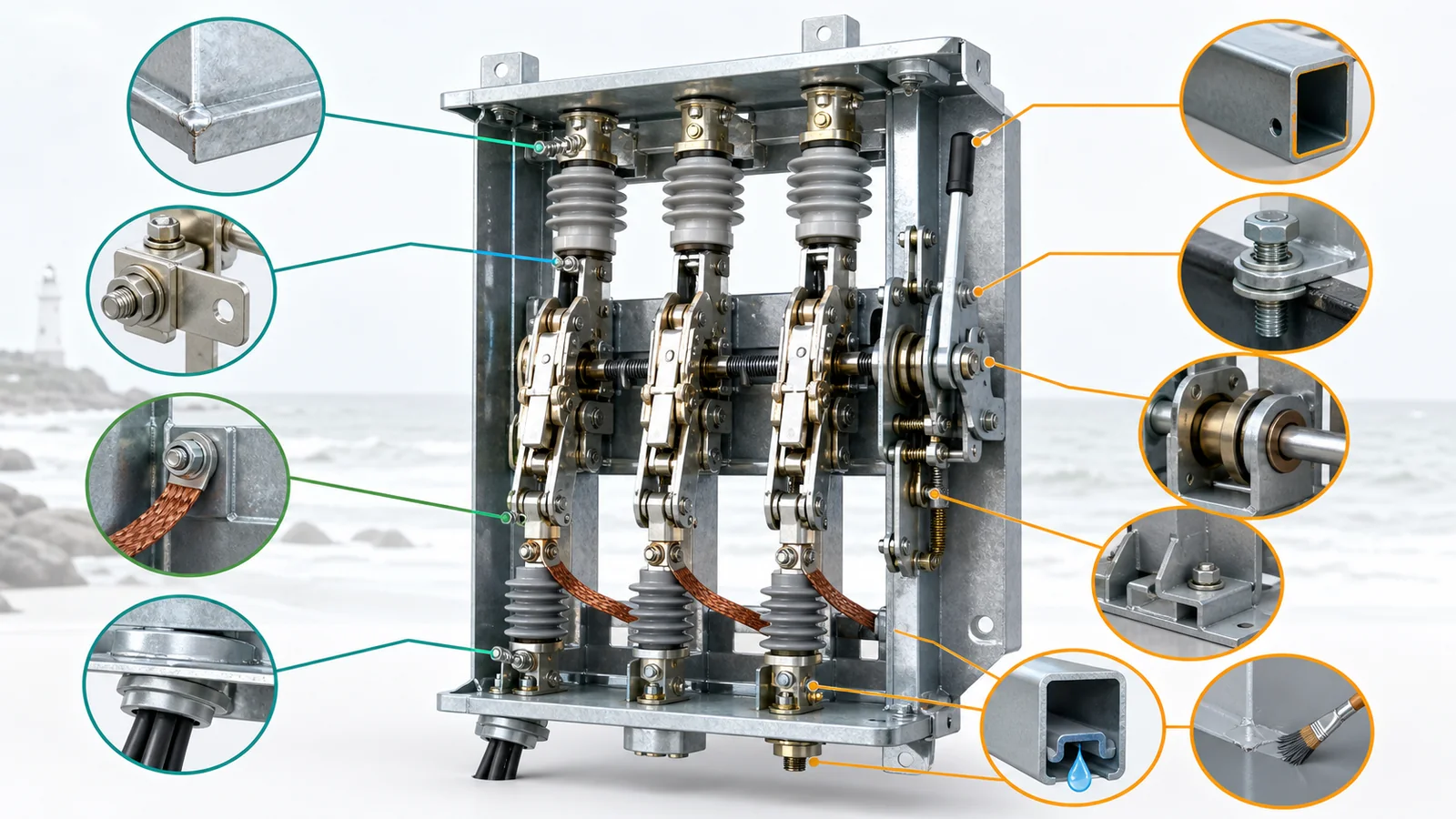
The mechanism review covers both the enclosure boundary and every moving part outside it. For the cabinet, check base material and finish, door and gasket construction, cable entries, glands, breathers, drains, installed orientation, condensation control, internal terminal blocks, auxiliary wiring, motor/manual interfaces, locks, position indication, and interlock circuits. An enclosure designation is useful only when it applies to the offered cabinet, entries, orientation, and assembly details.
External rods, shafts, pins, springs, bearings, bushings, levers, and earthing-switch linkages need their own material, protection, lubricant, drainage, and access review. A stainless cabinet does not protect a carbon-steel linkage outside it. A sealed bearing does not prove that an adjacent shaft, pin, or exposed spring has compatible protection.
| Mechanism question | Release evidence | Hold example |
|---|---|---|
| Are enclosure seals, entries, and drains complete in the installed orientation? | GA, enclosure detail, cable-entry instruction | Open entry or drain location is unresolved |
| Are internal circuits protected from condensation and corrosive deposits? | BOM, wiring detail, terminal/enclosure specification | Internal component suitability is assumed |
| Are external moving joints defined as a material system? | Mechanism BOM and interface schedule | Shaft, pin, bushing, and fastener codes conflict |
| Can position indication and interlocks remain inspectable? | Operating drawing and inspection method | Environmental protection blocks verification |
| Can specified maintenance be performed safely? | Access drawing and maintenance plan | Joint or drain cannot be reached |
Environmental protection does not expand the device’s switching capability or change the approved ratings. It supports the mechanism and assembly in the specified service conditions; the duty and interlock sequence still come from the electrical and operating basis.
The environmental RFQ checklist should supplement, not replace, the complete outdoor disconnect switch RFQ checklist. The 33-132 kV disconnect switch specification remains the foundation for ratings, insulation basis, mechanism interfaces, and release evidence across the higher-voltage range.
Require a reconciled package:
Keep evidence boundaries visible. An insulator record does not prove the frame or mechanism. A coating record does not prove water cannot collect at an assembled interface. An enclosure result does not prove exposed linkages. A short-circuit study defines electrical duty but not pollution performance. A generic certificate does not prove that the offered drawing revision contains the evaluated materials and geometry.
The release package should therefore map every environmental requirement to one controlled assembly feature, evidence source, owner, and inspection or document record. Missing applicability is a technical hold, not an administrative item to close after manufacture.
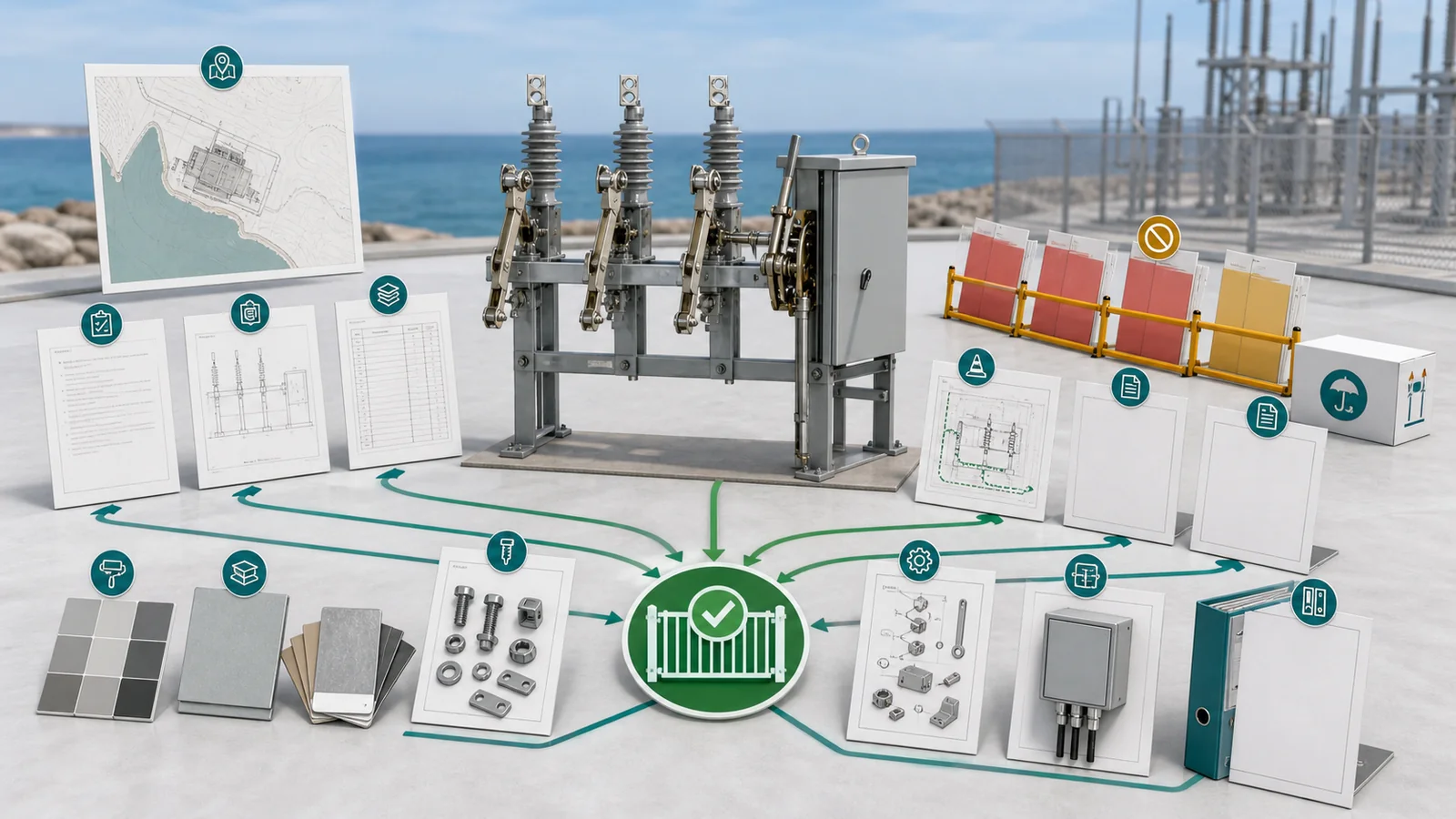
Representative engineering review, not a XIYA POWER customer project, factory case, field record, or service result.
Consider an inquiry for a three-pole, motor-operated outdoor disconnector at a coastal industrial site. Electrical ratings and isolation duty are already controlled elsewhere. The environmental schedule says only “coastal, heavy pollution” and asks for an “anti-pollution type.” The offered comparison includes alternate external insulation, a galvanized support frame, stainless external fasteners, and a painted mechanism cabinet.
The site file does not identify the pollution-severity assessment method, deposit and wetting pattern, prevailing exposure, cleaning access, or maintenance responsibility. The GA, coating schedule, and mechanism BOM also use inconsistent material identifiers at selected shaft, fastener, and enclosure interfaces. Drainage and washing access are not shown.
Hold environmental configuration release. The review sequence is:
This sequence does not predetermine the insulator material, creepage value, coating system, or correction. It prevents a product suffix and a few isolated material choices from replacing complete-assembly evidence. Send the site data, GA, environmental schedule, mechanism details, maintenance basis, and open deviations through the XIYA POWER contact page for configuration review.
Provide the adopted pollution-severity method and evidence, contamination type, wetting/drying pattern, prevailing exposure and orientation, ambient and humidity range, UV, altitude, wind, ice, seismic and corrosive-media inputs where applicable, plus cleaning access, outage limits, maintenance responsibility, and relevant nearby-equipment records.
No. Total creepage is one input. The review must also consider the candidate material family, shed/profile and diameter, orientation, parallel paths, wetting pattern, sheltered surfaces, applicable corrections, mitigation, and evidence tied to the offered drawing.
No universal ranking is valid. Compare the actual polymer, porcelain, or glass arrangement against the site’s pollution and wetting conditions using the adopted standard method and the applicable material-family requirements. Confirm profile, geometry, evidence, and manufacturer applicability for the offered assembly.
No. It addresses only the specified parts. The complete review includes base frames, coatings, welds, edges, plated contacts, shafts, bearings, fasteners, dissimilar-metal interfaces, crevices, drainage, bonding paths, repair methods, and the mechanism enclosure.
Review enclosure material and finish, seals, cable entries, breathers and drains, condensation control, internal terminals and wiring, external rods and joints, shafts, pins, bearings, bushings, springs, lubricant, position indication, interlocks, earthing linkages, and safe maintenance access.
Close the site assessment, project specification, controlled GA, insulation and creepage/profile schedule, material/coating and interface schedules, mechanism BOM and enclosure details, applicable design/test evidence, inspection requirements, deviations, maintenance/access plan, packing/preservation basis, and document register for one consistent configuration.