Quotation form
Send an inquiry
Start with the basics. Our team can follow up for missing drawings, standards or packing details.
Submitted details are used only for quotation, technical review and project communication.

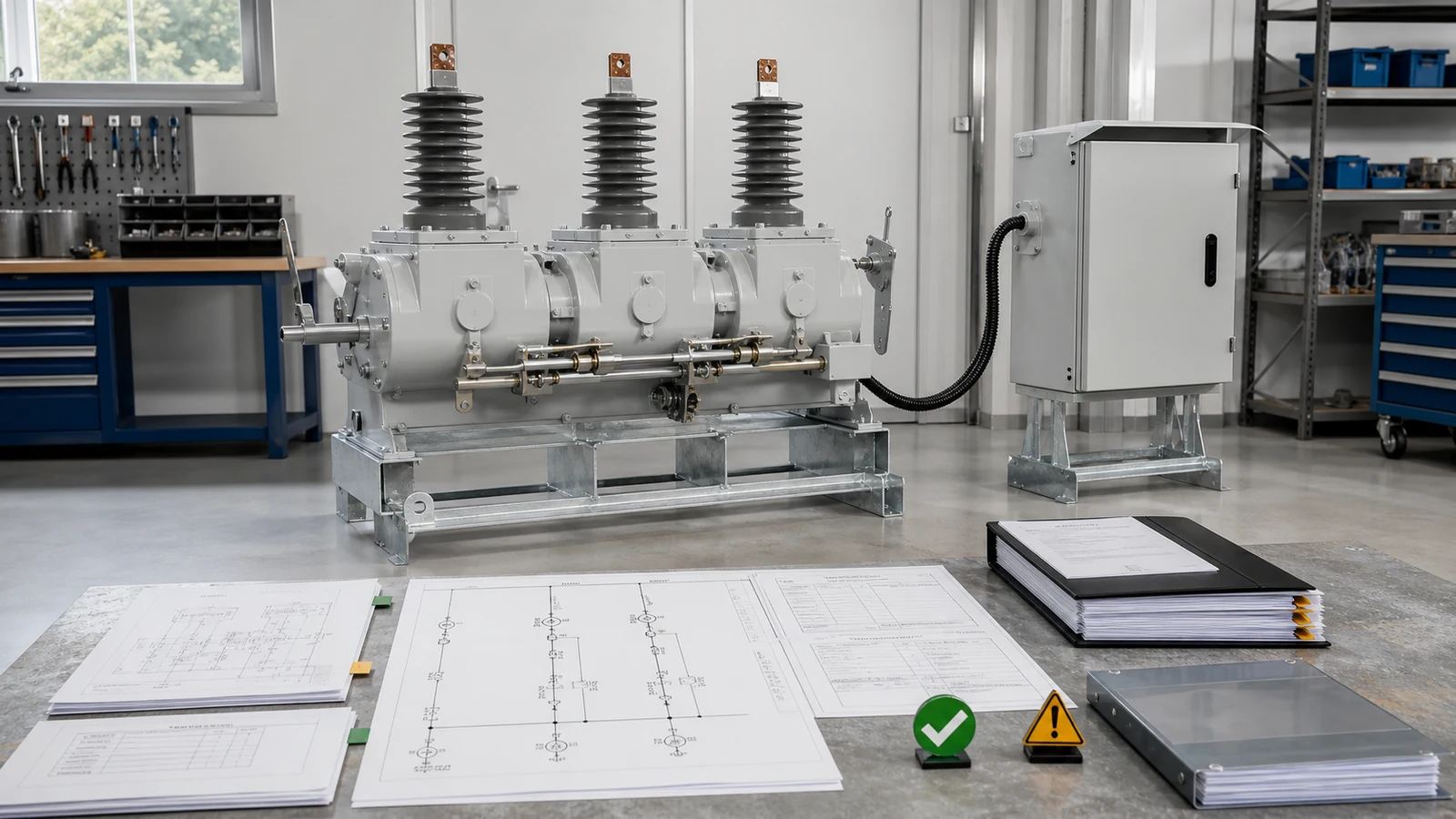
An automatic vacuum recloser RFQ checklist should make competing offers technically comparable before commercial evaluation begins. It must connect feeder studies and approved operating decisions to one identifiable primary device, controller, sensing package, control-power arrangement, communication interface, and evidence set. A catalogue designation or nominal voltage is not enough.
The practical output is a controlled procurement record. Each required input has a source and revision, each supplier value identifies the exact offered configuration, each interface has an owner, and each assumption or deviation has a disposition. This article provides that selection matrix, data pack, representative review, and technical-release logic without supplying universal ratings or protection settings.
Visual disclosure: all images are generated illustrative technical visualizations, not XIYA POWER factory, customer, product-test, installation, commissioning, or field photographs.
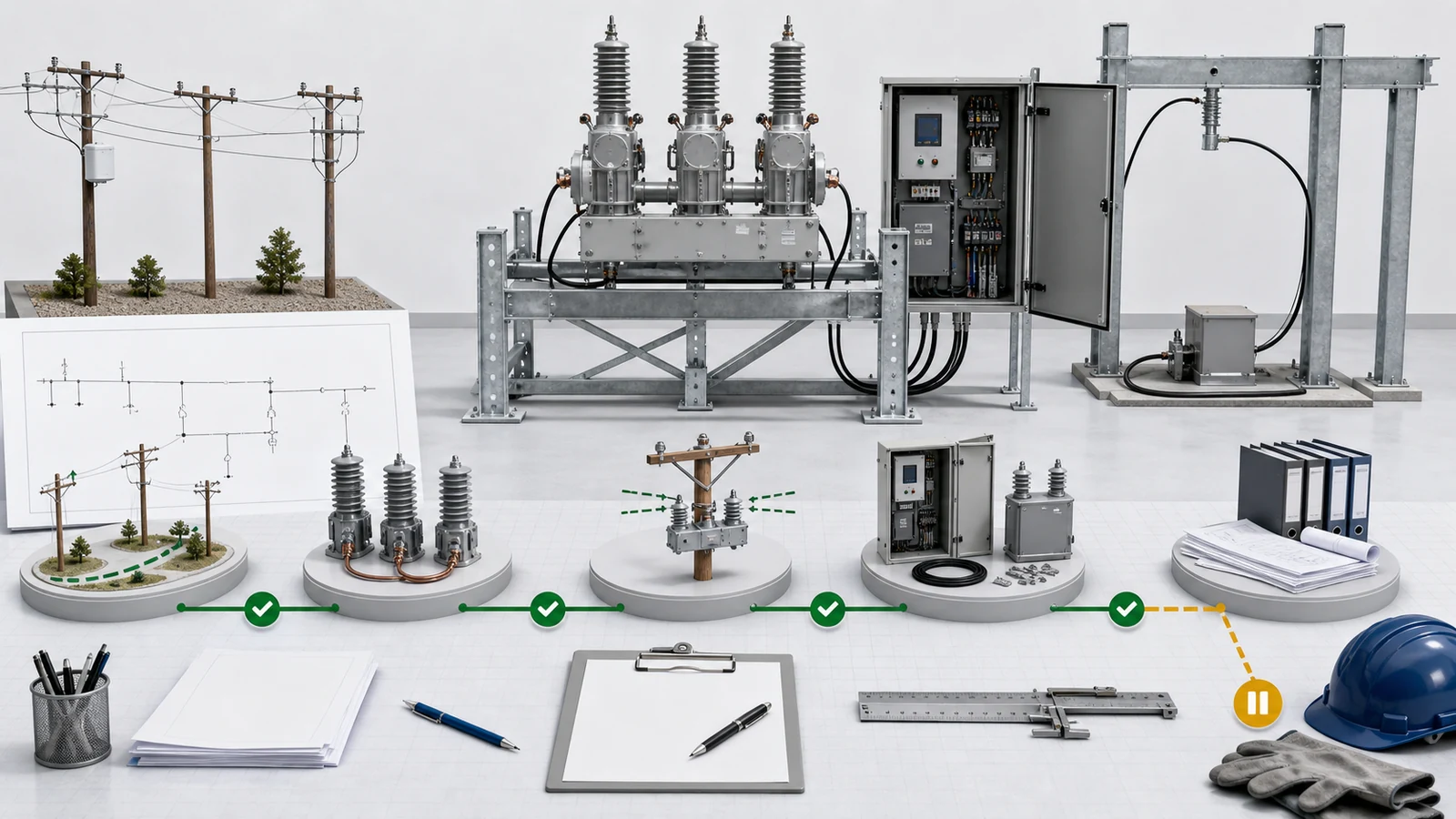
An automatic vacuum recloser RFQ becomes comparable only after its upstream decisions are frozen or named as holds. These decisions cover feeder role, phase architecture, line position, operating states, scope boundaries, and source-document revisions. Otherwise, suppliers price different packages and their headline ratings conceal different exclusions.
Use the Smart Grid equipment framework to locate the procurement boundary. First close whether a recloser is the correct device for the allocated duty through the recloser versus circuit breaker guide. Then close gang-operated three-phase, independent-pole, or single-phase fit through the recloser phase-configuration guide. This RFQ checklist starts after those decisions; it does not reopen them.
| Readiness decision | Controlled source | RFQ field | Supplier return | Hold condition |
|---|---|---|---|---|
| Feeder role and position | Approved one-line and role statement | Position, normal and abnormal states | Capability confirmation | Role or state undefined |
| Phase architecture | Approved selection record | Pole count and permitted mode | Exact offered architecture | Architecture still under review |
| Package boundary | Scope schedule | Device, controller, cables, structure, RTU and accessories | Inclusions, options and exclusions | Disciplines assume different scopes |
| Installation basis | Site and layout inputs | Mounting, conductors, access and environment | Dimensioned arrangement | Interface data incomplete |
| Document basis | Controlled transmittal | Document list and revisions | Acknowledged revision list | Superseded inputs remain in use |
`
`
An open row is not solved by a supplier assumption. Either close it before issue or carry it as a named clarification with an owner and release gate.
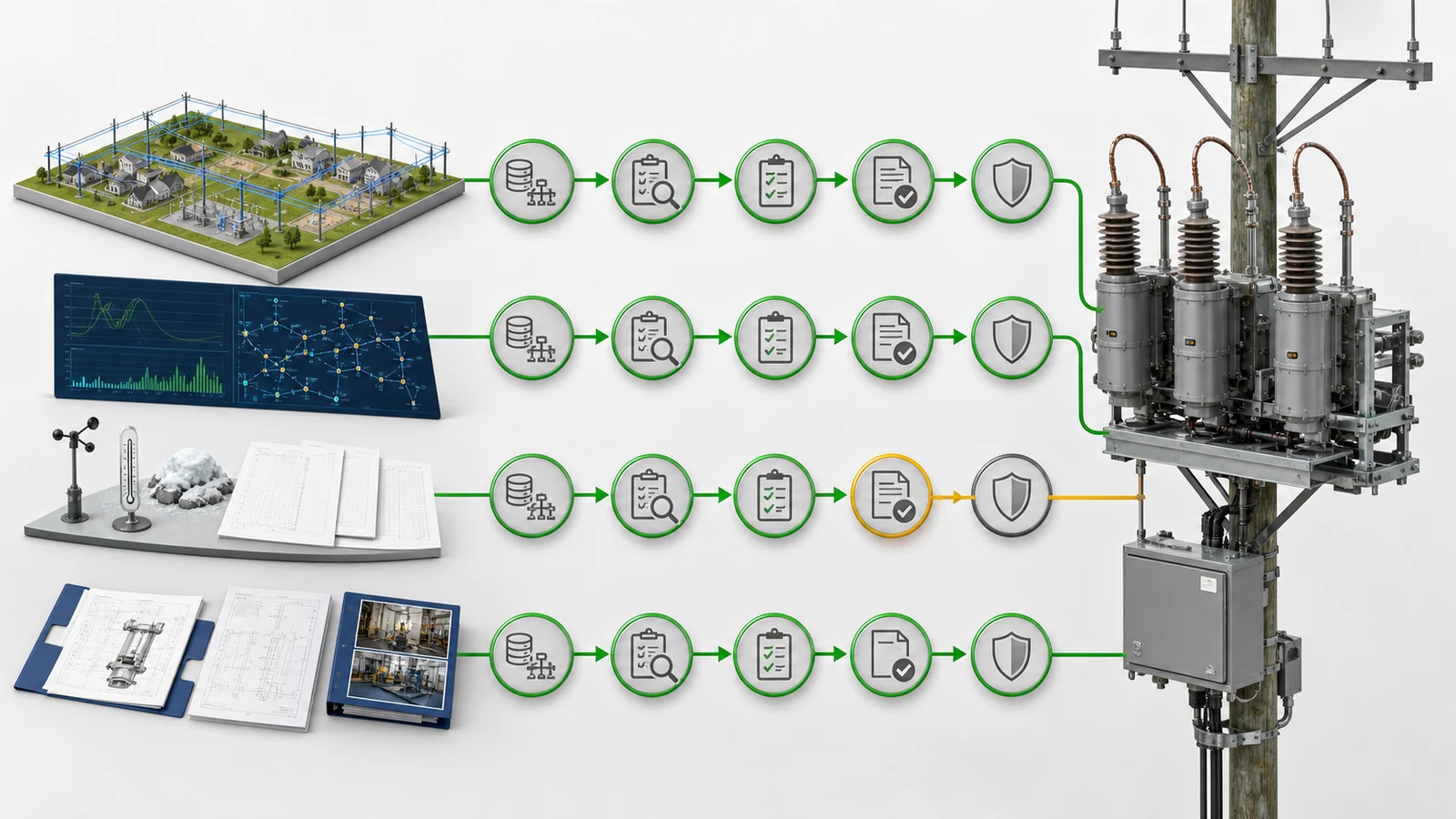
The Automatic Vacuum Circuit Recloser product owner explains the body-and-controller package, but a family page cannot select a project rating. Keep three columns separate: system input, specified device requirement, and supplier offered value.
The public scope of IEC 62271-111:2019 covers overhead, pad-mounted, dry-vault, and submersible single- or multi-pole AC automatic circuit reclosers above 1,000 V through 38 kV; it excludes equipment requiring dependent manual operation. That scope does not provide this feeder’s ratings, sequence, tests, or acceptance decision. Do not copy paid clauses or treat a standard reference as evidence that the offered configuration meets the project duty.
| RFQ input | Controlled source | Supplier must return | Release check |
|---|---|---|---|
| Nominal and highest system voltage | Network standard and insulation study | Offered voltage class and declared highest voltage | Both fields match their separate sources |
| Frequency and earthing | Network data and earthing study | Configuration compatibility | Exact system basis acknowledged |
| Present and planning load | Load flow and forecast | Offered normal-current rating | Thermal basis covers the stated duty |
| Maximum and minimum fault cases | Position-specific short-circuit study | Interruption, making and relevant duty ratings | Evidence maps to the offered unit |
| Insulation basis | Approved insulation schedule | Offered withstand levels | Schedule and configuration agree |
| Service conditions | Project specification and site data | Confirmed limits and any derating | Altitude, temperature, pollution and installation are addressed |
| Operating duty | Approved operating philosophy | Offered capability and deviations | No assumed universal sequence |
`
`
Nominal voltage cannot determine highest voltage, insulation level, normal current, fault duty, or operating sequence. A maximum fault value also does not replace the minimum-fault case used by the protection study. Every requirement needs a source, revision, offered value, applicable release evidence, and reviewer.
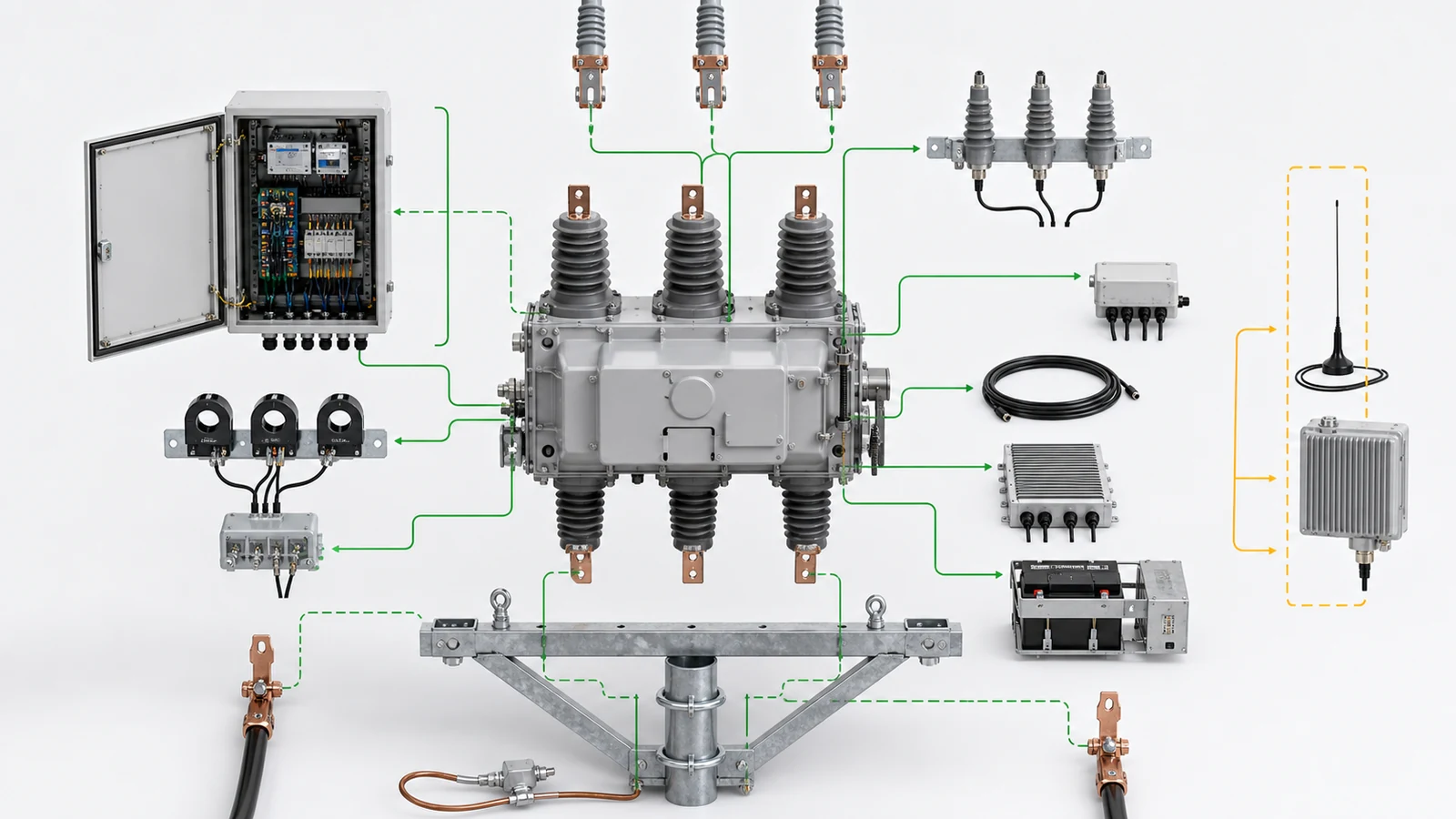
Describe the complete package rather than naming only an interrupter and controller. The primary-device return should identify pole count, operating mode, vacuum interrupter, mechanism, bushings, terminals, source/load orientation, and conductor interfaces. It should separately identify sensing, mounting, control cabinet, cables, auxiliary supply, earthing, surge interfaces, access, and any bypass or isolation boundary.
| Package element | Project input | Normalized supplier return | Evidence or interface hold |
|---|---|---|---|
| Primary body and mechanism | Duty and operating philosophy | Exact configuration and mechanism data | Configuration-applicable evidence |
| Terminals and conductors | Type, size range, orientation and connection | Terminal arrangement and accepted conductor range | Approved connection drawing |
| Current/voltage sensing | Required quantities, locations, classes and burdens | Sensor types, ratios/ranges, accuracy data and wiring | Protection and metering interfaces closed |
| Mounting and cabinet | Pole/structure, cabinet location, access and environment | Dimensions, masses, attachment and cable routes | Civil, mechanical and access review |
| Control power | Source, range, burden and degraded-state requirement | Power demand and offered supply arrangement | Supply capacity confirmed |
| Battery and charger | Required autonomy and duty, when specified | Offered capacity, charger and calculation | Project autonomy basis closed |
| Earthing and surge boundary | Connection points and project scope | Included items, interfaces and exclusions | Earthing and surge drawings agreed |
`
`
Do not assume a sensor, voltage transformer, battery, surge arrester, connector, mounting frame, modem, or bypass device is standard. Require the supplier to mark each item as included, optional, or excluded. Product data, project specification, drawings, calculations, and evidence must describe the same configuration.
The recloser technical foundation owns the basic switching, sensing, controller, reclosing, and lockout concepts. The RFQ should convert the approved protection philosophy into capability and interface requirements, while the utility or project protection authority retains setting calculation and approval.
| Control item | Project authority provides | Supplier returns | Release owner |
|---|---|---|---|
| Protection functions | Approved function list and study revision | Supported functions and limitations | Protection authority |
| Sensing | Sources, locations and required performance | Compatibility and exact offered inputs | Protection/metering reviewer |
| Reclose and lockout philosophy | Permitted modes and required behavior | Implementable modes and deviations | Protection and operations owners |
| Close permissives and interlocks | Required logic and external signals | Logic capability and I/O mapping | Protection/control reviewer |
| Records | Required event, alarm and disturbance outputs | Formats, storage and retrieval method | Protection/SCADA reviewer |
| Configuration control | Settings owner, approval route and change rules | Firmware/software versions, file formats and backup method | Named configuration owner |
The RFQ may request capabilities for directional, earth-fault, overcurrent, voltage, frequency, cold-load, inrush, or other functions only where the approved design requires them. It must not invent pickup values, curves, shot counts, dead times, reclaim times, synchronism thresholds, or line-operating procedures. A supplier proposal is not an approved protection setting file.
Communication needs more than a protocol name. State the physical medium, protocol/version/profile, addressing, point-list revision, command authority, local/remote permissions, time synchronization, and event requirements. Also define user roles, configuration backup, cybersecurity boundary, loss-of-communication state, and gateway or RTU ownership. Mark unfinished details as controlled holds rather than accepting catalogue defaults.
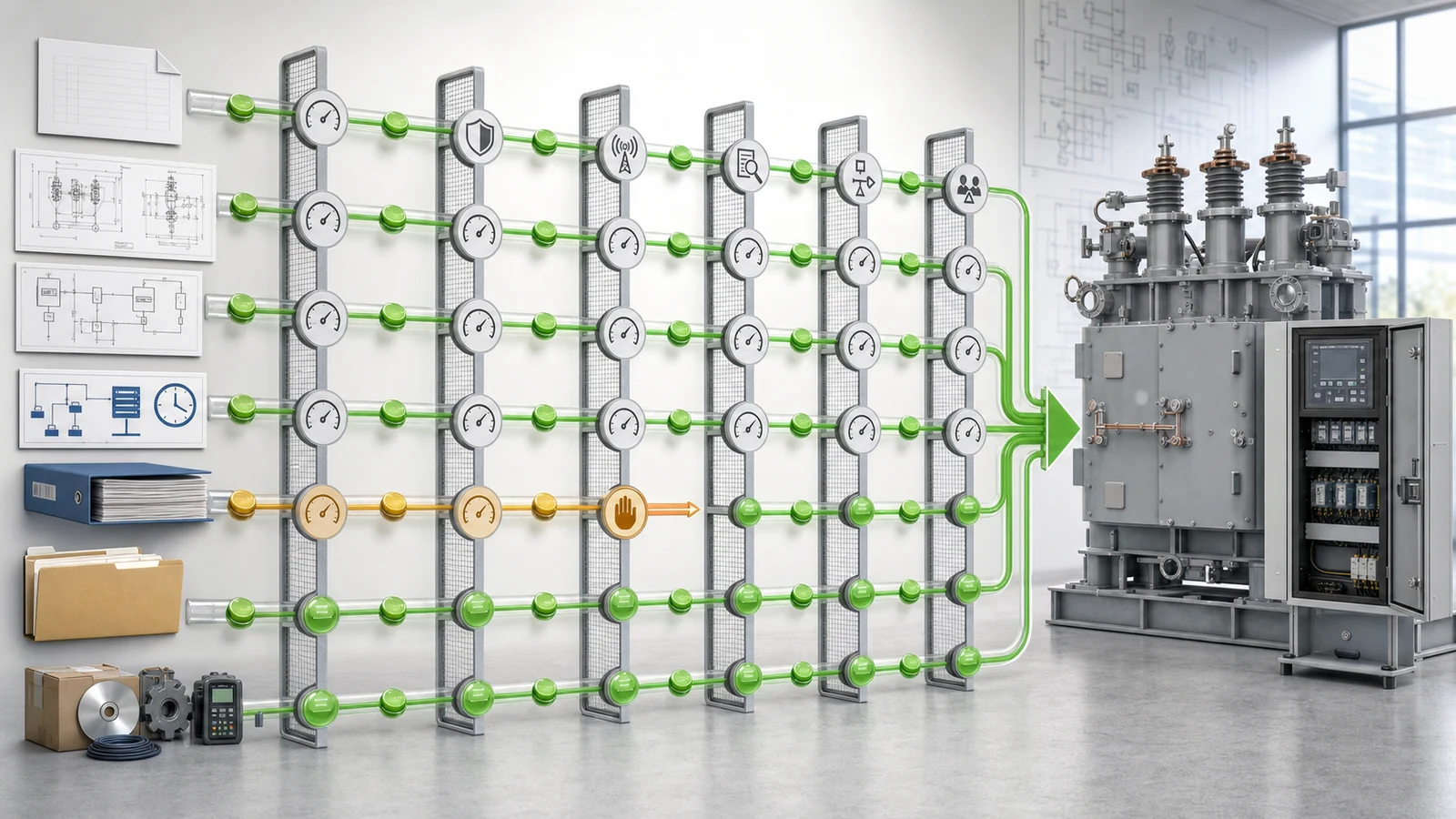
Build one normalized RFQ checklist and data pack so every bidder answers the same fields:
| Required return | Release evidence | Reviewer | Technical-release condition |
|---|---|---|---|
| Configuration-specific data sheet and drawings | Revision-controlled manufacturer data | Technical lead | Offered package is uniquely identified |
| Ratings and duty schedule | Project specification and short-circuit study mapped to the offer | HV/protection engineer | Every rating has a source and applicable evidence |
| Protection and I/O capability matrix | Approved function list, point list and logic narrative | Protection/control team | No unsupported function or assumed setting |
| Communication profile | Protocol profile, addressing, time and cybersecurity interfaces | SCADA/IT owners | End-to-end ownership is closed |
| Design/type evidence applicability matrix | Evidence identifies the offered configuration and justified differences | Technical/quality team | Applicability accepted |
| Routine and FAT plan, where required | Approved inspection and witness plan | Quality/project owner | Scope and acceptance sources agreed |
| Software, licenses, cables, tools, spares and training | Itemized supply and O&M schedule | Asset owner | No hidden operating dependency |
| Assumptions, exclusions and deviation register | Nil return or disposition for every departure | Named approvers | All deviations closed or formally accepted |
| Document schedule | Deliverable, revision, owner and date | Project manager | Release documents are committed |
`
`
A price-complete quotation is not technically complete. The one-line, installation drawings, manufacturer data, project specification, load and fault studies, protection study, and communication documents must identify one offered configuration. Release evidence, deviations, and approvals must use the same controlled revisions.
Representative engineering review, not a XIYA POWER customer, utility, factory, test, FAT, site, installation, commissioning, outage, service, or field case. All values are illustrative and non-universal.
The review position is a 22 kV, 50 Hz effectively earthed overhead feeder with a selected gang-operated three-phase, pole-mounted automatic vacuum recloser. Available controlled inputs show a 310 A present peak load, a 420 A planning load, and a 12.5 kA maximum symmetrical fault basis at that position.
The draft schedule asks suppliers to return a 27 kV-class offer with at least 630 A normal current and a 16 kA interruption basis. These are preliminary request fields, not XIYA POWER product ratings or an approved final specification; each must be confirmed against the complete duty and configuration-applicable evidence.
The available pack contains single-line diagram revision D, a fault study, a load forecast, protection-coordination study revision A, and a draft SCADA point list. It proposes IEC 60870-5-104 over the utility private radio network, while the exact profile and gateway boundary remain open.
Decision: hold technical release. The voltage/insulation schedule, conductor/terminal data, sensor/CT/VT package, protection-function list, settings ownership, reclose/lockout schedule, and control-power basis are incomplete. The communication profile, time synchronization, cybersecurity, mounting, earthing, surge scope, evidence applicability, routine/FAT requirements, and deviations also remain open. Close those records in a normalized supplier return before comparing technical compliance; no test or operating outcome is claimed.
Include the frozen feeder role and phase architecture, system/fault basis, service conditions, and complete device/sensing package. Add mounting, control power, protection ownership, communication interfaces, drawings, applicable evidence, deviations, deliverable schedule, and named release holds.
No. Highest system voltage, insulation basis, normal current, making and interruption duties, minimum-fault sensitivity, service conditions, and operating duty come from separate controlled project sources. The supplier should return an offered value against each field, not infer the package from nominal voltage.
Include approved functional requirements, sensing inputs, logic ownership, file format, and workflow. Do not publish invented pickups, curves, shot counts, dead/reclaim times, or thresholds. The named utility or project protection authority calculates and approves settings using the controlled studies.
State medium, protocol/version/profile, addressing, point list, commands and permissions, time synchronization, records, cybersecurity boundary, loss-of-communication state, and gateway/RTU ownership. A generic “SCADA-ready” declaration does not close interoperability.
Require configuration-specific data sheets and drawings, a completed ratings schedule, protection/I/O and communication matrices, and an evidence-applicability table. Add the routine/FAT plan where specified, software and O&M supply lists, assumptions, exclusions, deviations, and a controlled document schedule.
Release it only when all required inputs, supplier values, interfaces, evidence, deviations, and approvals identify the same configuration and revision. Any open rating basis, sensing, control-power, communication, evidence-applicability, or deviation hold prevents technical release.