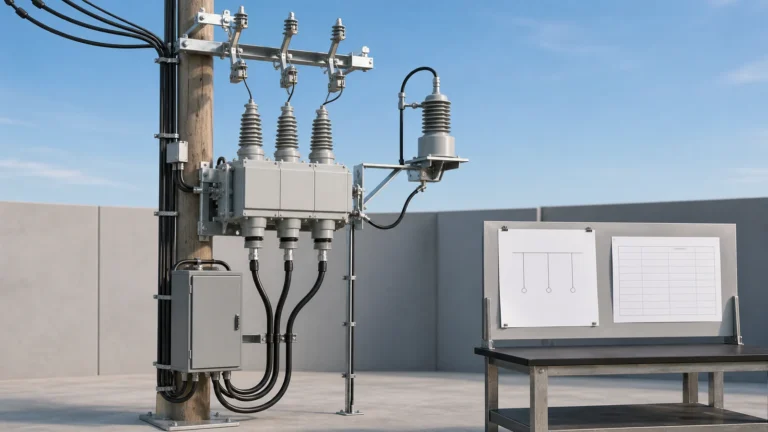
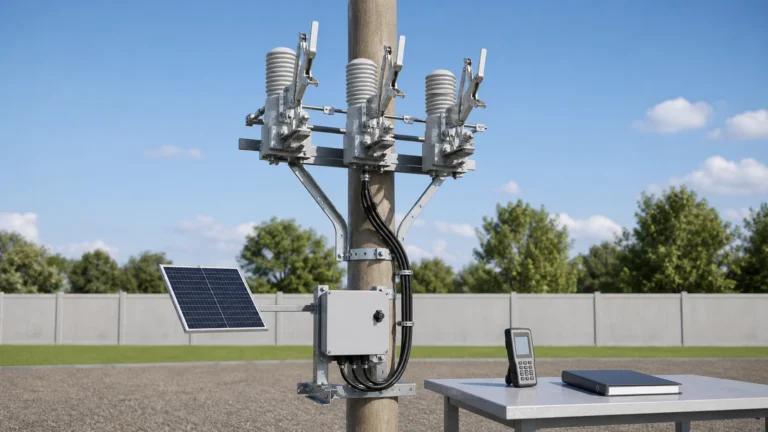
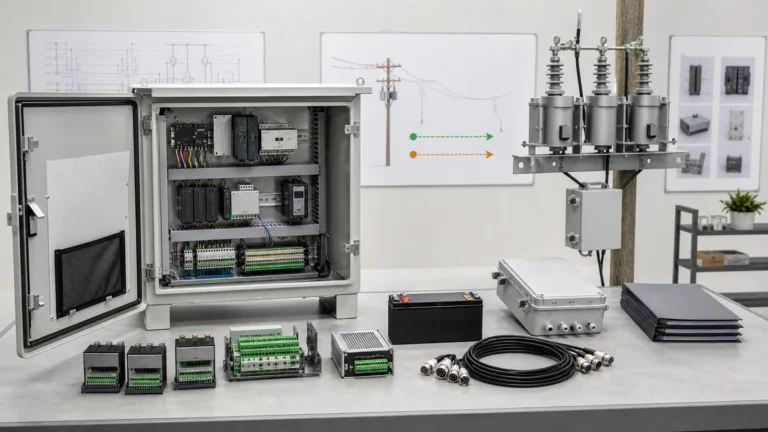
Quotation form
Send an inquiry
Start with the basics. Our team can follow up for missing drawings, standards or packing details.
Submitted details are used only for quotation, technical review and project communication.

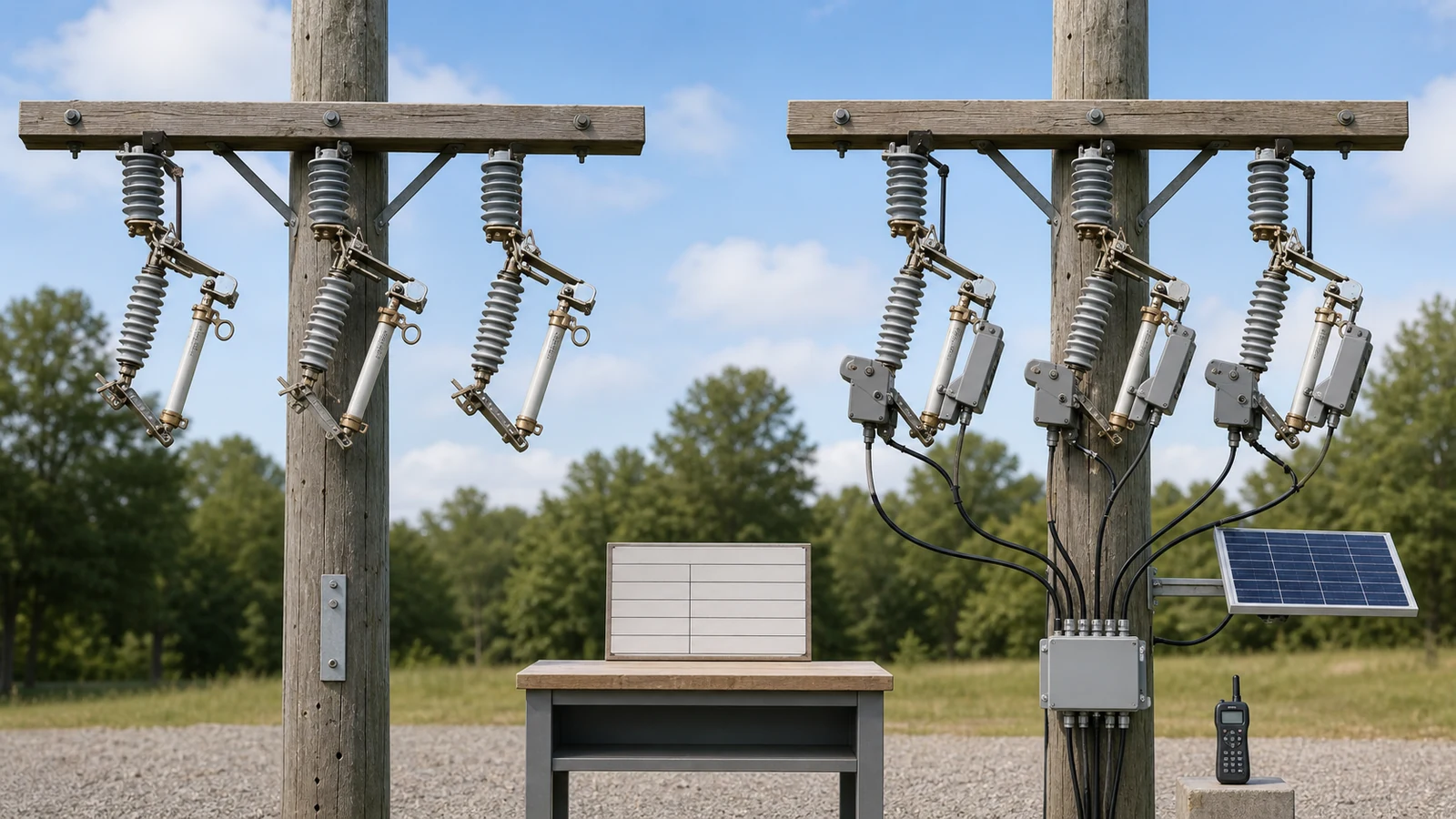
All images are generated illustrative technical visualizations, not XIYA POWER factory, quotation, order, design, selection, installation, inspection, test, commissioning, maintenance, failure, outage, or field photographs.
A smart drop out fuse vs fuse cutout decision begins after the fuse-protection basis is approved. Choose the conventional path when passive protection and manual operation meet the operating plan. Choose smart equipment only when motorized operation or alarms have defined power, communication, site, maintenance, and evidence owners.
The smart path adds motor, terminal, remote-control, charging, and alarm layers. The Smart Grid equipment hub keeps fuse-based protection separate from reclosing, boundary protection, load switching, and no-load isolation.
Use one comparison matrix before requesting a model:
| Decision | Required input | Smart path | Conventional path | Release evidence | Hold condition |
|---|---|---|---|---|---|
| Protection | Approved cutout and fuse-link basis | Same fuse-based protection plus accessories | Passive cutout and fuse link | Protection study and selected schedule | Accessories substitute for coordination |
| Operation | Operating philosophy, authority, fallback | Motorized or remote-assisted movement | Operating-rod practice | Approved operation and authority record | Purpose or owner is unclear |
| Monitoring | Event to detect, meaning, response | Declared sensor and alarm package | Patrol or separate monitoring | Event and response schedule | Only alarm supported is returned |
| Power | Loads, source, charging, degraded state | AC, solar, or battery-supported terminal package | No powered accessory package | Power schedule and manufacturer data | Capacity or behavior is absent |
| Communication | Bearer, recipients, retries, time, records | Call, SMS, WeChat, dry contact, or declared interface | None unless separately added | Interface and notification schedule | Delivery path is only a feature label |
| Site fit | Pole, crossarm, clearance, cable, clamps, exposure | Fuse body plus motor, cable, terminal, and power hardware | Cutout body and bracket | Approved overlay and drawings | Added package does not fit |
| Lifecycle | Skills, inspection, batteries, spares, credentials | More secondary assets and records | Fewer powered dependencies | Maintenance and spares plan | No lifecycle owner exists |
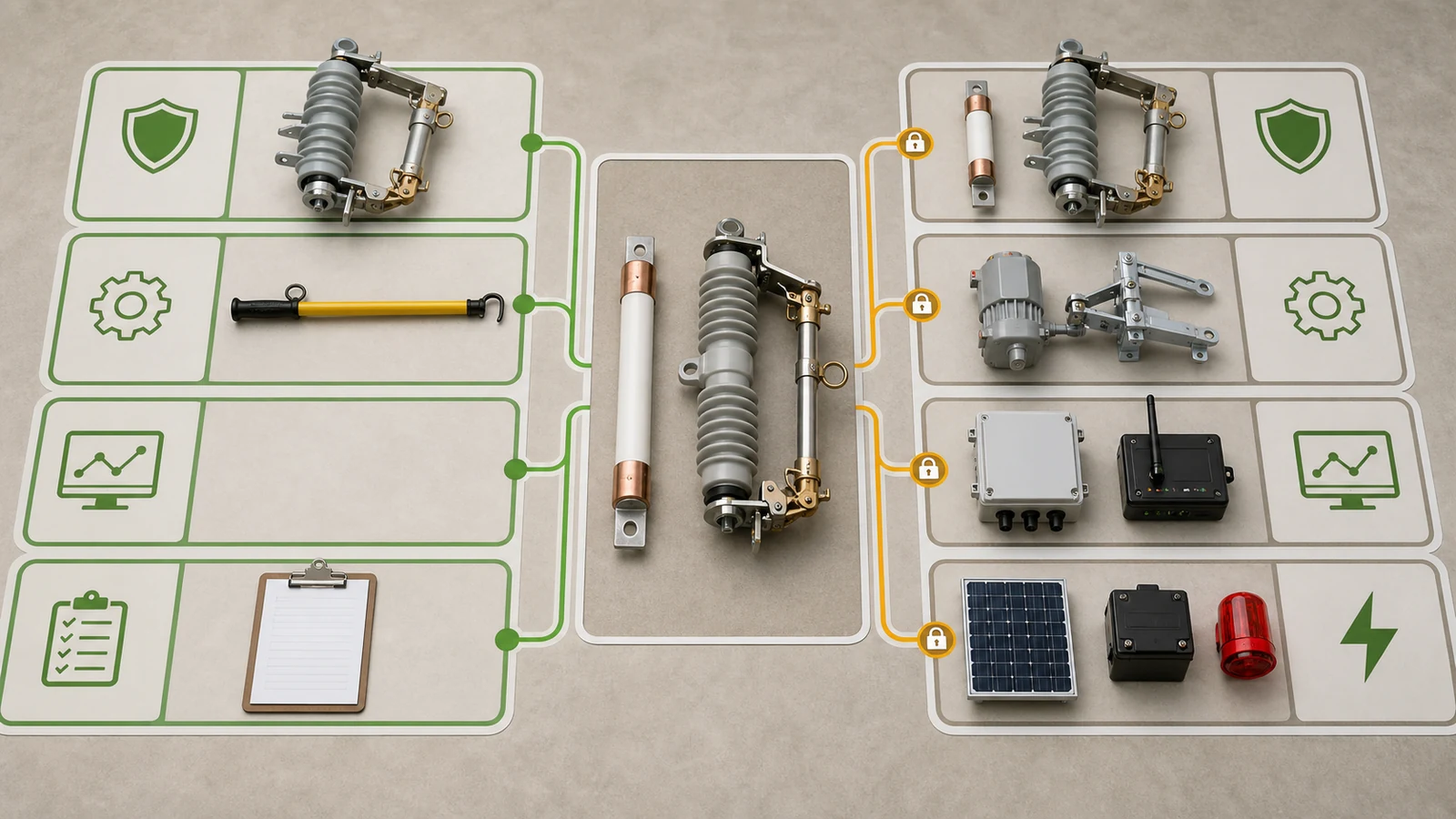
The smart route is not automatically superior. It earns selection only when the added operating or notification value exceeds the extra interfaces, failure modes, maintenance, and document burden.
The conventional drop-out fuse range includes different voltage rows, current classes, bodies, insulators, fuse tubes, links, brackets, and protected forms. A conventional cutout is not one universal comparator.
Use the approved system voltage, transformer duty, load, prospective fault current, insulation, environment, mounting, and fuse-link coordination for both paths. Use the transformer fuse selection guide to review those inputs. Final selection remains governed by the approved protection study and selected manufacturer data.
The public IEC 60282-2:2008 page covers indoor or outdoor expulsion fuses on 50 Hz and 60 Hz AC systems above 1,000 V. That scope does not select a fuse link, motor, terminal, alarm, charging source, communication path, or project package.
Build an evidence-source register before comparing offers. Link the project specification, approved protection study, short-circuit study, selected manufacturer data, site drawing, and operating philosophy to one revision. Mark which source controls each decision.
When sources disagree, record a deviation instead of choosing the most convenient value. A newer smart-accessory sheet cannot silently replace the approved fuse-body or fuse-link basis. Likewise, a conventional offer cannot omit the common environmental and mounting inputs.
Require each supplier to state assumptions, exclusions, and document revisions. This makes the added smart package visible as a set of controlled interfaces rather than a list of features.
The smart drop-out fuse product page separates two document layers:
| Layer | Published screening data | Selection consequence |
|---|---|---|
| RW-M12 / RW12-5 series | 12 kV, 50 Hz, 100-200 A, 12.5 kA, 1,000 mechanical operations | Screens the fuse body and motorized structure |
| ICC-RRW12 installation set | 12 kV, 50 Hz, 100 A, 12.5 kA, 500 mechanical operations | Screens the installed terminal and motor-wiring set |
| Series environment | -30 C to 70 C catalog entry | Do not transfer to the installation set automatically |
| Installation-set environment | -30 C to 45 C, altitude <=2,000 m, pollution IV, 2 mm ice | Confirm against the selected manual and site |
Source boundary: these are product-page screening values only. Keep the series and installation-set rows separate, and confirm the selected revision before use.
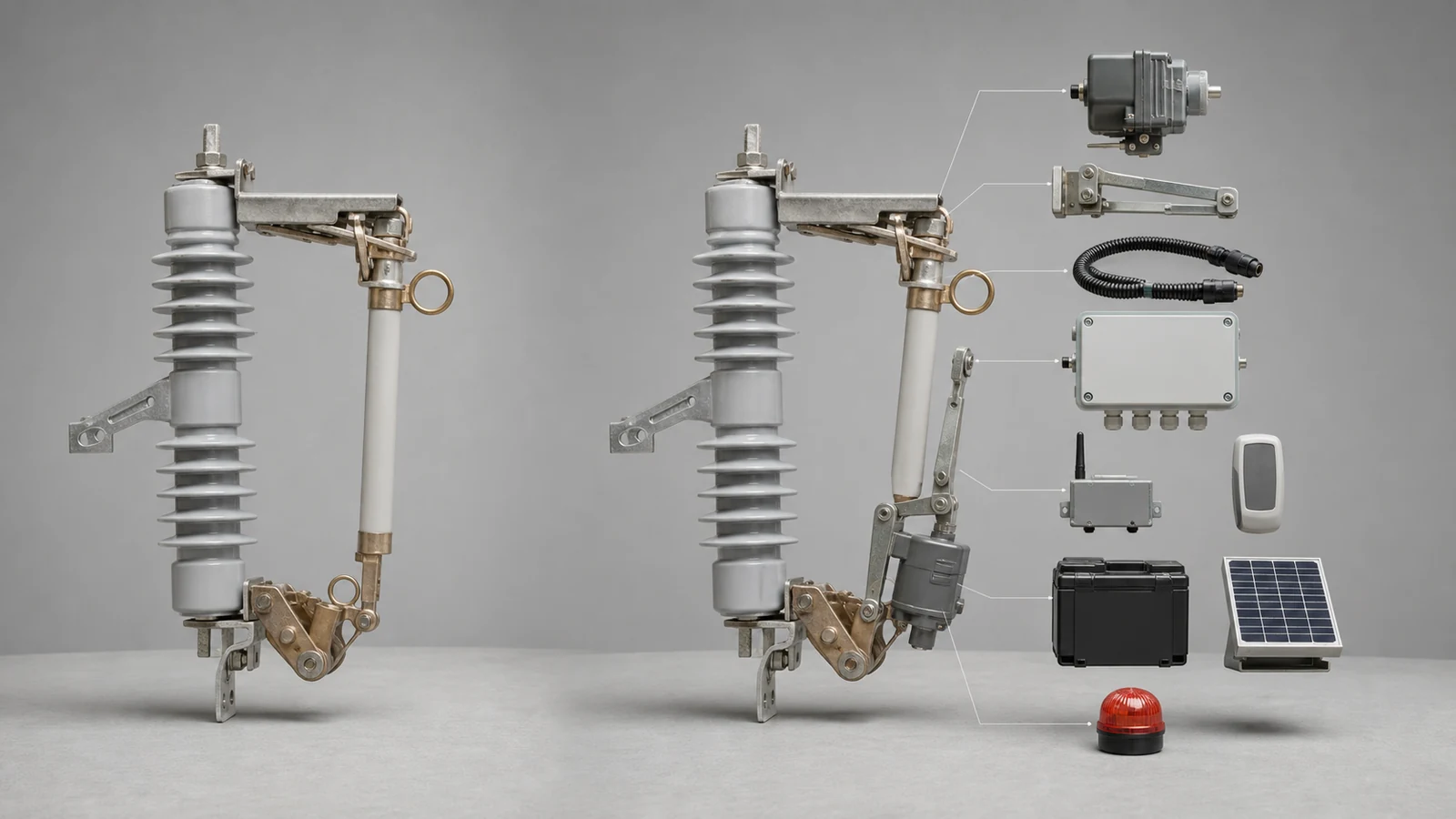
Do not merge these rows into one offered specification. Freeze the selected fuse body, fuse tube, link interface, arc-shield option, motor, installation set, terminal, receiver, cable, transmitter, charging package, and revision.
Smart accessories do not improve fuse selectivity by themselves. They also do not change transformer coordination unless an approved protection study changes the fuse-link basis.
A conventional cutout usually relies on the approved operating-rod method and local work controls. The smart path adds a power motor, manipulator arm, gripper or linkage, receiver, terminal, cable, and handheld or remote command endpoint.
Define why the motor exists. Possible project jobs include ground-level assisted opening, planned isolation, assisted closing after authorized replacement, or reduced climbing. Each job needs operating authority, state indication, local fallback, manual override, limits, interlocks, and a blocked-command response.
Motorized movement is not automatic reclosing. A fuse element still clears through its declared fuse behavior. A motor, receiver, or terminal does not detect transient faults, coordinate with an upstream breaker, replace a fuse link, or execute a reclose sequence unless separately designed and evidenced.
A user-boundary breaker may provide customer-zone interruption, sensing, and controller logic when the selected design supports those functions. This is a different duty from fuse-based branch protection. See the user boundary switch selection guide for the adjacent selection process.
Require a local fallback when the battery, terminal, receiver, communication, or motor is unavailable. The selected manual and approved operating procedure must define permissible states. This article does not provide an operating sequence.
An alarm feature begins with the sensing boundary. State whether the package detects a dropped fuse tube, motor position, terminal state, transformer alarm input, supply failure, or another declared event. Define normal, alarm, unknown, stale, and communication-loss states.
Then define event meaning and response. A fuse-drop indication does not prove the cause, faulted phase, transformer condition, or safe restoration state. Assign recipients, escalation, acknowledgement, retry behavior, timestamps, retention, and the record used for follow-up.
Call, SMS, and WeChat are delivery options, not complete protocols. Confirm network bearer, coverage basis, SIM or account ownership, recipient limits, message content, time source, delivery evidence, and fallback. If a dry contact or gateway is required, specify its electrical and mapping interfaces.
Build one power schedule for the terminal, receiver, motor, modem, indicators, heater, and charging equipment. Define continuous, intermittent, peak, and starting loads where applicable. Compare those loads with the selected source and manufacturer limits.
An AC label does not prove site compatibility. A solar option needs the panel, regulator, battery technology, capacity basis, mounting, cable, environmental derating, and energy balance. Define low-energy alarms and behavior when available energy cannot support operation or messaging.
Credentials, pairing, SIM details, configuration files, firmware, licenses, recipient lists, and backups need named custody. The as-left package should show what was supplied and how the notification path was configured.
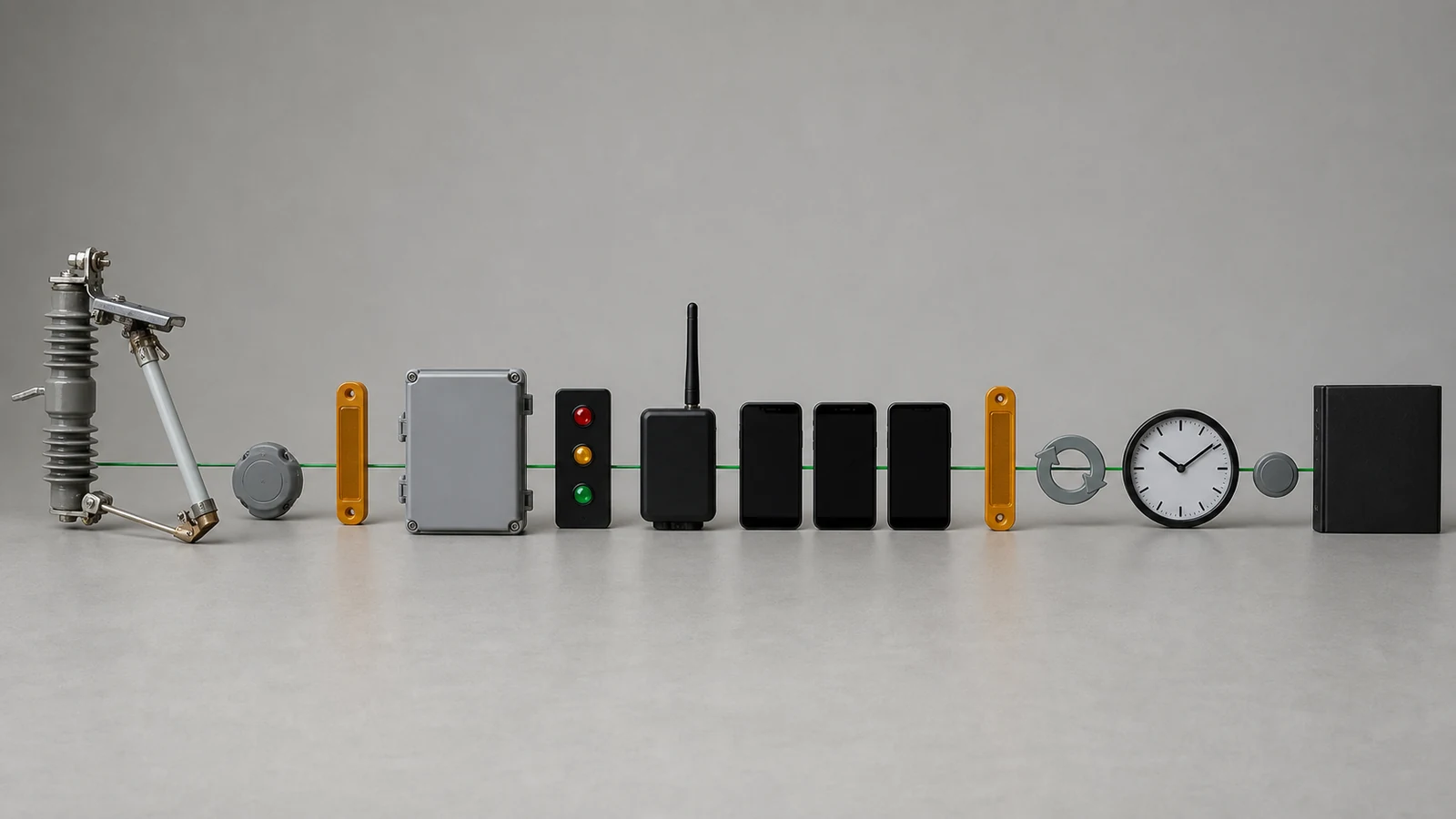
Keep monitoring separate from protection. Loss of an alarm channel should not be described as loss of fuse protection unless the selected design explicitly couples those functions.
Use this RFQ checklist for comparable returns:
| Package item | Required input | Approval evidence | Hold condition |
|---|---|---|---|
| Common fuse package | Voltage, current, fault duty, fuse link, body, tube, bracket, insulation | Approved study, schedule, manufacturer data | Protection basis differs between offers |
| Smart operating package | Motor, linkage, receiver, transmitter, cable, authority, fallback | Selected manual, wiring, operating philosophy | Added function is undefined |
| Monitoring | Sensor, event meanings, recipients, escalation, timestamps, retention | Alarm and response schedule | Notification claim lacks boundaries |
| Power | Source, loads, charger, battery, solar, alarms, degraded behavior | Load and energy schedule | Capacity or limits are missing |
| Site interface | Photos, crossarm, clearances, cable route, clamps, exposure, access | Approved pole overlay and drawings | Equipment envelope conflicts |
| Lifecycle | Inspection, batteries, spares, pairing, credentials, configuration, training | Maintenance and handover plan | No owner or replacement basis |
| Documents | Datasheets, manuals, drawings, test references, packing list, deviations | Revision register and traceability | Files describe different packages |
Conventional equipment remains a valid choice when passive fuse protection, manual practice, patrol response, and available crews meet the approved operating philosophy. It avoids powered terminal, charging, modem, credential, and configuration dependencies.
Smart equipment fits when remote-assisted movement or faster notification solves a defined operational problem. The project must also support the added pole space, power, communications, inspection, spares, training, and records.
Do not compare purchase price alone. Include terminal and solar hardware, communications, account charges, batteries, spares, periodic checks, troubleshooting skills, and configuration control across the intended service period.
Representative engineering review, entirely synthetic, illustrative, and non-universal. This is not a XIYA POWER customer, supplier, factory, quotation, order, design, selection, installation, inspection, test, commissioning, maintenance, failure, outage, or field case. No compliance, acceptance, safety, supply, or result is claimed.
Synthetic project inputs: The system is 10 kV nominal, 12 kV equipment class, and 50 Hz. Its approved fuse-based branch uses a 40 A K-type fuse link. Prospective fault current at the fuse point is 8.6 kA symmetrical RMS.
Candidate-return screening values: The conventional return includes the approved cutout body, bracket, fuse tube, and fuse-link interface without control accessories. The smart return states RW12-5, a 100 A ICC-RRW12 set, 12.5 kA capability, motor, digital terminal, receiver, transmitter, and optional solar charging.
The smart return does not identify one controlled revision across body and installation-set documents. O&M asks for a fuse-drop alarm within 10 minutes and remote-assisted open or close. It does not request automatic reclosing.
The return says call, SMS, or WeChat without defining sensor boundary, event meaning, recipients, bearer, retries, timestamps, dry-contact output, or test method. The alarm decision remains open.
The site has no auxiliary AC supply and requests solar. Panel, regulator, battery, capacity, autonomy, load schedule, low-energy alarm, and degraded behavior are absent.
A synthetic pole overlay shows 115 mm between a conductor and the proposed motor-cover envelope. The selected manual calls for more than 12 cm. The returned motor cable is 4.0 m, while the synthetic route is 4.6 m.
Receiver pairing, transmitter custody, credentials, spare battery, spare receiver, configuration backup, and as-left records are unassigned.
Synthetic illustrative review table:
| Gate | Decision | Primary omissions | State |
|---|---|---|---|
| 1 | Common fuse protection, body, link, duty, revision | One controlled smart-package revision | Hold |
| 2 | Motor purpose, authority, fit, clearance, cable, fallback | Clearance, cable length, operating controls | Hold |
| 3 | Alarm sensing, meaning, delivery, time, response | Sensor boundary, recipients, bearer, retries, evidence | Hold |
| 4 | Power, accessories, spares, credentials, handover | Solar and battery data, owners, backups, records | Hold |
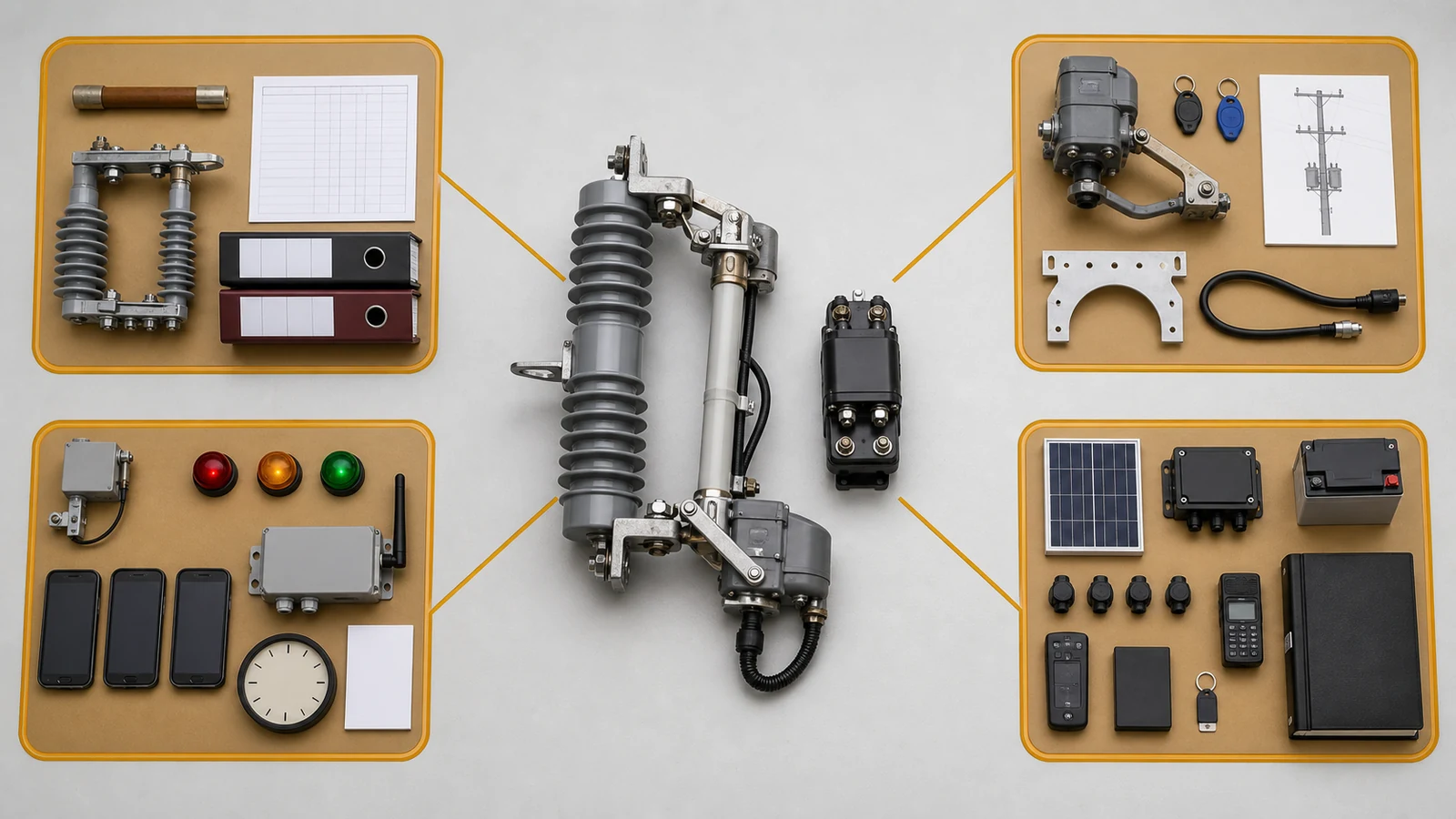
Neither path is selected, accepted, ordered, supplied, installed, tested, commissioned, or proven reliable. Resolve each independent gate before choosing the added automation burden.
Both can retain fuse-based branch protection. The smart path adds motorized operation, terminal power, remote accessories, and optional alarm delivery. Those additions create more site, maintenance, communication, and evidence requirements.
Not by itself. Coordination still depends on the approved transformer, system, fault, cutout, and fuse-link basis. Motor or alarm accessories do not change fuse characteristics without a separate protection-design change.
No. Motorized movement executes an authorized command or declared control function. Automatic reclosing requires fault detection, timing, sequence, lockout, interruption duty, and coordination that must be separately designed and evidenced.
Define the sensor, event meanings, recipients, escalation, bearer, retries, timestamps, quality, retention, delivery evidence, account ownership, credentials, configuration, and response procedure.
Use it when approved passive fuse protection, manual operation, patrol response, local crews, and the site’s maintenance model meet requirements without powered monitoring or remote-assisted movement.
Hold when protection, motor purpose, authority, site fit, clearance, power, battery, alarm semantics, communication, spares, credentials, documents, or lifecycle ownership remains missing, incompatible, uncontrolled, or unapproved.