Quotation form
Send an inquiry
Start with the basics. Our team can follow up for missing drawings, standards or packing details.
Submitted details are used only for quotation, technical review and project communication.

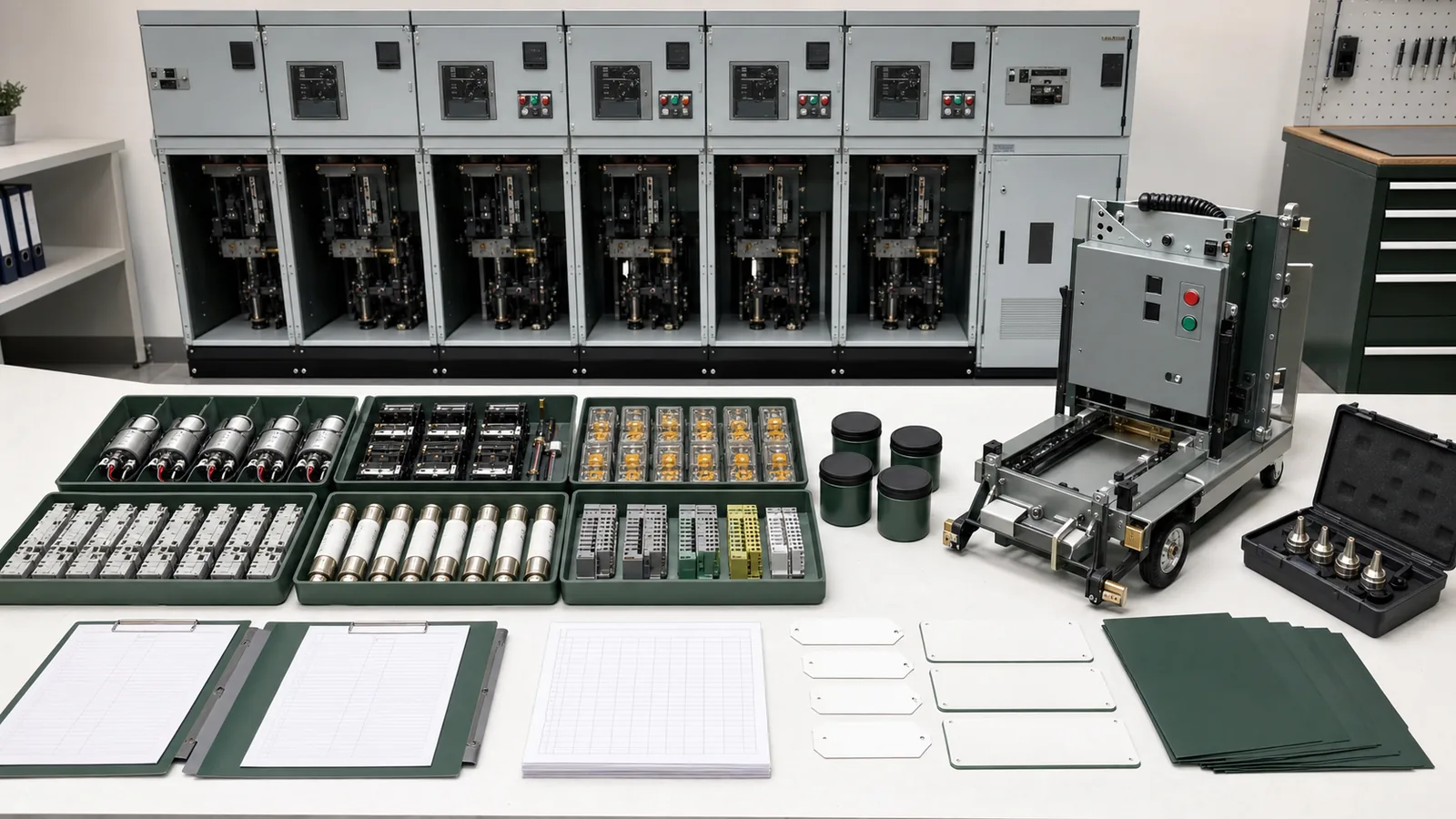
All images are generated illustrative technical visualizations, not XIYA POWER factory, parts, tools, stores, packing, inspection, installation, commissioning, maintenance, outage, or field photographs.
By Candy Zhao, Sales Director at XIYA POWER.
A switchgear spare parts schedule is order-ready only when every line resolves five decisions: service phase, item identity and applicability, quantity basis, condition and logistics, and release evidence. A generic recommended spares list or a combined quantity is only an input. The schedule defines what is ordered and how it is traced; it does not independently approve replacement compatibility.
Use one selection matrix from RFQ through handover. Each decision needs a controlled required input, a named decision owner, an evidence source, and a hold condition.
| Decision | Required input | Buyer or supplier decision | Evidence source | Hold condition |
|---|---|---|---|---|
| Service phase | Equipment scope, project stages, maintenance strategy | Buyer defines the split; supplier confirms delivery timing | Approved schedule with separate phase columns | Phase is combined or unlabeled |
| Identity and applicability | Manufacturer, part number, BOM or drawing revision, equipment tags | Supplier declares applicability; responsible engineering reviews compatibility | Controlled BOM, drawing register, declaration | Description is generic or mapping is absent |
| Quantity basis | Installed population, commonality, criticality, lead time, coverage period | Buyer decides with supplier input | Line-specific quantity rationale | Percentage or total has no stated basis |
| Condition and logistics | Condition, shelf life where relevant, storage, preservation, transport data | Supplier returns data; buyer reviews order requirements | Product data and preservation record | Applicable data is missing |
| Evidence and handover | Inspection requirement, deviations, package mapping, receipt and stock fields | Quality, logistics, and stores close their records | Inspection record, packing list, receipt record | Evidence is incomplete or inconsistent |
These gates are independent. A part number does not close preservation, and a packing-list entry does not prove applicability. The OEM and ODM manufacturing scope identifies the product, model, rating, quantity, drawing or sample basis, inspection expectations, packing, documents, and replacement-part details that should be established before production release.
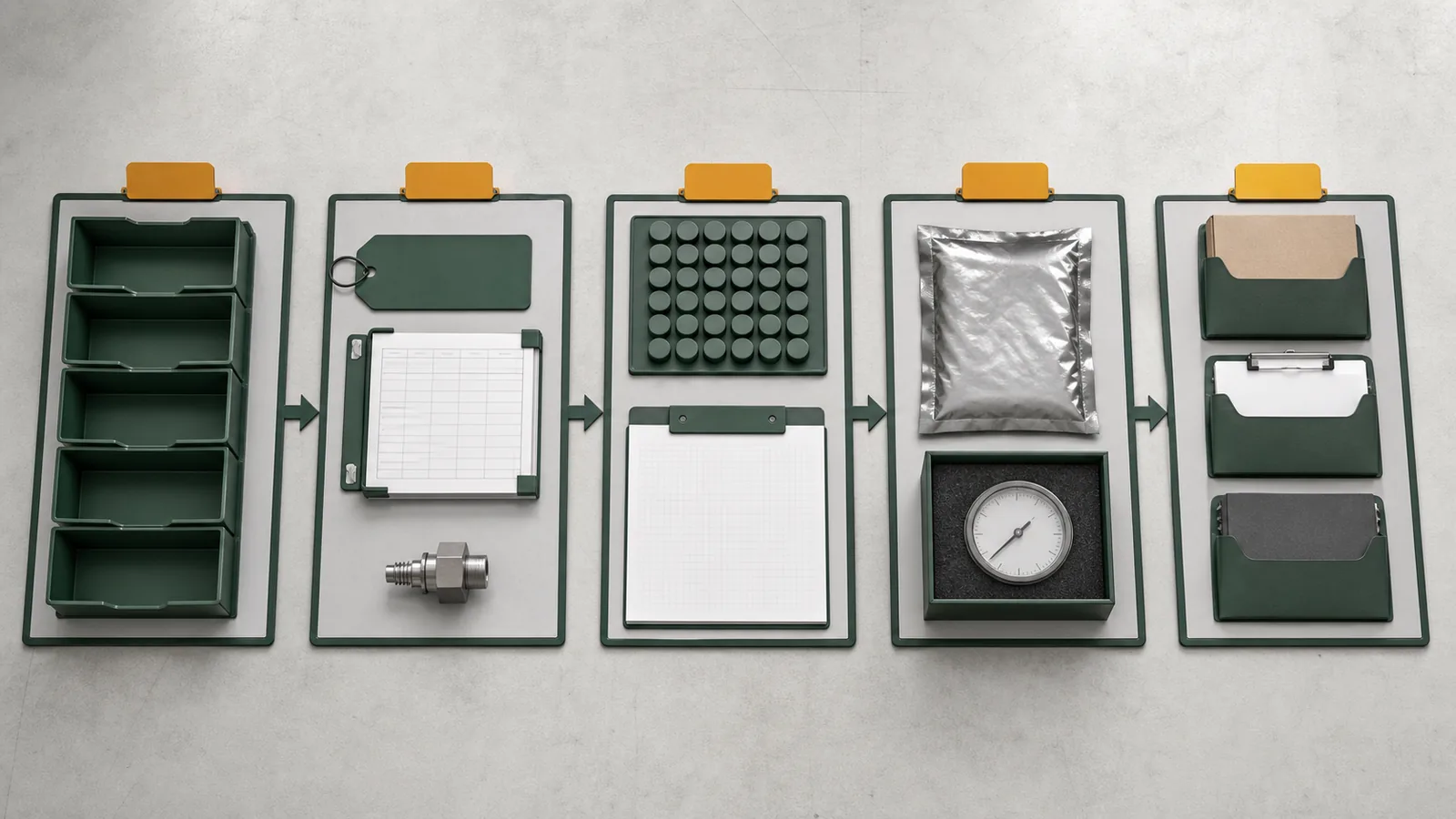
Illustrative technical visualization: exactly five spare-schedule decision gates remain in an amber review state, without a pass or accepted mark.
A usable schedule keeps five categories visible because their owners, delivery points, and disposition rules differ.
| Category | Purpose | Schedule control |
|---|---|---|
| Installation consumables | Contract-defined materials consumed during site assembly | State scope, delivery point, unit, and whether unused material transfers or is disposed of |
| Commissioning spares | Parts held for damage or defects identified during handling, pre-service checks, functional tests, and handover | State commissioning custodian, consumption record, and transfer or return rule |
| Operating spares | Parts transferred to the maintenance store for an agreed coverage period | State stock owner, receipt data, storage, and replenishment basis |
| Insurance or strategic spares | Long-lead or high-consequence items held against an agreed risk | State criticality basis, preservation, inspection, and release authority |
| Special tools | Equipment-specific handling, testing, or adjustment equipment | List separately with tool identity, package, custodian, calibration if applicable, and return status |
These labels do not determine quantities. They prevent an operating spare from being consumed without transfer control, a returnable tool from disappearing into a consumables total, or an unused commissioning item from entering stores without identity and condition records.
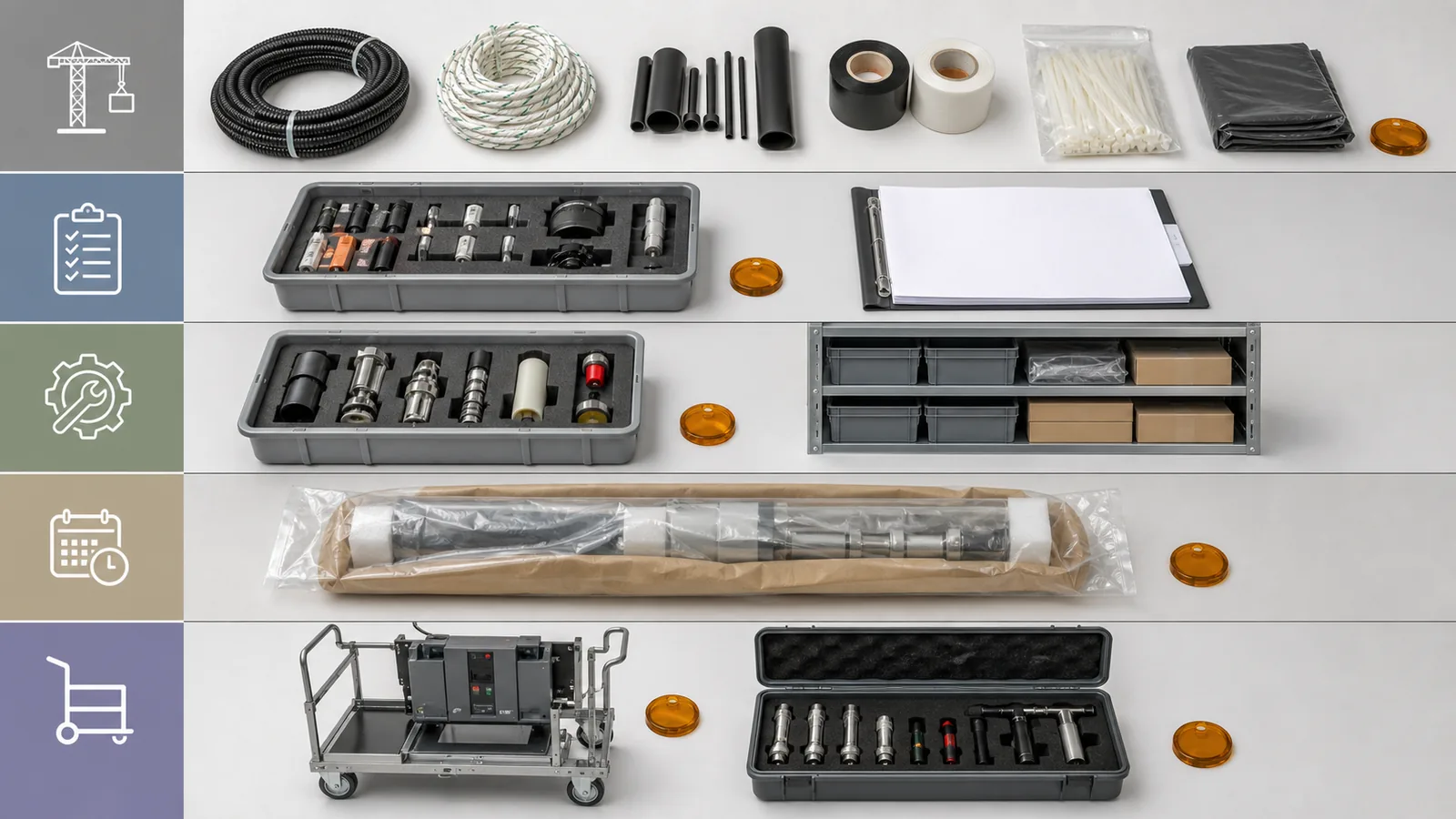
Illustrative technical visualization: five separate lifecycle lanes distinguish installation consumables, commissioning spares, operating spares, strategic spares, and special tools without quantities or recommendations.
Each spare line should connect the ordered item to the equipment version it may support. Capture:
The supplier declaration is evidence for a compatibility review, not the compatibility approval itself. If a revision, voltage, mechanism, connector, dimensions, firmware, material, or other controlled attribute affects fit or function, the responsible engineer must resolve it against the actual equipment baseline.
The official public page for IEC 62271-1:2017+AMD1:2021 describes common specifications for relevant AC high-voltage switchgear and controlgear. That public scope helps identify the equipment context; it does not set universal spare quantities, interchangeability, lead times, shelf life, preservation, or buyer workflow. The contract, applicable particular standard, approved equipment data, manufacturer data, project specification, supplier records, project strategy, and responsible approvals remain controlling. Electrical studies, including a short-circuit study or TCC, may constrain the ordered equipment configuration, but they do not set spare quantities automatically.
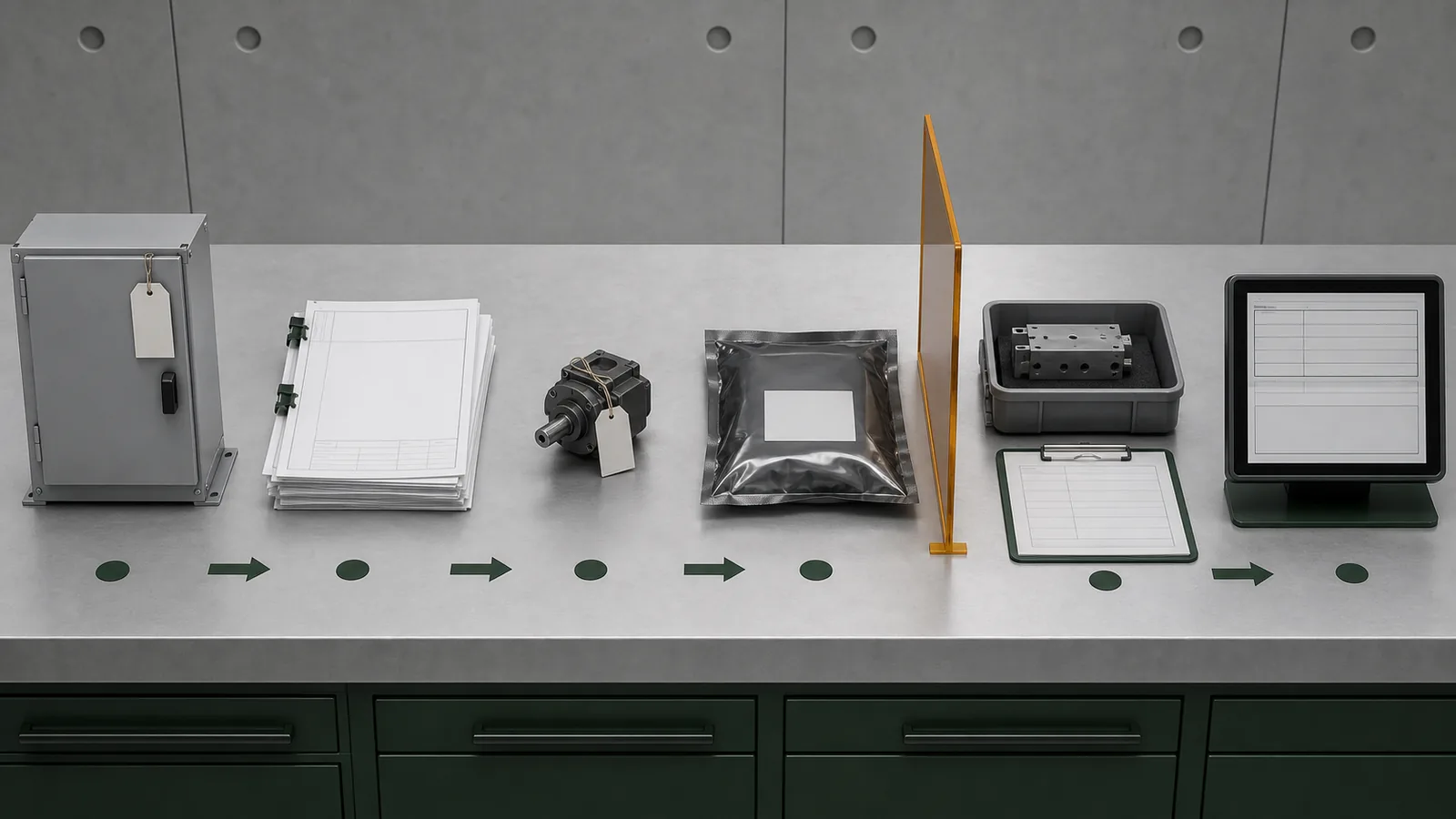
Illustrative technical visualization: one chain connects equipment tag and controlled BOM revision to manufacturer part number, package label, receipt record, and stock register, with an amber engineering-compatibility boundary.
Do not begin with a percentage. Start with the installed population and identify which exact part numbers are common across configurations. Then consider the consequence of having no replacement, expected exposure during installation or commissioning, planned maintenance strategy, confirmed replenishment lead time, local repair capability, storage constraints, and the buyer’s agreed coverage period. Record the rationale by line or commonality group.
The supplier can return recommended quantities and lead-time evidence, but the buyer owns the final commercial stock decision with engineering, maintenance, quality, and stores input. A recommendation without its assumptions cannot be compared across bids.
Use this RFQ checklist or its equivalent PO schedule:
| Required input | Supplier return | Decision owner | Hold condition |
|---|---|---|---|
| Installed population by equipment tag | Quantity by exact part number | Buyer engineering | Population or mapping is absent |
| Commonality groups | Tags and revisions sharing each part | Supplier, reviewed by engineering | Group is asserted but not evidenced |
| Commissioning scope | Separate candidate commissioning quantity and rationale | Commissioning and procurement | Mixed pool or no rationale |
| Maintenance and criticality basis | Candidate operating or strategic quantity and rationale | Maintenance and asset owner | Unsupported percentage only |
| Replenishment input | Confirmed lead time and validity basis | Supplier and procurement | Lead time is unstated |
| Coverage and local capability | Buyer-defined period, repair, storage, and response assumptions | Buyer | Assumptions are not recorded |
| Condition and evidence | Shelf-life, preservation, records, and package fields where applicable | Supplier, quality, and logistics | Schedule line cannot be released or received |
The spare schedule should feed, rather than duplicate, three controlled workflows.
The switchgear inspection and test plan owns item-level inspection requirements, participation points, records, holds, and release authority. The schedule identifies which spare lines require those records.
The export packing and document handover process owns preservation, package identity, weights where required, packing lists, transport-state records, deviations, and shipment release. The schedule supplies the line IDs, quantities, equipment mapping, and condition data to be packed.
The controlled marking review owns package-label content, language, artwork, authorization, and installed evidence. The schedule provides the approved item identity, tags, quantities, preservation marks, and schedule revision that labels must reference.
Close the chain by reconciling schedule line to package ID, packing-list line, physical label, receipt result, deviation status, and stock-register import field. Keep any mismatch open. A photographed box, a packing total, or a signed document register cannot replace line-level reconciliation.
Invented representative engineering review for method demonstration only. It is not a XIYA POWER customer, supplier, quotation, order, design, BOM, spare recommendation, stock record, packing record, inspection, FAT, installation, commissioning, maintenance, outage, or field case. Every equipment identity, quantity, revision, duration, and returned detail below is fictional and non-universal.
The invented input contains ten indoor 12 kV-class metal-clad panels: two incomers, one bus coupler, six feeders, and one voltage-transformer panel. Nine fictional withdrawable circuit-breaker units cover the incomers, coupler, and feeders. The equipment schedule baseline is revision D; the spare return is revision B. A two-year operating pool is a fictional commercial request, not a recommended stocking period.
The candidate commissioning pool contains 18 control fuse links, 12 indication modules, 20 terminal blocks, and 2 temporary test-plug assemblies. The candidate operating pool contains 1 withdrawable breaker unit, 2 closing coils, 2 trip coils, 1 spring-charging motor, 3 auxiliary-contact blocks, and 2 containers of supplier-identified mechanism lubricant. One breaker handling trolley and one test-plug kit are listed separately as special tools.
| Open hold | Invented returned gap | Decision still open |
|---|---|---|
| Identity and applicability | Breaker, coils, motor, and contact blocks have generic descriptions but no manufacturer part numbers, revision-D BOM mapping, equipment-tag mapping, or supplier declaration | Exact identity and compatibility review input |
| Quantity and service phase | One total combines commissioning and operating pools; temporary test plugs are not identified as consumed, transferred, or returnable | Phase split and quantity rationale |
| Condition, shelf life, and preservation | Lubricant lacks product identity, batch, expiry, storage range, transport status, and mechanism-applicability record; condition and preservation are incomplete | Condition and logistics requirements |
| Evidence and handover | Spares box and tools box do not map schedule lines, quantities, package IDs, tags, revision, inspection status, receipt fields, or stock-register data |
Release and handover evidence |
All four holds remain open. No line, quantity, part, tool, lubricant, package, or order is selected, recommended, compatible, accepted, rejected, released, received, installed, consumed, or field proven. Missing evidence does not prove unsuitability or non-delivery; it prevents a controlled decision.
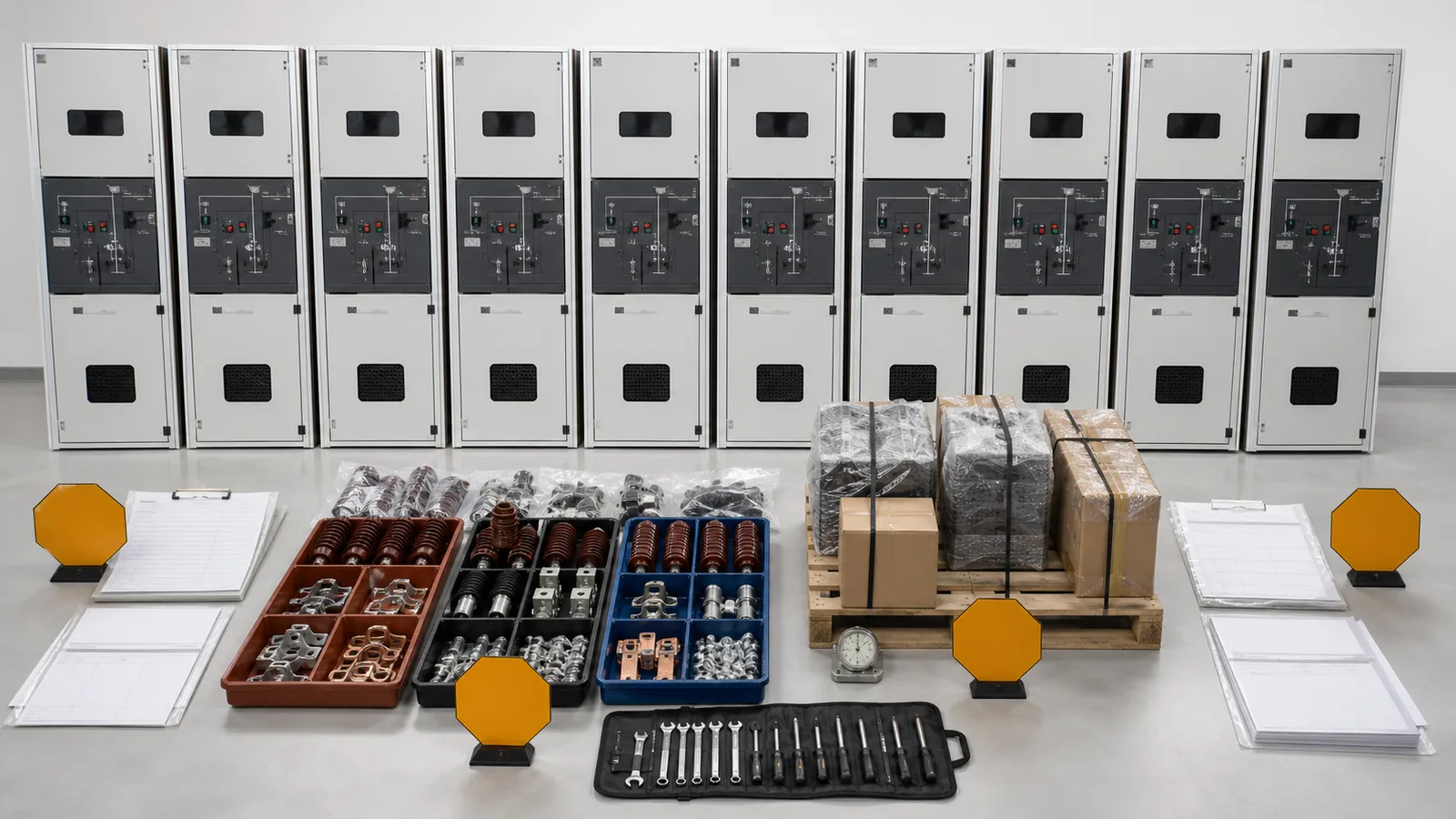
Illustrative technical visualization: an invented ten-panel lineup and separate spare and tool packages are surrounded by exactly four amber holds, with no accepted, rejected, recommended, compatible, or released state.
For an order-specific schedule review, send the equipment list, controlled revisions, commissioning scope, maintenance strategy, and required handover fields to XIYA POWER.
Commissioning spares are controlled for handling, pre-service checks, functional testing, and handover, with a stated consume, transfer, or return rule. Operating spares are received into maintenance stock for an agreed post-handover coverage period. They need separate quantities, custodians, delivery timing, and records.
Include line ID, description, manufacturer, exact part number, BOM or drawing revision, equipment tags, identity attributes, unit, quantity by service phase, applicability declaration, package ID, condition, storage, preservation, shelf-life or inspection data where relevant, required records, deviations, and receipt or stock-register fields.
Use installed population, proven commonality, criticality, outage consequence, commissioning exposure, maintenance strategy, replenishment lead time, local capability, storage constraints, and the buyer-defined coverage period. Record assumptions by line. Do not apply an unsupported universal percentage.
Only a controlled exact part can be assessed across several panels. The supplier should map its part number and applicable revision to every equipment tag. Responsible engineering then reviews compatibility. A generic description or declaration alone does not approve substitution or fit.
List them in a separate schedule section. Give each tool an identity, applicability, quantity, package, custodian, calibration requirement where applicable, and consume, transfer, or return status. Do not hide tools inside a spare-parts total.
Keep it on hold when service phase, identity, equipment mapping, quantity rationale, condition, storage, preservation, required inspection, deviations, package mapping, receipt fields, or stock data is unresolved. A hold records an open decision; it is not proof of failure, incompatibility, or non-delivery.