Quotation form
Send an inquiry
Start with the basics. Our team can follow up for missing drawings, standards or packing details.
Submitted details are used only for quotation, technical review and project communication.

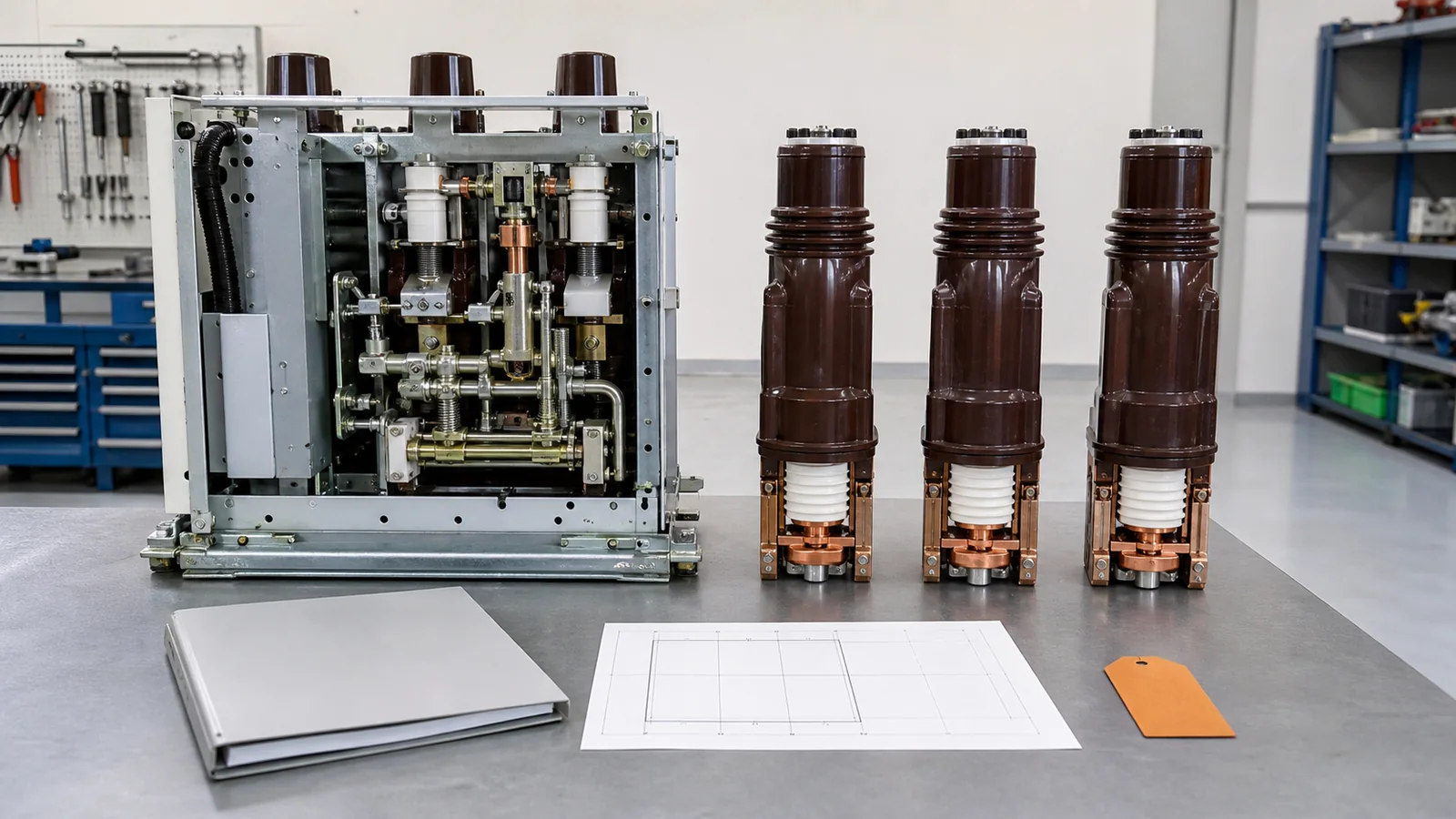
A vacuum pole assembly replacement should be released only when it is directly traceable to the exact breaker configuration or passes a documented engineering-equivalence review. Matching appearance, a VS1 compatible description, or the same voltage, current, and short-circuit headline ratings cannot establish mechanism, kinematic, dimensional, insulation, or three-pole compatibility.
The practical buying question is therefore not simply “does this pole fit?” It is: can the supplier and buyer close an evidence chain from the original breaker configuration to the offered pole set, with an approved validation and acceptance basis? The answer should end in one of three controlled states: directly traceable replacement, engineering-equivalence review, or do-not-release hold.
Visual transparency: Every image in this article is a generated illustrative technical visualization, not a XIYA POWER factory, customer, test, installation, or field photograph.
Readers who need introductory context can first review what a vacuum pole assembly is and the role of a vacuum circuit breaker. This guide concentrates on replacement compatibility rather than basic component function.
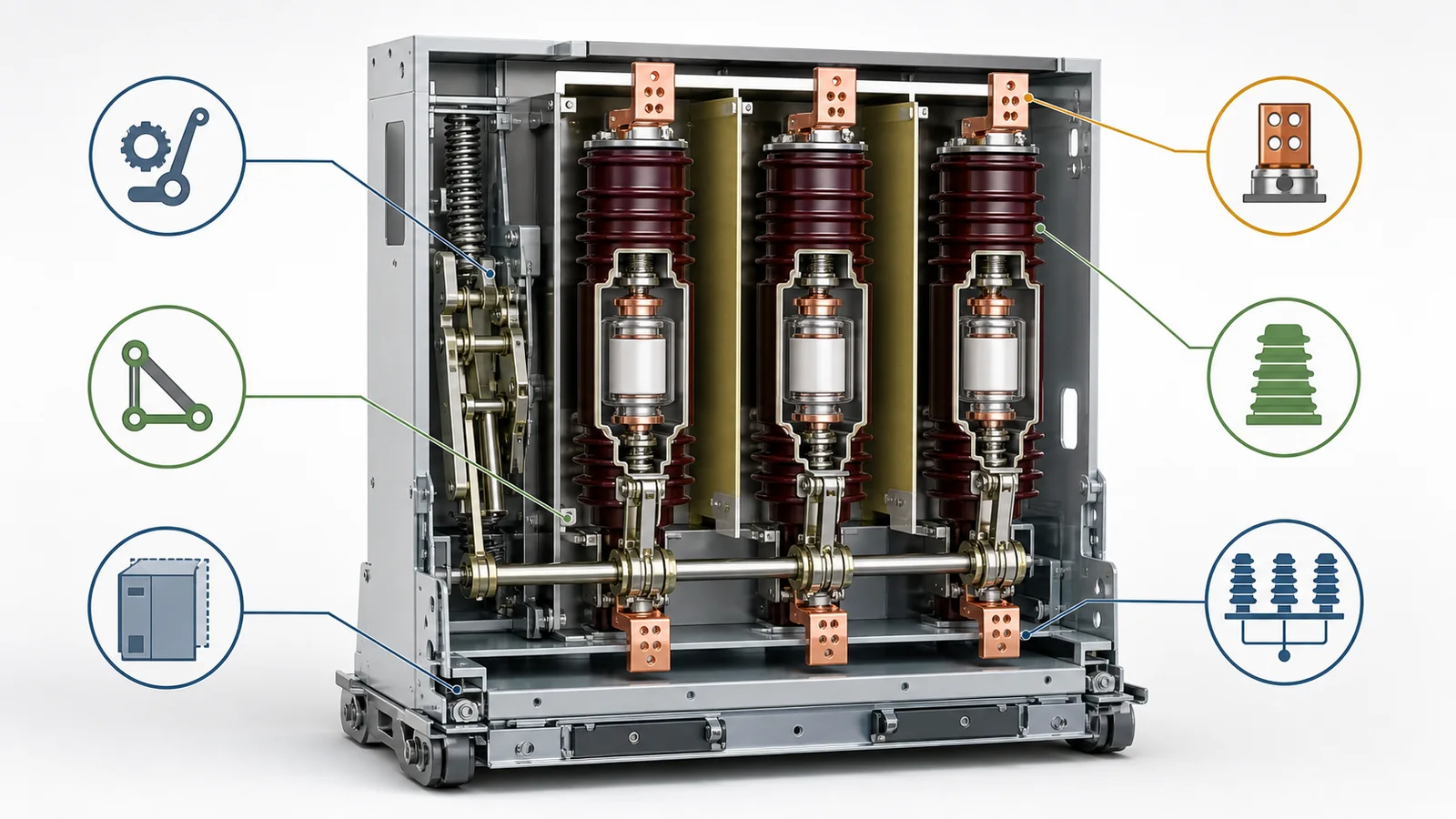
A vacuum pole is part of a coupled system. The three poles share mechanism energy, drive and linkage relationships, operating timing, insulation boundaries, terminal geometry, and the breaker duty declared on the nameplate. A pole that bolts into place can still be unsuitable if its internal spring load, contact travel, current path, terminal centerline, or phase relationship differs from the original configuration.
A directly traceable replacement has controlled manufacturer records that connect the candidate model and revision to the exact breaker type, serial range, mechanism, and application. When that chain is missing or incomplete, the candidate requires an engineering-equivalence review across every relevant interface. If critical original data, candidate data, validation authority, or acceptance evidence remains unavailable, the correct state is do not release.
Photographs, family names, informal cross-references, and measurements from one removed part may support identification or condition review, but none independently proves compatibility. Purchasing should remain conditional until technical ownership, evidence applicability, deviations, and hold points are clear.
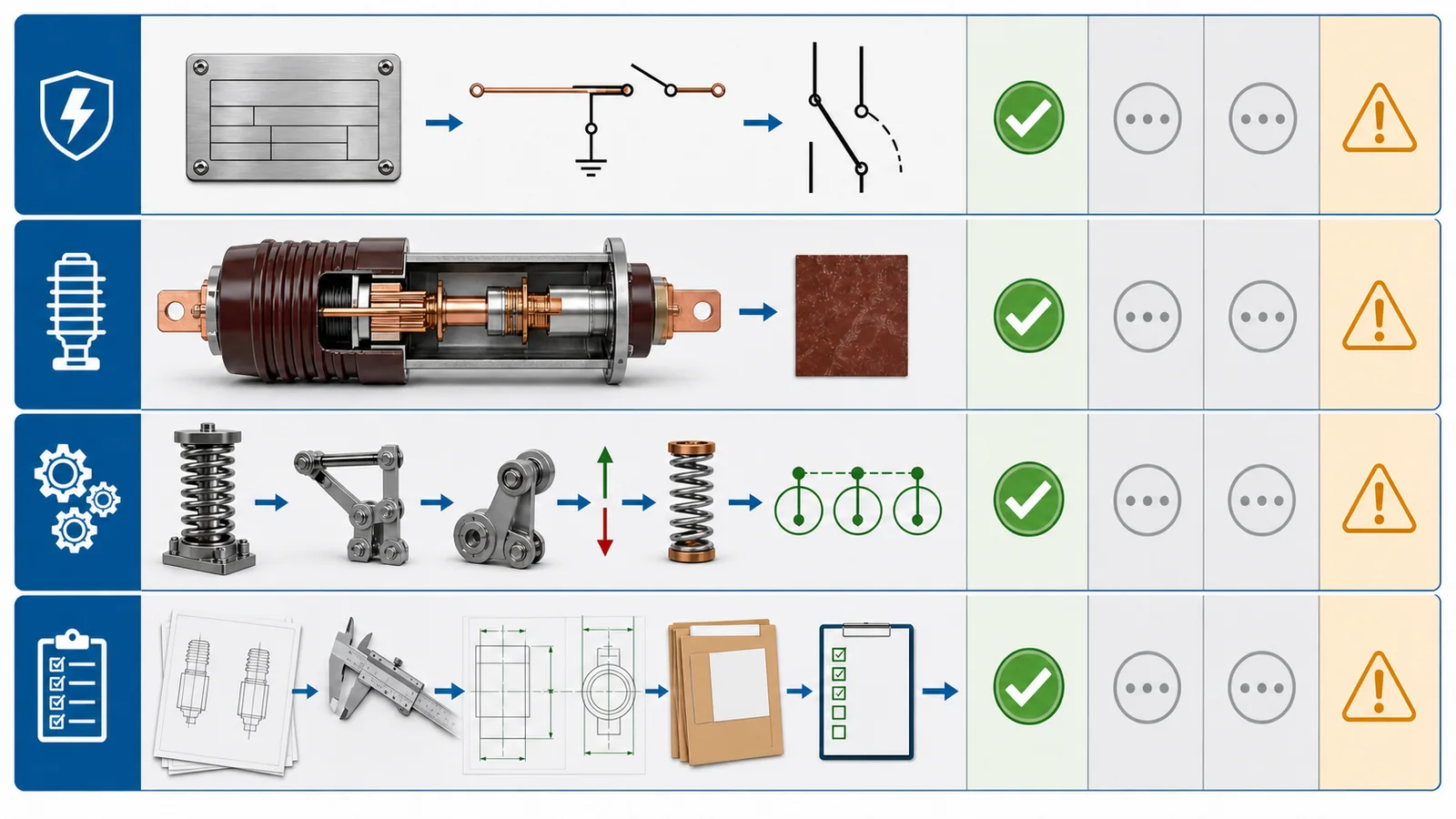
The RFQ and technical review should convert compatibility into a selection matrix and acceptance matrix rather than a single yes/no supplier statement. Use the same rows as an RFQ checklist so the supplier must return the required input and release evidence for each interface.
| Layer | Data to compare | Release question |
|---|---|---|
| Ratings and duty | Exact identities and revisions; rated voltage and insulation level; frequency; continuous current; breaking and making duty; short-time current and duration; operating sequence; application duty | Does the evidence apply to this complete breaker configuration, not merely a product family? |
| Pole, insulation, and current path | Interrupter and pole construction; insulation material system; conductor and thermal path; contact material; terminal arrangement and plating | Is the offered construction equivalent at every electrical and insulation boundary? |
| Mechanism and kinematics | Mechanism energy; linkage and lever ratio; drive coupling; stroke; overtravel; contact compression and force; speed; phase timing; damping and rebound | Will the existing mechanism drive the candidate through the manufacturer-defined motion and force relationship? |
| Dimensions, evidence, and validation | Mounting pattern; terminal centers; phase spacing; envelope; moving and fixed connections; three-pole strategy; controlled drawings and tolerances; validation plan; approval owner | Can the candidate be inspected against controlled data and released through an approved process? |
Headline kA, kV, and A values close only part of the first layer. A general outline can support an early screen, but it is not a tolerance return or an inspection basis. Every open matrix row needs an owner, required evidence, due state, and release disposition. A deviation should identify what differs, why the difference is acceptable, which evidence supports that conclusion, and who approves it.
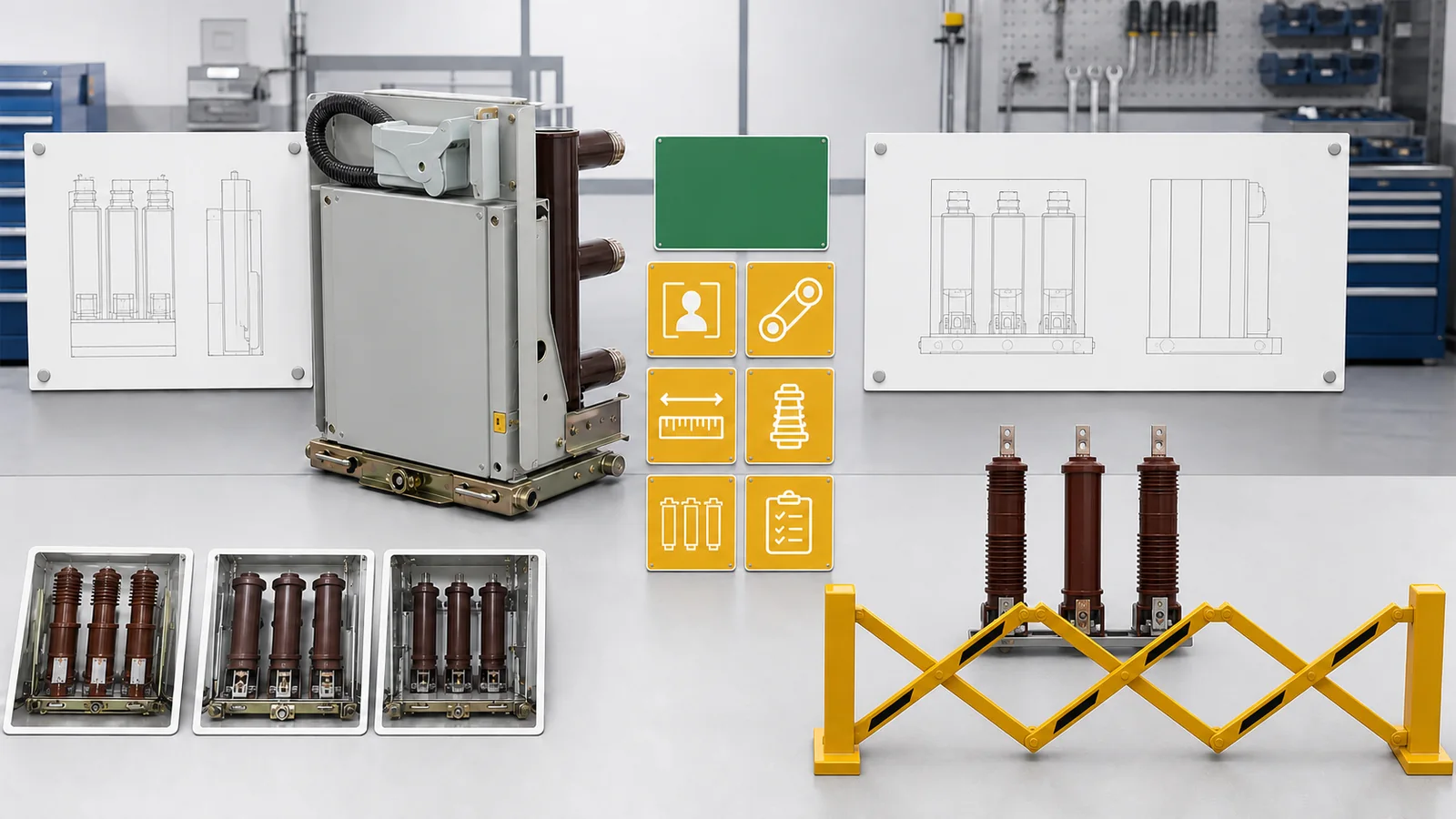
The comparison begins with the original configuration, not the candidate catalogue. Record the breaker manufacturer, type, serial or production range, year, mechanism model, pole identity, drawing number and revision, ratings, operating sequence, and documented modifications. Then obtain the original controlled pole drawing and any configuration-specific replacement instruction or service bulletin.
The baseline needs more than mounting dimensions. It should define stroke and its datum; overtravel and contact-compression definitions and ranges; contact-force basis; spring and linkage relationships; terminal centerlines and phase spacing; mounting tolerances; insulation material; current-path geometry; and any approved three-pole matching rule. Missing original data does not justify a narrower comparison. It creates a hold item whose resolution must be agreed before release.
Measurements and photographs from a used pole are still useful as condition evidence. They can document the as-found state and help identify conflicts that need investigation. They cannot recreate the original design tolerance, prove the correct measurement datum, or establish the intended value before wear or deformation. The controlled original drawing and the candidate’s applicable tolerance return remain necessary.
The prior vacuum pole assembly specification and drawing review explains the drawing-interface foundation. A replacement review uses that foundation but extends it to configuration traceability, kinematic equivalence, phase-set consistency, validation, and release ownership.
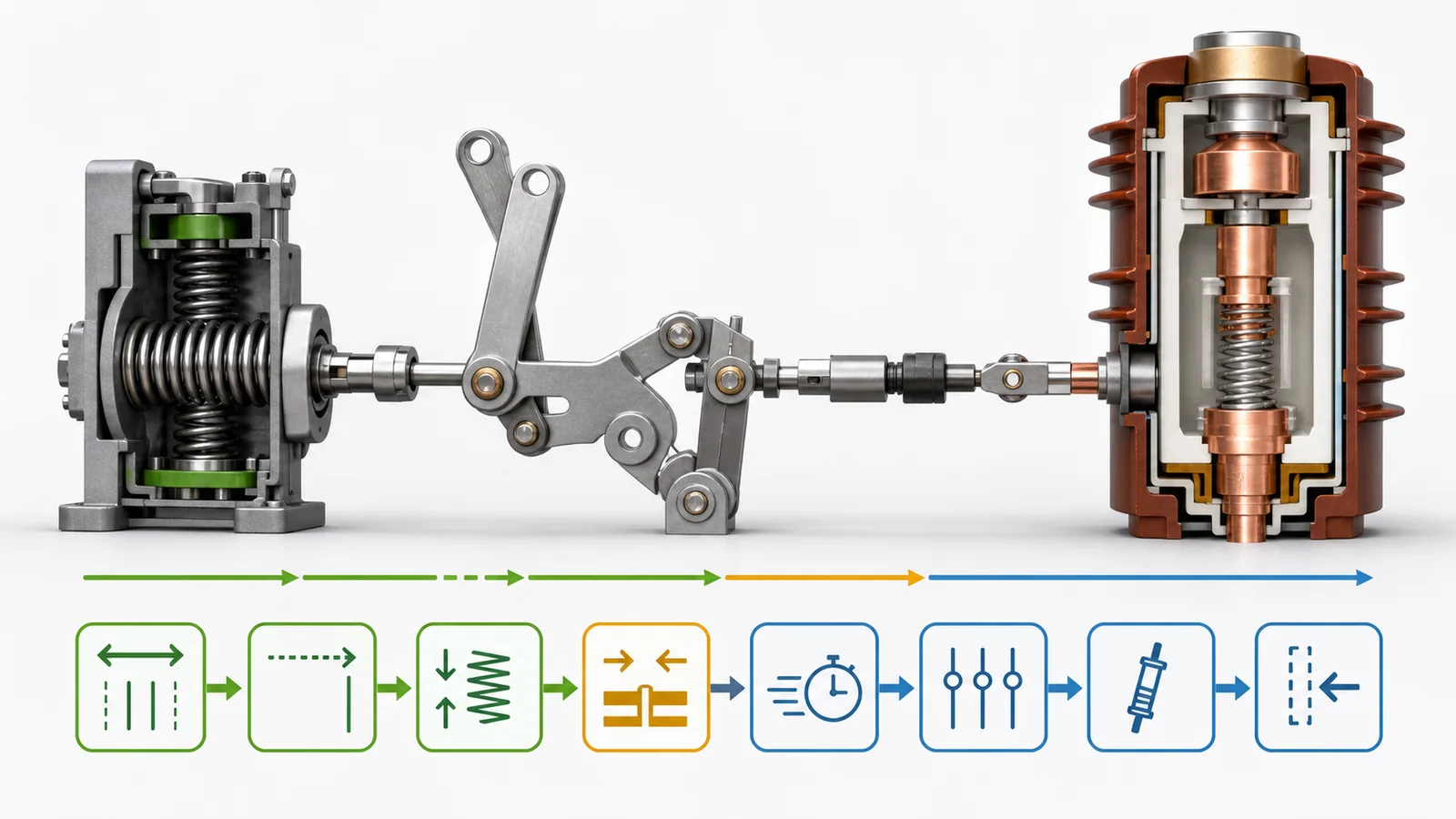
Mechanism compatibility is frequently underestimated because it is not obvious from a static outline. Stored energy passes through a particular shaft, linkage, lever ratio, and coupling into the moving contact system. A change in spring preload, moving mass, friction, or lever geometry can change the travel, force, speed, timing, and rebound produced by the existing mechanism.
Stroke, overtravel, contact compression, and contact force are related but not interchangeable. Stroke is travel from a defined datum. Overtravel is movement beyond initial contact touch. Contact compression is spring deflection in the closed state. Contact force is the resulting force relationship. Their definitions, ranges, datums, and measurement methods belong to the exact manufacturer configuration; no universal value should be imported from another pole family.
Dimensional closure also extends beyond hole patterns. Compare terminal centerlines, phase spacing, moving-connection geometry, fixed-terminal surface and plating, overall envelope, travel clearance, insulation interfaces, and busbar stress boundaries. A three-pole set must have an approved phase-matching strategy; mixing sources or revisions without explicit technical acceptance leaves timing and force consistency unproven.
The validation plan should translate these interfaces into an inspection basis and acceptance matrix. It may reference document review, controlled dimensional checks, and configuration-specific mechanical or electrical verification required by the OEM, project specification, or purchased standard. This article does not prescribe procedures or acceptance limits. The public scope of IEC 62271-100:2021 covers three-phase AC circuit breakers for indoor or outdoor installation at 50/60 Hz on systems above 1,000 V; it does not, by itself, provide proof that a proposed pole fits a particular breaker.
Safety boundary: This article does not authorize disassembly, adjustment, installation, testing, switching, or energization. Stored-energy mechanisms, high-voltage insulation systems, vacuum interrupters, and heavy moving parts require competent authorized personnel working to approved documentation. Installation and energization remain blocked until the applicable validation and acceptance process is complete.
Ask the supplier to return a candidate-specific package, not only a catalogue page. It should identify the exact pole set, manufacturing revision, applicable breaker configurations, controlled drawing revision, dimensions and tolerances, materials, terminal details, mechanism interface, declared duties, and evidence applicability. Where direct traceability is claimed, the record should connect the candidate to the exact original breaker configuration. Where equivalence is claimed, the supplier should answer every row in the agreed matrix.
The buyer’s release package should then contain the original baseline, candidate return, marked comparison, open-item register, deviations, validation plan, acceptance criteria, responsible reviewers, and final approval. Evidence sources for release include controlled manufacturer data, the project specification, the applicable short-circuit study, original breaker records, and candidate-specific validation records. Evidence from a similar family should be marked as reference only until applicability is demonstrated. A verbal assurance such as VS1 compatible should never override contradictory or missing controlled data.
This package also creates a practical procurement boundary. Commercial release can be tied to technical holds, documentation deliverables, inspection access, and disposition of nonconformities. For supplier context, use the Vacuum Pole Assembly page and the broader switchgear components framework after the original baseline has been established.
The final technical sign-off should answer four questions without inference: what exact configuration is being supplied, what controlled evidence proves compatibility, what validation closes residual uncertainty, and who owns acceptance. If any answer is missing, the package is not ready for release.
Representative engineering review only. All values are illustrative and non-universal. This is not a XIYA POWER customer, factory, tender, test, FAT, repair, installation, commissioning, field, maintenance, failure, outage, or service case. No failure cause, test outcome, successful replacement, or restored-service result is claimed.
The existing equipment is an illustrative 12 kV, 50 Hz withdrawable VCB feeder with a nameplate basis of 1,250 A and 25 kA. The request is to replace the three-pole set after one pole was removed from service for condition assessment.
Available original records are the breaker nameplate, one assembly drawing, the mechanism model, and photographs of the removed three-pole set. Missing records are the controlled pole drawing revision; manufacturer-defined stroke, overtravel, and contact-force ranges and datums; complete modification history; and a configuration-specific replacement instruction.
The candidate states 12 kV / 1,250 A / 25 kA and VS1 compatible, with a general outline and photographs. It does not establish direct pole identity, mechanism energy or linkage compatibility, the stroke/overtravel/contact-force relationship, terminal centers and phase spacing, insulation and material system, three-pole matching, or evidence applicable to the complete breaker.
An informal measurement from the removed pole may be retained as condition evidence only. It is not a controlled design datum, candidate tolerance return, or acceptance basis.
The representative decision is hold technical release. Do not release the candidate for installation or energization until the exact identity, duties, controlled drawings and tolerances, mechanism and kinematic interfaces, insulation and current-path interfaces, phase-set strategy, evidence chain, validation plan, acceptance matrix, and responsible approval owner are closed. Matching headline ratings and a family label are insufficient.
No. Those values are necessary screening inputs, but they do not prove breaking and making duty, short-time duty, mechanism energy, stroke relationship, terminal geometry, insulation system, or phase-set consistency. Release requires direct traceability or a complete engineering-equivalence review.
Confirm the mechanism model and energy basis, linkage and lever ratio, drive coupling, stroke definition and datum, overtravel, contact compression and force relationship, operating speed, phase timing, damping, and rebound against controlled data for the exact breaker. A pole that moves when coupled is not thereby validated.
No. They describe different parts of the motion and force relationship. Their precise meanings, datums, ranges, and methods are manufacturer-defined. Treating one as a substitute for another, or transferring values between manufacturers, can invalidate the comparison.
No. They document the used part’s condition and may reveal questions, but they cannot supply original design tolerances or prove the intended datum. Keep them in the evidence record while requiring controlled original and candidate drawings.
There is no universal answer. The strategy must consider OEM guidance, retained-pole condition, source and revision consistency, timing and force matching, and the approved validation plan. Whether one or three poles are proposed, the complete-breaker compatibility decision remains.
Require controlled original and candidate records, direct traceability or a completed four-layer equivalence review, applicable drawing and tolerance returns, documented deviations, an approved validation plan, a completed acceptance matrix, and sign-off by the named owner. Until that evidence chain closes, installation and energization remain hold points.