Quotation form
Send an inquiry
Start with the basics. Our team can follow up for missing drawings, standards or packing details.
Submitted details are used only for quotation, technical review and project communication.

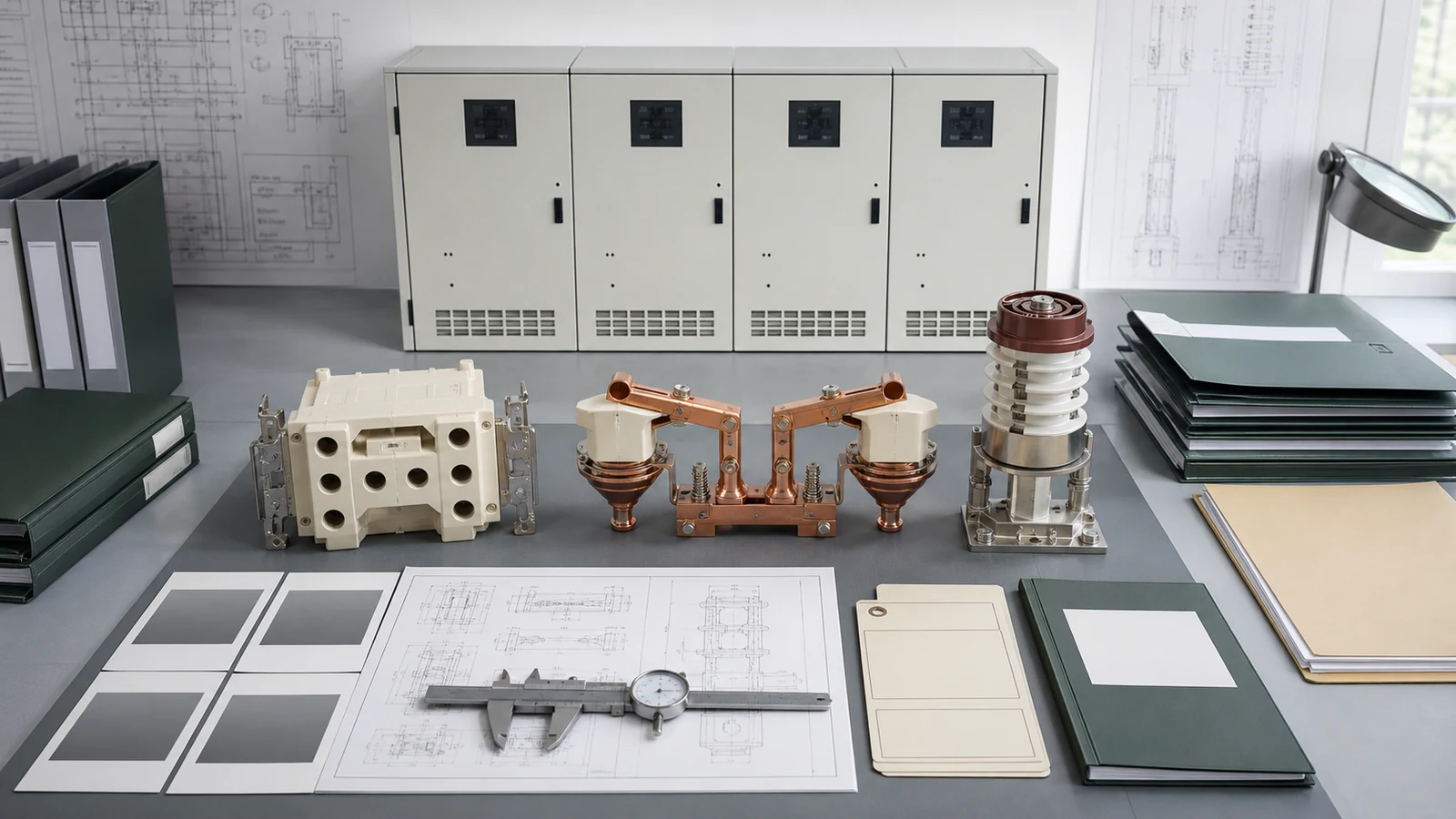
All images are generated illustrative technical visualizations, not XIYA POWER parts, drawings, samples, factory, inspection, FAT, installation, commissioning, operation, maintenance, failure, incident, or field photographs.
By Candy Zhao, Sales Director at XIYA POWER.
Replacement switchgear components procurement cannot rely on resemblance, a reused model name, one drawing or one measured sample. A buyer needs the as-found equipment identity, an applicable drawing/configuration basis, bounded sample evidence, ratings and materials, planned validation layers, deviations and a named purchase-release authority. Each source answers a different compatibility question; none proves universal interchangeability by itself.
Start with one selection matrix so every required input, decision, evidence source and hold condition remains traceable.
| Gate | Required input | Decision | Evidence source | Hold condition |
|---|---|---|---|---|
| As-found identity | Cabinet/bay, breaker or mechanism, circuit role, part position, marks, history | Which installed configuration is being matched? | Owner records, nameplates, controlled photos | Equipment or part identity is ambiguous |
| Drawing/configuration | Assembly and part drawings, revisions/status, datum, interfaces, tolerances | Which source defines each interface? | Approved register and drawing set | Revision or applicability is unconfirmed |
| Sample/measurement | Retained sample identity/condition, method, calibrated tools, repeated readings | Which sample observations remain reliable? | As-found and measurement records | Wear or method obscures the original state |
| Rating/material | Duty, insulation, conductor/resin, plating, hardware, control/sealing, service inputs | Which exact characteristics must match? | Project specification, manufacturer data, short-circuit study | Any characteristic lacks an adopted basis |
| Compatibility/validation | Comparison, gauge, material, bench, assembly and equipment-level plan | What can each validation layer prove? | Approved validation plan and records | Evidence scope or owner is missing |
| Purchase/release | Supplier return, deviations, evidence applicability, incoming plan, authority | Is one defined candidate ready for purchase release? | Data pack and technical approval | A prior hold remains open |
The Switchgear Components range routes replacement inquiries by cabinet position and function across insulation, current-path, mechanism/control, cabinet, vacuum and protection groups. That component-category structure narrows the search; it does not certify a replacement.
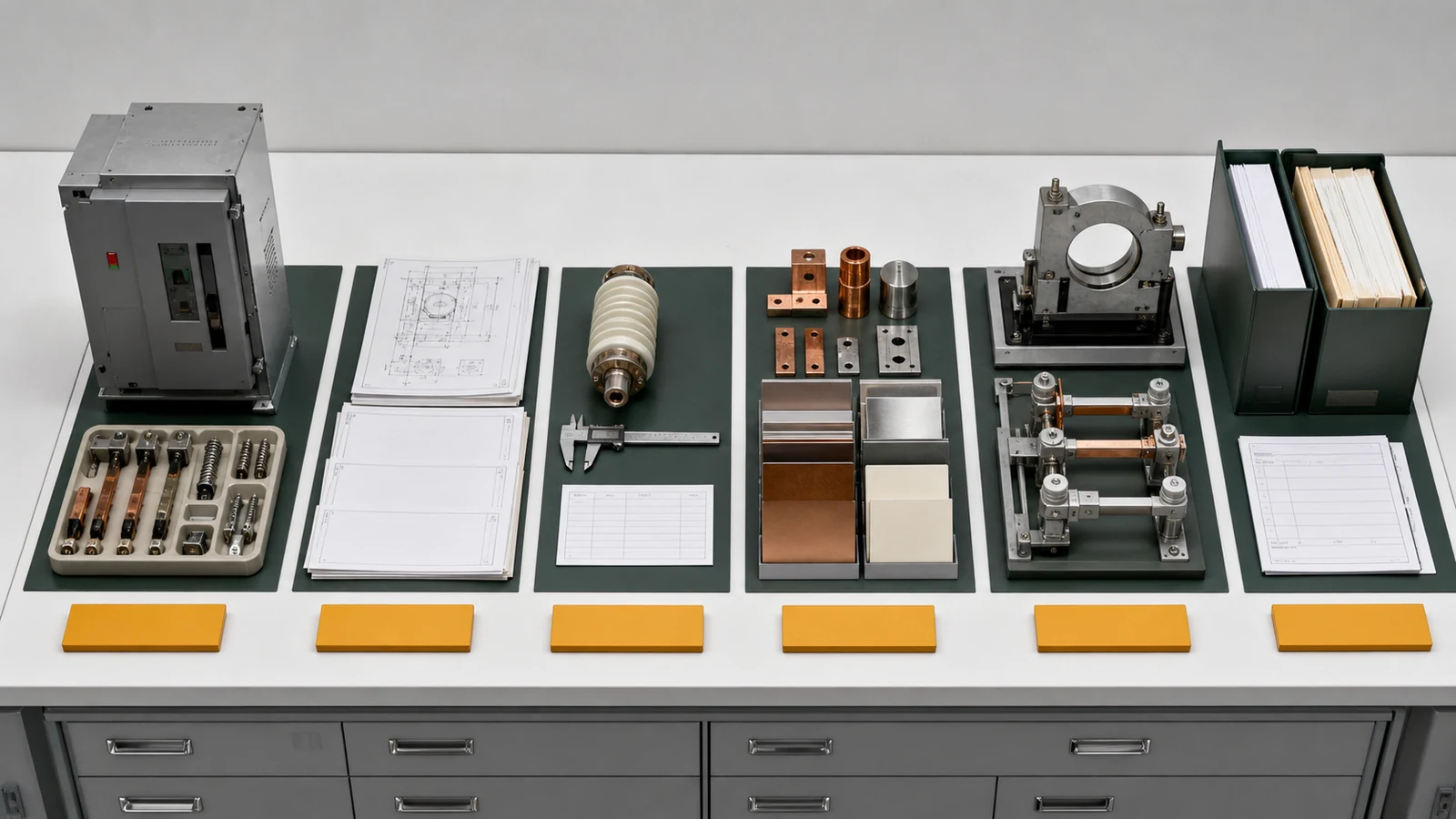
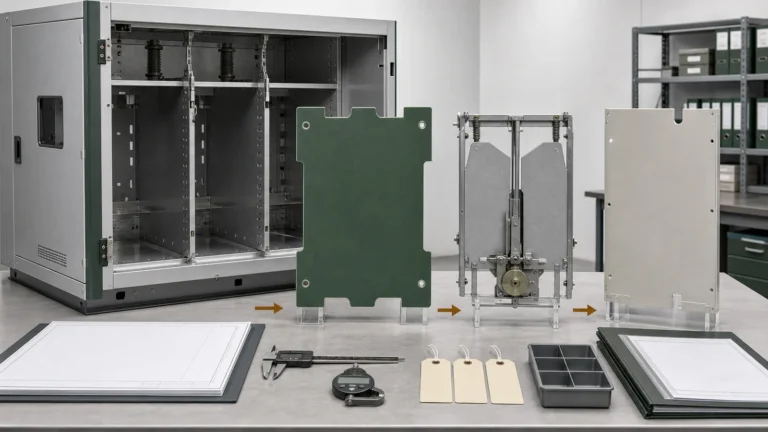
Illustrative technical visualization: exactly six amber procurement gates remain independent, with no selected or compatible replacement.
Record the cabinet designation and bay, breaker or mechanism model, serial/manufacture state where available, circuit role, exact part location and orientation, old marks, nameplate, removal context and known alteration history. Capture the part and its surrounding interface before cleaning, repair or separation changes the evidence. Photographs need an owner, date, view and scale reference; they identify visible features, not hidden ratings or materials.
Connect the installed part to the equipment records. The original assembly drawing, part drawing, breaker/mechanism record and later modification package may describe different states. State which revision was applicable at installation, which is current, and whether a retrofit or undocumented repair changed the cabinet. If those records conflict, preserve the conflict as a hold instead of choosing the most convenient document.
A supplier also needs the current project context: system/equipment voltage, current and fault-duty basis where relevant, service environment, operating/control function, quantity, destination requirements, and whether the request covers an identical replacement, an engineered substitute, or only a family-identification review. Do not infer a part’s duty from cabinet appearance.
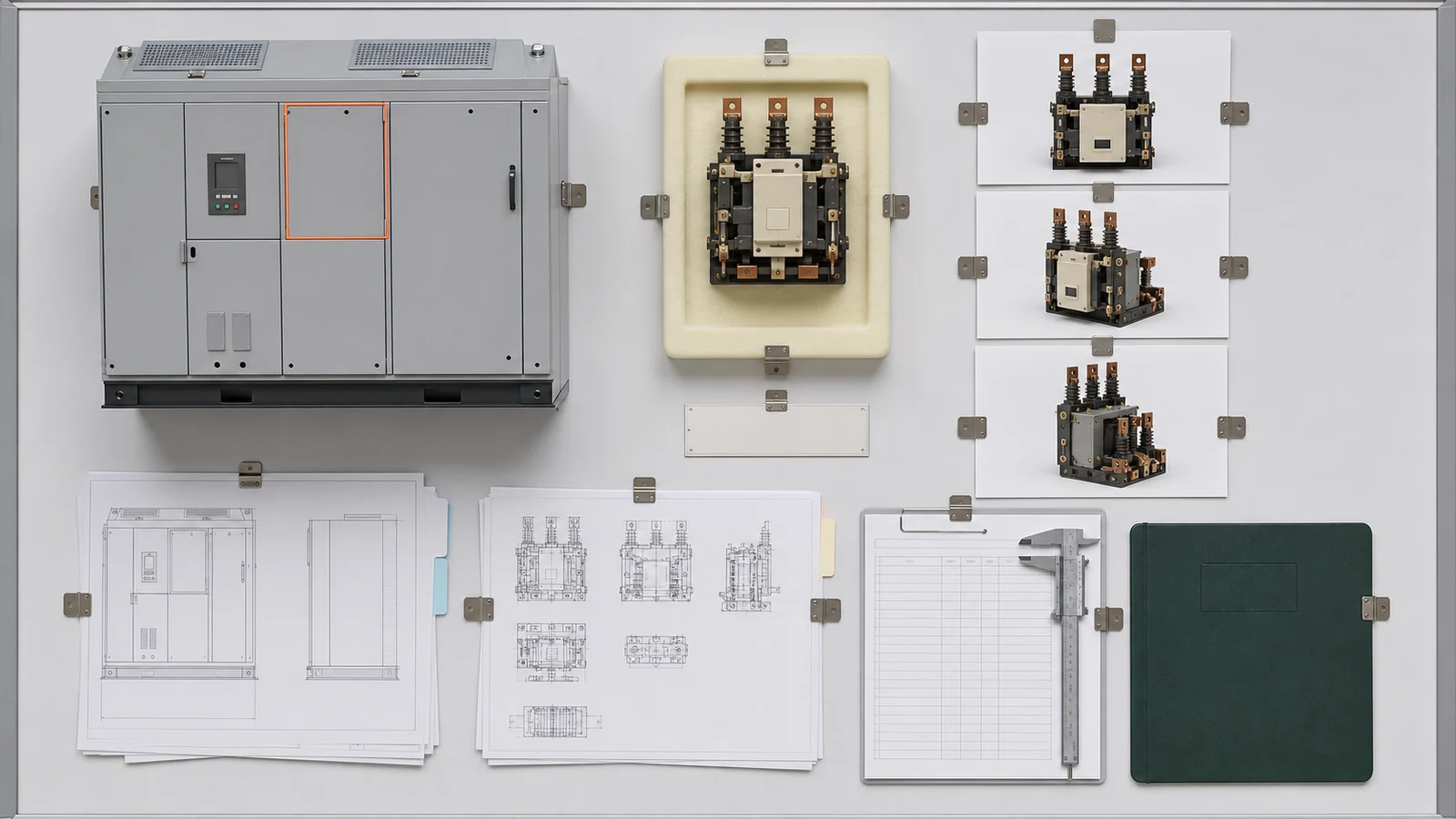
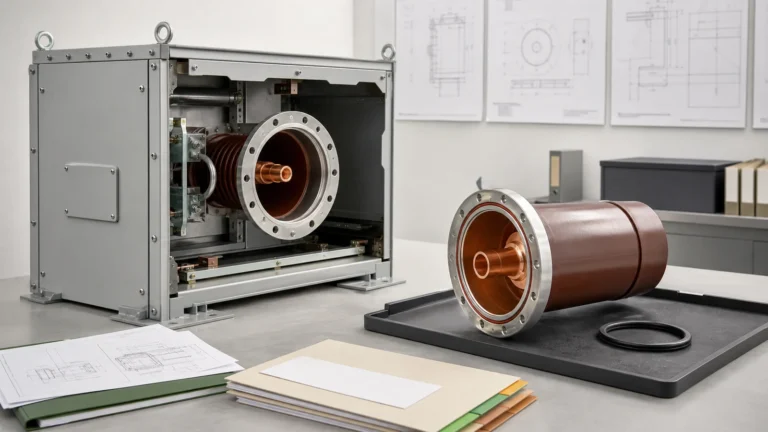
Illustrative technical visualization: cabinet position, old part, marks, photos, drawing revisions and measurement records form one as-found pack without a compatibility claim.
An applicable drawing needs a number, revision, approval status and configuration relationship. Record the assembly-to-part datum, mounting centers, hole pattern, bores, terminals, conductor direction, mating geometry, travel or clearance envelope and tolerances that actually control the interface. Supplier drawings should identify returned values and deviations against the buyer’s controlled source rather than present a stand-alone outline.
A retained sample is useful only within its recorded condition. Identify its source cabinet, removal date, part mark and as-found wear, deformation, corrosion, contamination or repair. Use a defined measurement method, calibrated instrument and repeated readings where appropriate. A worn contact, compressed spring, distorted resin part or drilled mounting hole may no longer represent the original manufactured value. Measurements document the sample; they do not automatically create the design master.
Separate observed and specified characteristics. A photograph can show shape, orientation and visible damage. A measurement can show the current geometry at stated points. Drawings can define intended dimensions and tolerances when their applicability is approved. Material, resin, plating thickness, spring properties, vacuum-interrupter performance or control-voltage suitability require their own records and evidence.
The official public page for IEC 62271-1:2017+AMD1:2021 covers common specifications for AC switchgear and controlgear above 1,000 V, for indoor or outdoor installation, at service frequencies up to and including 60 Hz, except where particular standards specify otherwise. That hierarchy does not identify an old part, set replacement dimensions or declare interchangeability. Particular equipment standards, project specifications, approved drawings, manufacturer data and responsible technical review govern the candidate.
Use a family matrix before deciding which part-specific records are required.
| Family | Interface focus | Rating/material focus | Validation boundary |
|---|---|---|---|
| Insulation parts | Mounting, bore/conductor, flange, creepage geometry, live/earthed clearances | Voltage/insulation basis, resin/material, embedded inserts, environment | Visual similarity cannot prove dielectric or mechanical suitability |
| Current-path contacts | Mating diameter, engagement, terminal, alignment, spring/contact geometry | Current/fault duty, conductor, plating, spring and hardware | Sample fit cannot prove contact force, resistance or thermal performance |
| Mechanism/control parts | Shaft/linkage, mounting, travel envelope, terminals, pinout | Control voltage, polarity, coil/contact duty, spring/latch material | Bench motion does not prove cabinet interlocks or timing |
| Vacuum/protection parts | Pole centers, terminals, drive/linkage and insulation boundaries | Voltage, current, interruption duty, mechanism and evidence applicability | Rating marks do not prove mechanism or interruption compatibility |
| Barriers/cabinet fittings | Cutout, mounting, shutter/barrier movement, retention and clearances | Insulation role, material/coating, environmental and hardware inputs | Free movement outside the cabinet does not prove installed function |
The contact arm, tulip and fixed-contact guide owns detailed engagement, plating and fit inputs. The vacuum-pole replacement guide owns mechanism, stroke, contact-force and interruption-evidence inputs. This page keeps those family checks inside a multi-part purchasing package without replacing their technical detail.
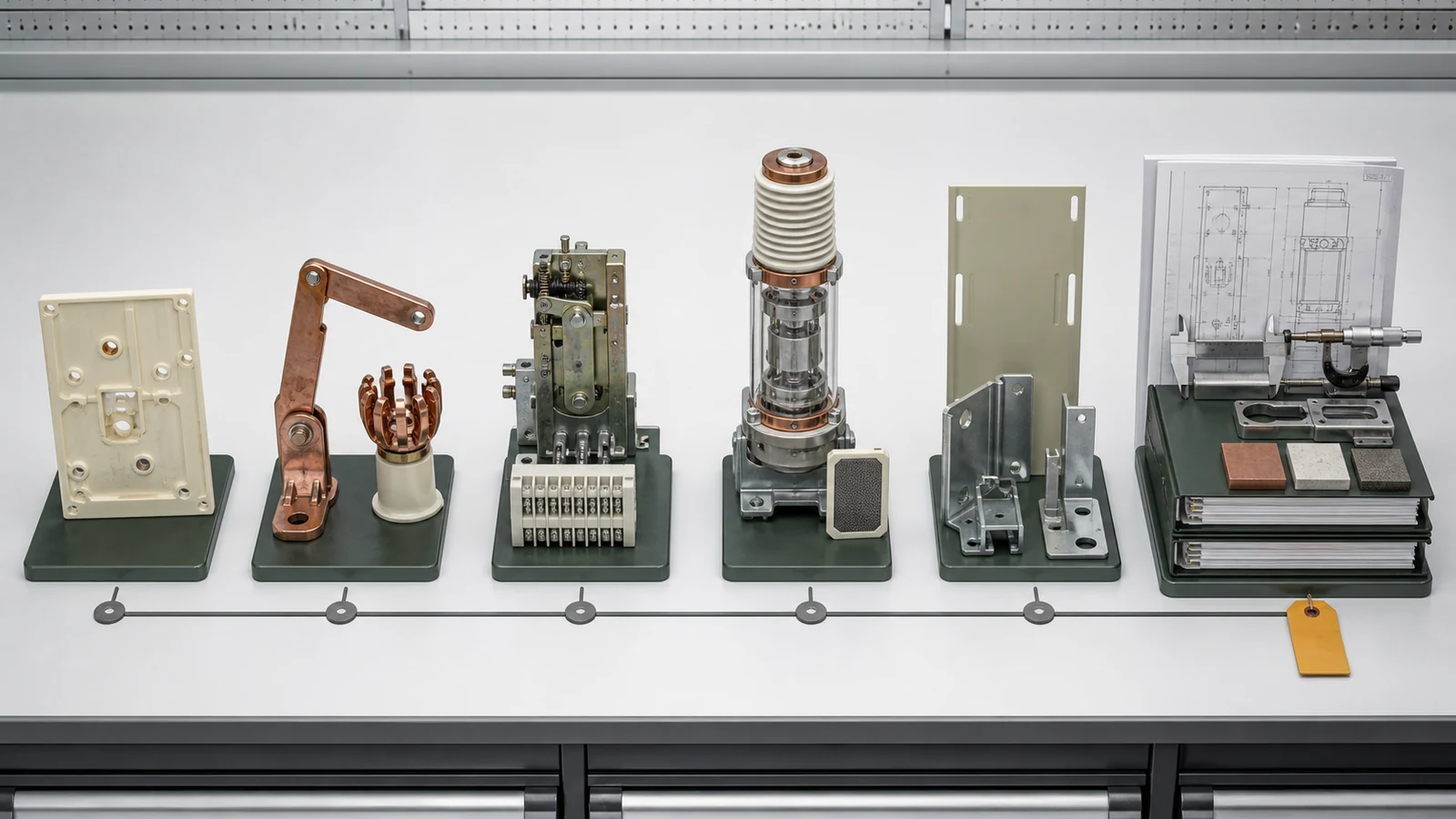
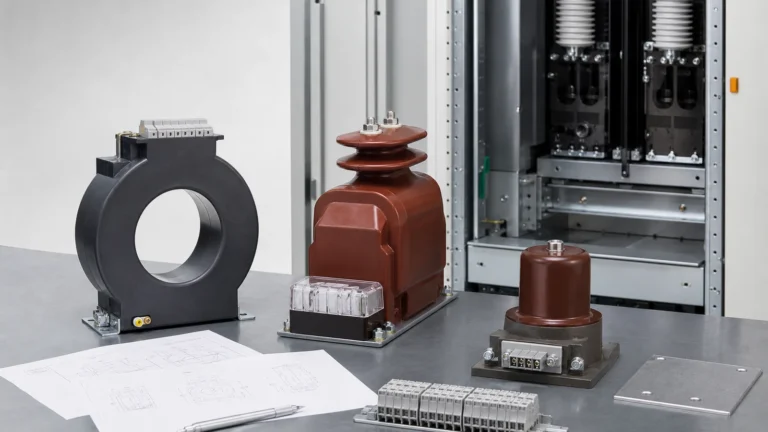
Illustrative technical visualization: insulation, current-path, mechanism/control, vacuum/protection and cabinet-part reviews connect to validation records without a pass state.
Define applicable validation layers and their limits before requesting a firm candidate.
| Layer | Can establish | Cannot establish alone |
|---|---|---|
| Drawing comparison | Revision relationship, intended dimensions/interfaces and declared deviations | Physical conformance or installed performance |
| Sample comparison | Visible family/features and as-found differences | Original design, rating, material or tolerance |
| Dimensional/gauge check | Measured conformance to an approved characteristic | Thermal, dielectric, fault or long-term performance |
| Material/certificate review | Declared material/plating and traceability within its scope | Interface fit or complete-equipment performance |
| Approved bench check | Defined observations under the recorded fixture/method | Cabinet interlocks, wiring, timing or system duty outside that scope |
| Assembly/interface verification | Fit, alignment, mounting, connection and defined mechanical or electrical interfaces in the approved assembly | Complete-equipment performance, project duty or any characteristic outside the interface check |
| Complete-equipment/project test | Defined equipment functions or performance under the approved configuration, method and test conditions | Untested configurations, service conditions, system duty or performance outside the approved test scope |
The RFQ checklist should request the supplier’s part identity, configuration-applicable drawing, rating/material schedule, dimensional return, deviations, certificate/evidence mapping, sample proposal if used, validation responsibility, inspection/test plan and incoming requirements. A purchase data pack retains all inputs, open/closed decisions and the named technical authority. Commercial price and availability do not close technical holds.
After delivery, the component acceptance checklist owns lot identity, condition, document revision, incoming dimensions/checks, traceability, nonconformance and disposition. Assembly and complete-equipment checks remain separate from both purchase release and incoming acceptance. Send controlled drawings, sample records and missing-data questions through the XIYA POWER contact page.
Invented representative procurement review for method demonstration only. It is not a XIYA POWER customer, supplier, quotation, order, design, drawing, sample approval, compatibility declaration, type test, factory, inspection, FAT, installation, commissioning, operation, maintenance, failure, incident, or field case. Every identity, rating, quantity, dimension, revision, measurement, material, and returned detail below is fictional and non-universal.
This representative engineering review uses an invented 12 kV-class indoor withdrawable cabinet and three candidate families: one epoxy contact box, one copper contact arm/contact set and one vacuum pole assembly. Fictional old records reference cabinet drawing revision C and breaker drawing revision D; candidate component drawings state revision B without an approved cross-reference.
The retained contact-box sample has fictional measured mounting centers of 210 mm, while the candidate drawing states 208 mm. The old contact-arm sample has a fictional M10 terminal and the candidate return states M12. Wear, deformation and an unverified method mean no sample value is treated as a design master. The fictional current-path mark states 1,250 A. A vacuum-pole candidate return states 12 kV and 31.5 kA, but mechanism model, stroke/travel, contact-force basis, terminal direction and applicable interruption evidence are incomplete. No value or candidate is accepted.
| Open hold | Invented gap | Evidence required before decision |
|---|---|---|
| Identity/configuration | Cabinet, bay, breaker/mechanism, circuit role, position, alteration history and applicable drawings are not reconciled | Controlled as-found pack and configuration record |
| Drawing/sample/interface | B/C/D revisions, 210/208 mm centers, M10/M12 terminals, datum, tolerances, wear and method remain unresolved | Approved cross-reference, interface drawing and measurement record |
| Rating/material | 12 kV, 1,250 A, 31.5 kA, resin, conductor/plating, hardware, mechanism and service inputs lack one adopted basis | Project specification, manufacturer data and applicable evidence |
| Validation/release | Supplier evidence, sample status, gauge/bench/assembly/equipment plans, deviations, incoming plan and authority are incomplete | Approved validation/data pack and named release |
All four holds remain open. No candidate, drawing, sample, dimension, material, rating, compatibility, compliance, validation, order, installation, commissioning, operation, failure or field outcome is selected or claimed. Missing evidence records an open decision; it does not prove incompatibility or failure.
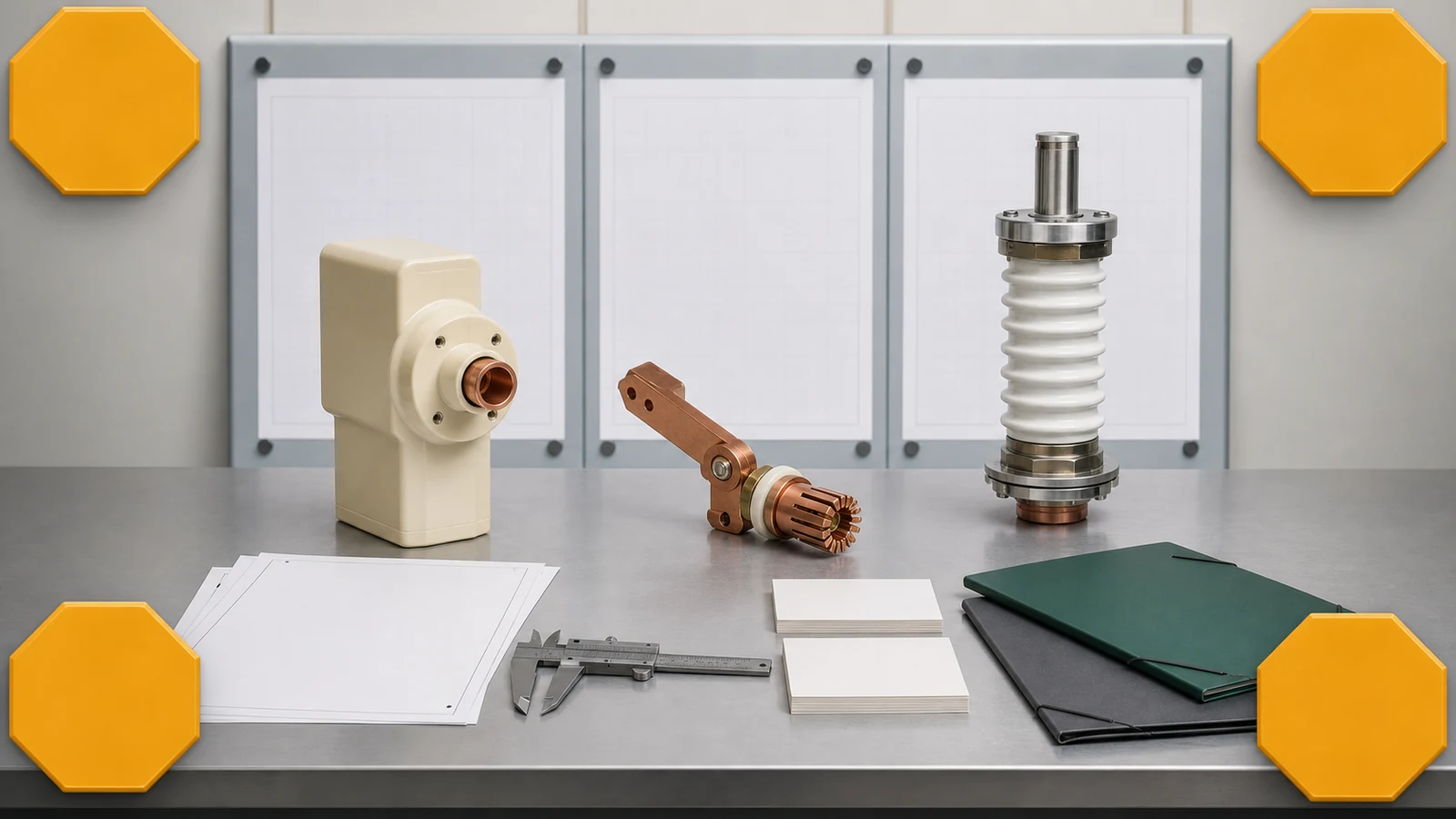
Illustrative technical visualization: an invented three-part replacement review has exactly four amber holds, with no accepted candidate, compatibility or release state.
Send the cabinet/bay and breaker/mechanism identity, part position and orientation, old marks/nameplate, controlled photos, alteration history, applicable assembly and part drawings, sample condition and measurements, project ratings/material/interface requirements, quantity and required supplier evidence. Mark unknowns rather than replacing them with assumptions.
Not automatically. Record its identity and condition, then measure it with an approved method and calibrated equipment. Wear, deformation, corrosion or repair can change dimensions and properties. The sample supports family and feature comparison; the approved configuration and evidence must establish design requirements.
No. A designation may span revisions, materials or applications. Confirm the part number’s applicable drawing/revision, equipment configuration, interfaces, ratings, materials, mechanisms or control details, deviations and validation plan before any purchase-release decision.
Use the interface-control characteristics on applicable assembly and part drawings: mounting and datum features, bores, terminals, mating/engagement geometry, orientation, travel/clearance envelope and tolerances. The exact set changes by component family; one overall dimension is rarely sufficient.
Define the applicable drawing, sample, dimensional/gauge, material/certificate, approved bench, assembly/interface and equipment-level layers, with an owner, method, criterion and evidence for each. Purchase release requires a defined candidate and approved plan; it does not claim that later incoming, assembly or equipment checks have passed.
The delivered lot still needs incoming identity, revision, condition, dimensional or approved functional checks, traceability and disposition. The installed configuration may also require fit, wiring, interlock, adjustment and complete-equipment checks under approved project procedures. Purchase release, incoming acceptance and equipment release are separate decisions.