Quotation form
Send an inquiry
Start with the basics. Our team can follow up for missing drawings, standards or packing details.
Submitted details are used only for quotation, technical review and project communication.


All images are generated illustrative technical visualizations, not XIYA POWER factory, product, order, inspection, test, FAT, shipment, installation, commissioning, or field photographs.
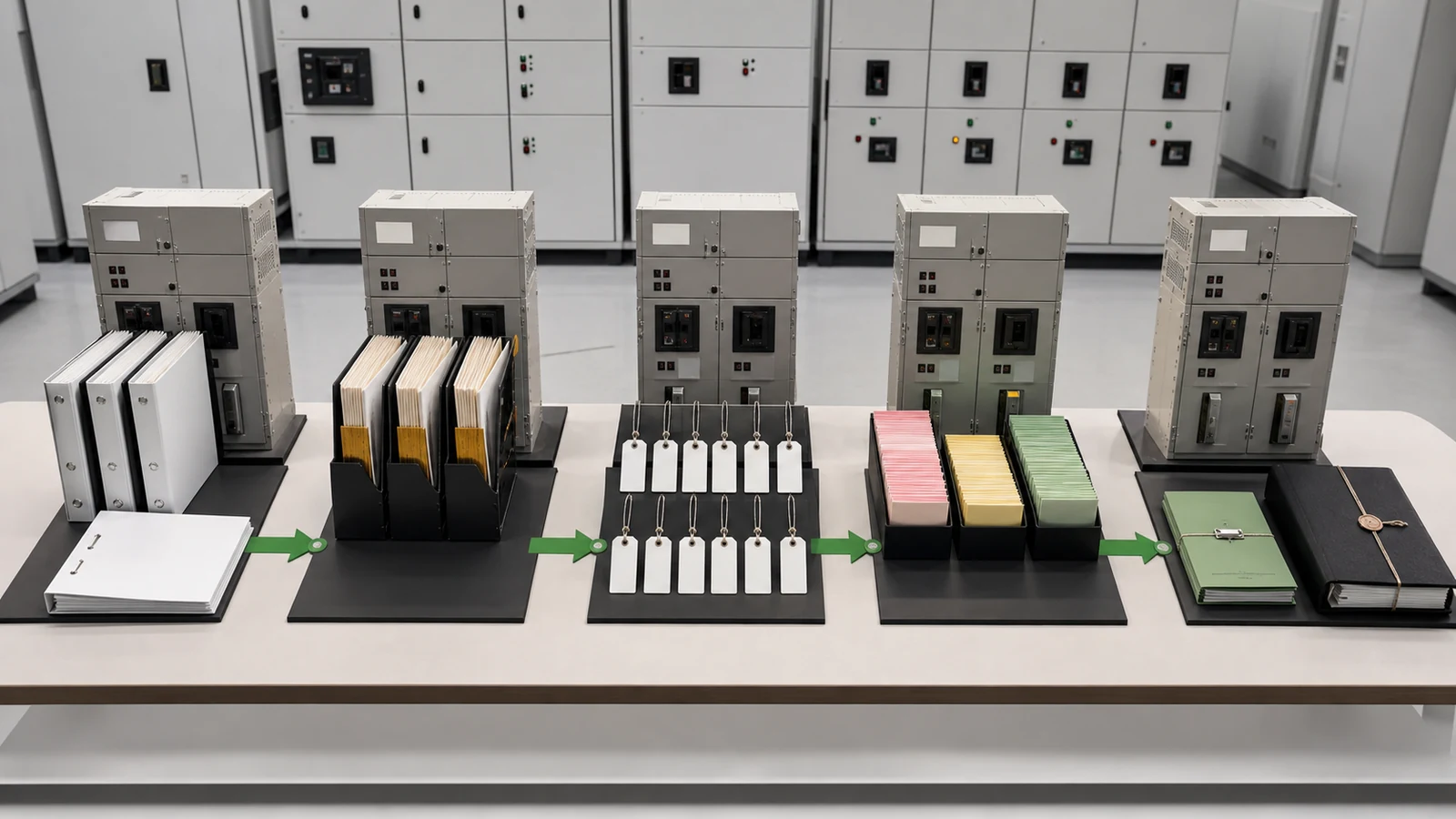
A usable switchgear FAT evidence pack is a controlled chain, not a folder of unrelated reports. It should map the agreed order basis and ITP to each panel’s original records, connect every deviation to disposition, correction, retest, and any required regression evidence, and finish with reconciled registers and an authorized release record. A missing link creates an evidence hold; it does not prove that equipment passed or failed.
Define the expected register before records begin to arrive. The buyer needs to know which requirement and ITP activity applies to each panel, which record should be returned, and which contract role can resolve a hold or authorize release. This structure turns separate files into auditable evidence.
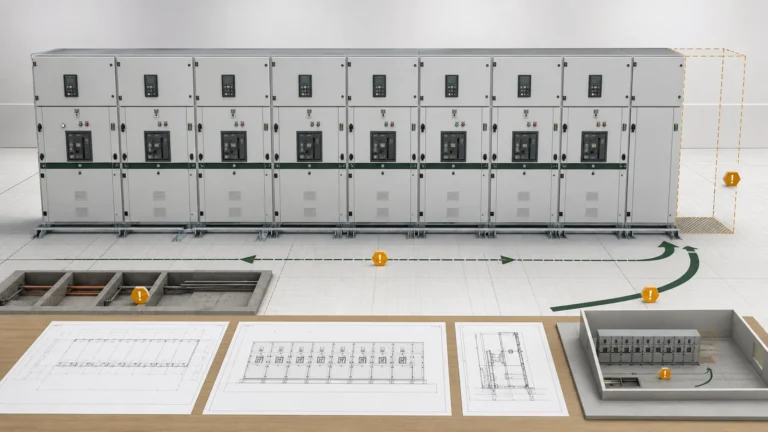
The complete switchgear cabinet scope separates approved drawings from inspection and delivery records. The basic switchgear FAT guide owns the inspection sequence; this guide starts with the returned evidence and the release decision.
Use this selection matrix to define each gate.
| Evidence gate | Required input | Release evidence | Decision |
|---|---|---|---|
| Order basis | Purchase order, project specification, agreed deviations, drawings, FAT procedure, accepted ITP | Controlled list of applicable requirements and revisions | Basis complete or return for resolution |
| Coverage | ITP activity list, panel register, expected-record index | Every required activity and panel maps to a returned record | Coverage clear or hold |
| Traceability | Panel IDs, report IDs, revisions, requirement and instrument references | Identifiers reconcile across the pack | Traceability clear or hold |
| Closure | Findings, dispositions, corrections, retests, regression scope | Every item has a complete linked chain or accepted exception | Closure clear or hold |
| Release | Hold points, punch and deviation registers, final index | Reconciled registers and authorized release note | Technical release or hold |
These are independent gates. A complete report count cannot compensate for an identifier mismatch, and a closed deviation cannot compensate for an unsigned release record.
A filename is not traceability. A reviewer should be able to move from an order or specification requirement to the accepted ITP item, the affected panel or lineup, the original controlled record, and the current review status without relying on email history.
The switchgear inspection and test plan guide owns ITP planning and hold, witness, and review-point design. The evidence pack consumes that accepted plan. It should not silently change its activities, responsibilities, or acceptance basis after records are returned.
For every expected record, capture:
The official page for IEC 62271-200:2021+AMD1:2024 CSV identifies the consolidated publication’s public scope as prefabricated metal-enclosed AC switchgear and controlgear above 1 kV and up to and including 52 kV. It covers equipment intended for indoor or outdoor installation. That scope can identify the equipment category in the order basis. The public page is not a project FAT template and does not supply project acceptance thresholds or release authority.
| Mapping point | Evidence to reconcile | Hold trigger |
|---|---|---|
| Requirement | Controlled requirement and revision | Acceptance basis is unclear |
| ITP activity | Accepted item ID and revision | Returned record does not map to agreed scope |
| Equipment identity | Panel or lineup ID | Record may relate to another unit |
| Original record | Report ID, revision, required authorization | Record is uncontrolled or incomplete |
| Measurement traceability | Report instrument ID and register entry | Identifier cannot be reconciled |
| Review status | Returned, absent, or pending reconciliation | Evidence decision remains open |
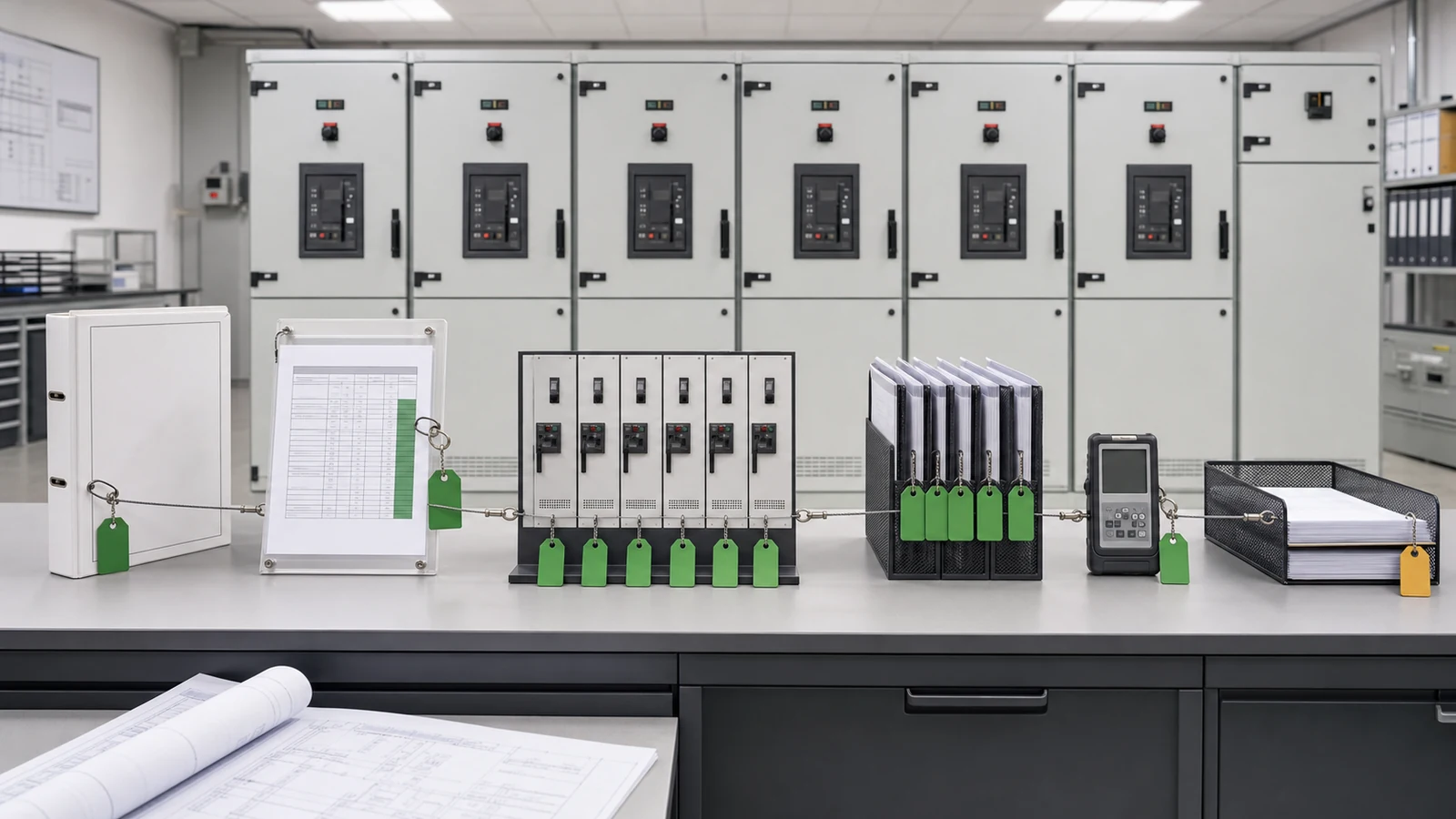
An absent record does not establish that an activity was omitted. It establishes only that the returned data pack cannot yet support the corresponding evidence decision.
A deviation or NCR begins a chain. It should identify the affected panel and requirement, record the approved disposition, link the correction evidence, identify the required retest scope, address regression where the correction may affect repeated or adjacent assemblies, and carry an authorized closure status.
The pack should not treat a correction note as closure by itself. If the disposition covers several panels, each affected identity needs linked evidence or a documented reason for exclusion. If a correction could influence another check, the agreed regression scope should state what evidence is required. This is document control, not a test-method prescription.
The insulation-resistance and withstand-voltage test guide owns the distinction between those electrical tests. The evidence reviewer records which approved activity was required and whether its controlled record was returned; this article does not repeat procedures, values, or thresholds.
| Chain step | Required evidence | Open state |
|---|---|---|
| Finding | Unique ID, panel scope, requirement reference | Finding cannot be traced |
| Disposition | Approved resolution path and authority | No agreed basis for correction |
| Correction | Record linked to the same finding ID | Disposition has no returned correction evidence |
| Retest | Linked record for the affected scope | Correction has no returned retest evidence |
| Regression | Defined scope and linked records where applicable | Related scope is undocumented |
| Closure | Reconciled status and authorized closure | Chain remains open |
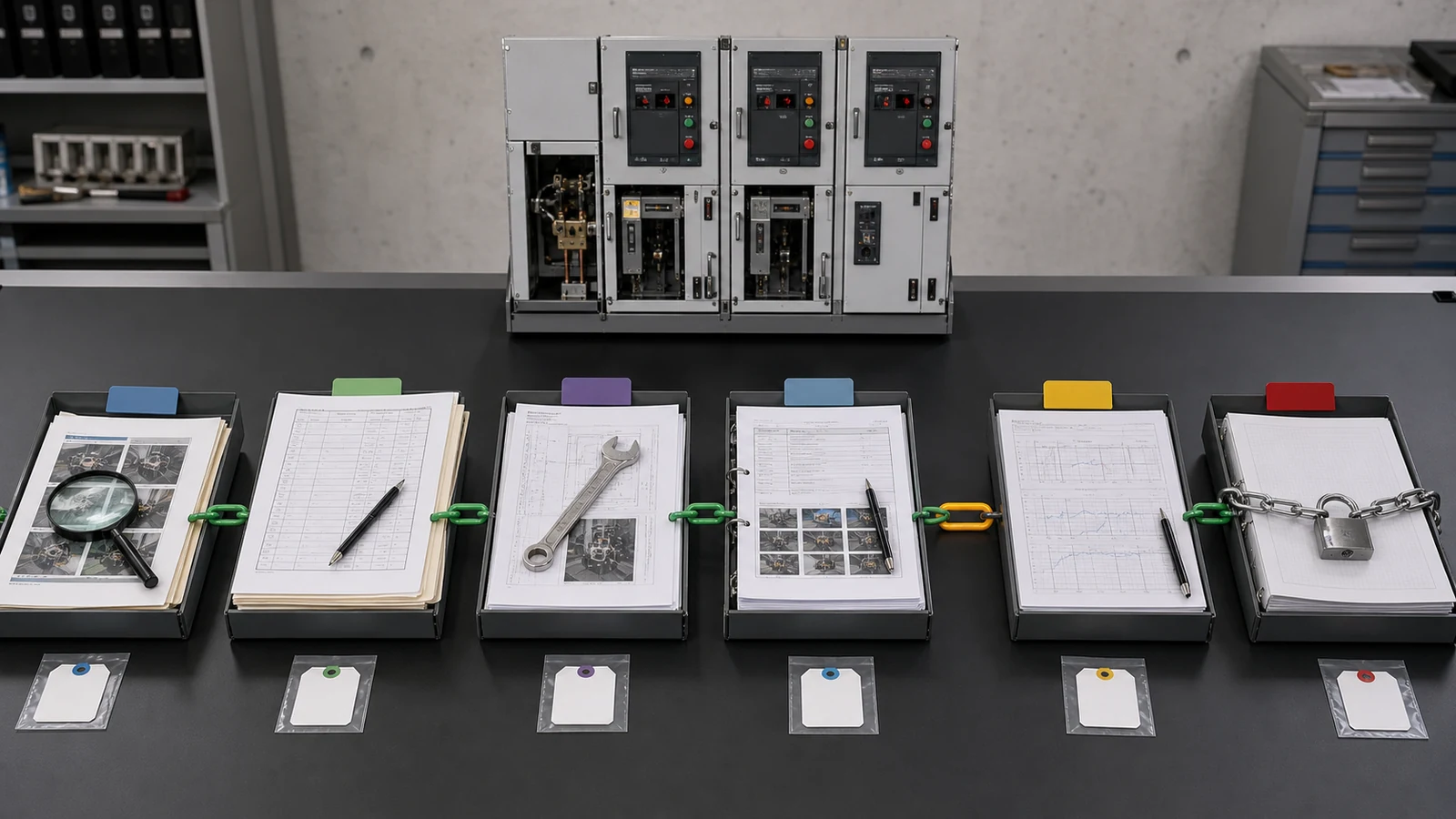
Keep evidence status separate from equipment status. An absent retest link means the evidence chain is incomplete. It does not, by itself, mean the equipment failed or that no activity occurred.
The final index should list every required record, its current revision, its equipment identity, and its return status. It should cross-reference the punch and deviation registers so that each item can be followed in both directions. A simple file list is insufficient because it does not show coverage, reconciliation, or authority.
Accepted exceptions must be explicit. The release note should identify the item, acceptance basis, responsible role, closure condition, and any agreed timing. An omitted record is not an accepted exception. It remains an evidence hold until the contractually authorized roles resolve or formally accept it.
Where the order basis includes an internal-arc requirement, the index should trace the released requirement to the controlled evidence identified for that project. The switchgear internal-arc classification guide owns AFL and AFLR selection; this evidence-pack review does not repeat that decision.
The release record should identify the lineup and revision state, unresolved or accepted items, scope of release, and authorized roles. Technical release authority comes from the contract and accepted procedure, not from this article, a report count, or one individual document.
The buyer’s review has three practical checkpoints.
RFQ checklist
Data pack return checklist
Technical release checklist
This selection matrix approach keeps the review focused on evidence. It gives procurement and engineering teams a repeatable handover test without re-performing inspections or interpreting raw measurements outside their assigned roles. The representative engineering review below demonstrates that logic with disclosed synthetic values.
Representative engineering review, entirely synthetic, illustrative, and non-universal. This is not a XIYA POWER customer, supplier, factory, product, order, inspection, test, FAT, shipment, installation, commissioning, or field case. No compliance, acceptance, technical release, or result is claimed.
Synthetic candidate-pack inputs: one 24 kV-class metal-clad lineup; eight panels identified P01 through P08; candidate FAT procedure revision D; and candidate ITP revision C. The candidate baseline index expects 34 planned inspection, routine, and as-built deliverable entries, while the candidate return lists 31. This 34-to-31 comparison excludes conditional deviation, retest, regression, hold-point, and release artifacts, which are reviewed separately.
Synthetic returned evidence state: within the baseline comparison, no routine report is mapped to P06, a final as-built index entry is absent, and one further expected entry has no mapped return status. One report reference cites instrument EQ-27 while the candidate calibration register lists EQ-72. Synthetic deviation DV-03 concerns an auxiliary MCB replacement identified for P03 and P04; the candidate pack contains disposition and correction records and a linked retest entry for P03, but no linked P04 retest entry or referenced regression scope. Final ITP hold H-09 is unsigned, the punch and deviation closure register is unreconciled, and no final release note is returned.
All counts, voltage class, revisions, panel IDs, instrument IDs, deviation IDs, omissions, and hold states in this table are synthetic. They do not show that an inspection, correction, replacement, test, retest, shipment, or release occurred.
| Evidence gate | Synthetic observation | Decision |
|---|---|---|
| Coverage | P06 routine-report mapping and final as-built index entry are absent; one further baseline entry has no mapped return status | Hold coverage; do not infer whether an underlying activity occurred |
| Traceability | EQ-27 on one report reference does not reconcile with EQ-72 in the candidate register | Hold traceability; do not infer calibration validity or actual use |
| Deviation and retest | DV-03 has candidate disposition and correction records, but P04 retest linkage and regression scope are absent | Hold the chain; do not infer whether replacement or testing occurred |
| Release | H-09 is unsigned, closure registers are unreconciled, and the release note is absent | Hold release; do not infer a shipment decision or outcome |

Each hold is independent. Reconciliation of the instrument identifier would not supply the missing P06 mapping. A completed deviation chain would not sign H-09 or create a release note. The example therefore preserves realistic evidence detail without presenting synthetic values as factory experience.
It should contain the controlled order basis, accepted FAT procedure and ITP, equipment and document registers, original inspection or routine reports, applicable instrument traceability, deviation and punch chains, retest and regression evidence where required, resolved hold points, final index, accepted exceptions, and authorized release record. The exact deliverables remain contract-specific.
No. Reports support individual activities, while release also requires complete coverage, reconciled identities and revisions, closed or accepted deviations, resolved hold points, and an authorized release record. A report set can be complete in one area while another evidence gate remains open.
Use one unique deviation ID across the finding, disposition, correction, affected-panel retest records, regression scope where applicable, and closure entry. The reviewer should not have to infer a link from dates, filenames, or similar wording.
Where measurement traceability is required, the report should identify the instrument so it can be reconciled with the controlled calibration register or required supporting record. A mismatch creates a traceability hold; it does not establish expiry, invalidity, or actual use.
Only when the contractually authorized roles accept them as documented exceptions. The release record should identify each item, acceptance basis, responsible role, closure condition, and any agreed timing. An unlisted open item remains an unresolved evidence hold.
The contract and accepted FAT procedure define the required authorization roles, which may differ by project. The evidence pack should name those roles and retain their required approvals. This guide does not assign release authority to a manufacturer, buyer, inspector, or third party.