Quotation form
Send an inquiry
Start with the basics. Our team can follow up for missing drawings, standards or packing details.
Submitted details are used only for quotation, technical review and project communication.

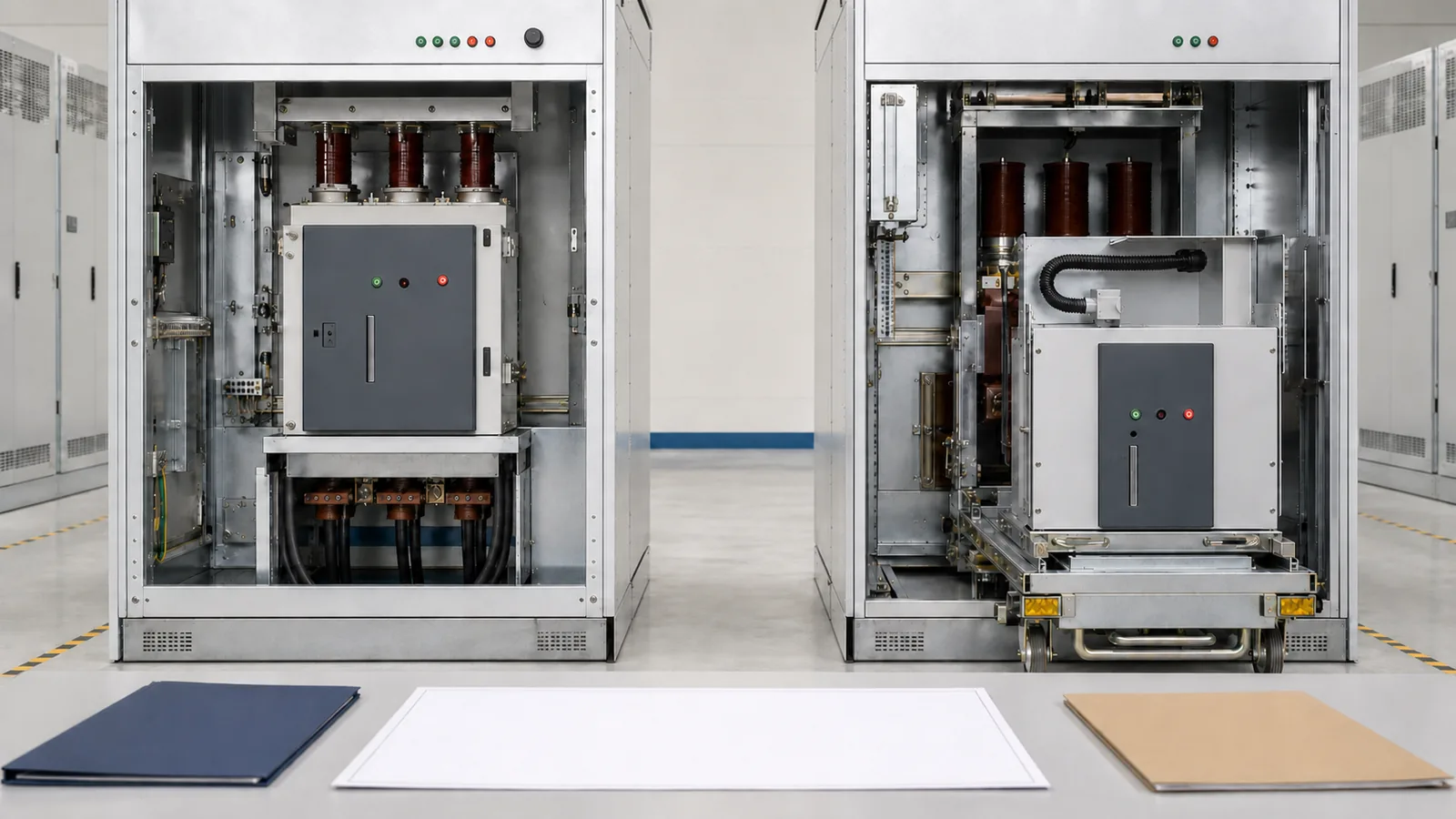
The xgn vs kyn28 switchgear decision is not settled by choosing fixed or withdrawable equipment in isolation. An XGN fixed-type offer places the primary switching device in a fixed cabinet arrangement; a KYN28 offer adds a withdrawable breaker truck, declared operating positions, shutters, interlocks, and a handling route. The correct fit depends on the one-line, bay schedule, room, access rules, maintenance philosophy, feeder criticality, spare strategy, civil interfaces, required classifications, and evidence for the exact offered assembly.
Use the broader RMU versus metal-clad versus fixed-type architecture comparison before narrowing the decision to these two cabinet families. CAB-05 does not compare every MV architecture. It asks whether the fixed-device intervention boundary or the withdrawable-truck workflow better matches one defined project.
For XGN, require the compartment arrangement, fixed-device access route, isolation and earthing interfaces, cable zone, front/rear access, extension provision, and maintenance boundary. For KYN28, require the breaker-truck positions, shutters, control-plug states, racking and handling interface, interlocks, spare-truck compatibility, cable zone, and room envelope. A family name does not prove these details.
IEC 62271-200:2021 publicly covers prefabricated AC metal-enclosed switchgear and controlgear assemblies above 1 kV up to and including 52 kV, at service frequencies up to 60 Hz, for indoor or outdoor installation. Its public change summary notes a more precise description of loss-of-service-continuity categories. The purchased standard and project specification control clause-level requirements. Neither XGN nor KYN28 proves compliance, LSC category, partition class, or IAC rating without configuration-applicable evidence.
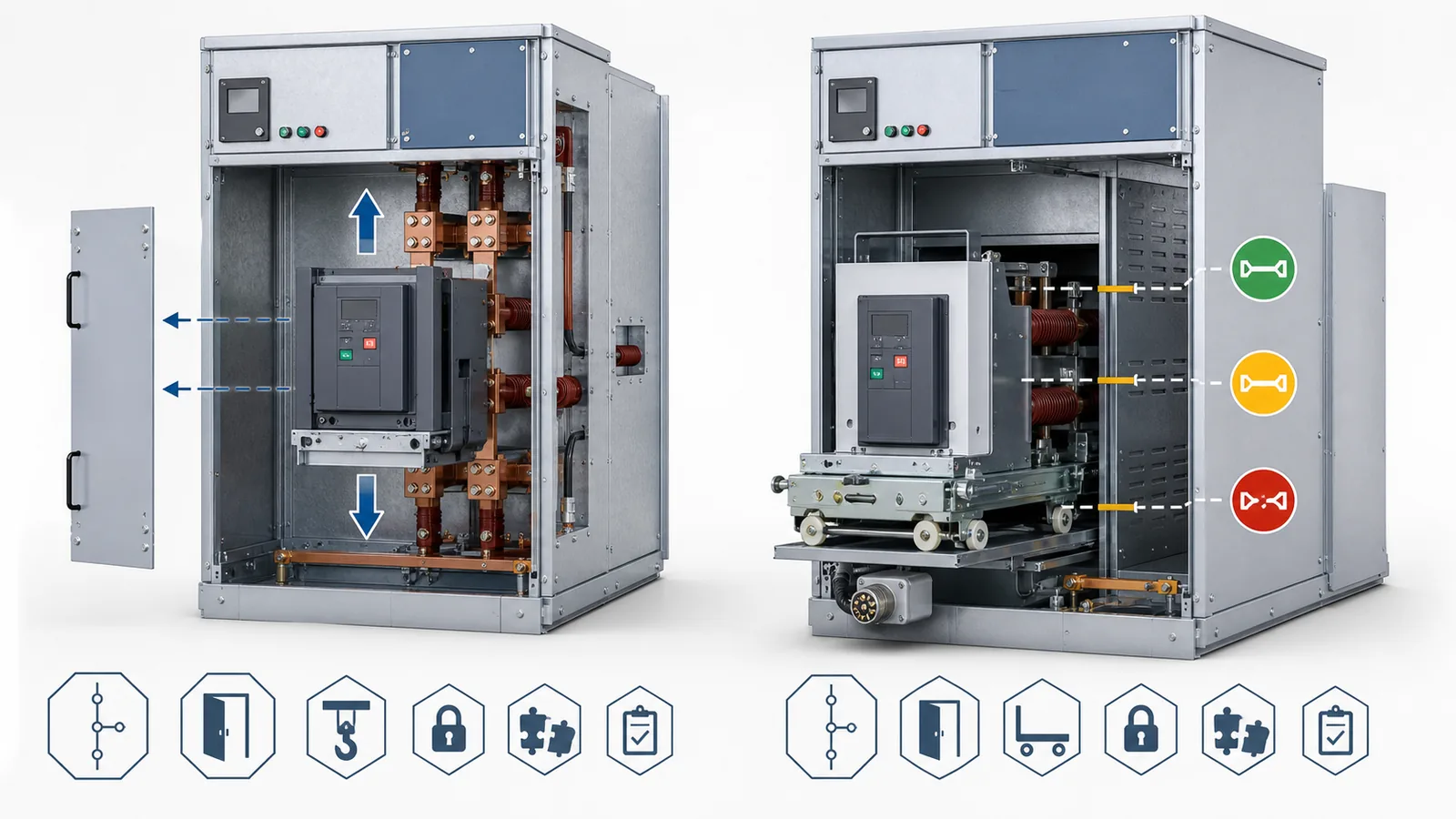
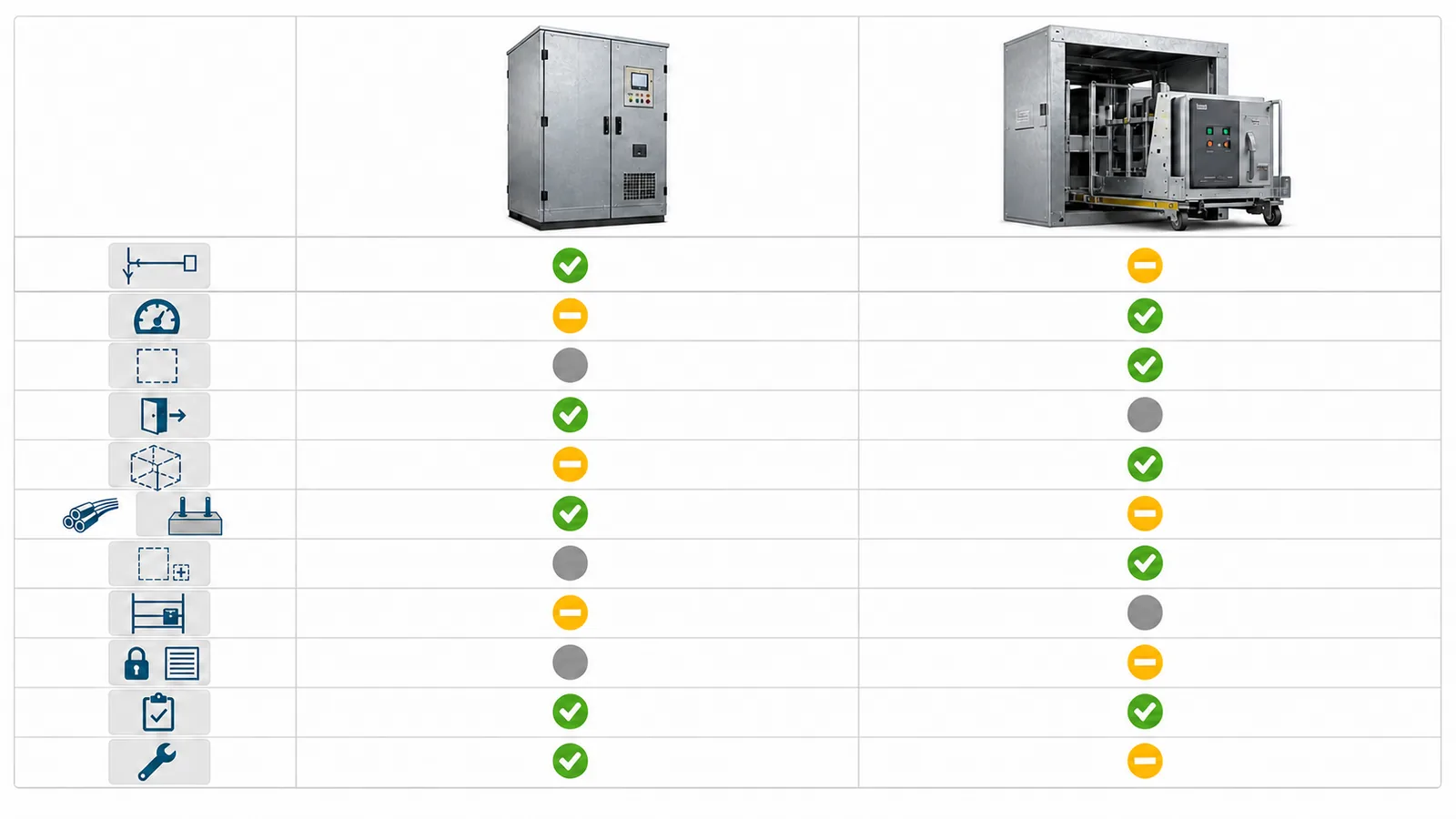
The following selection matrix converts architecture labels into project questions. Entries are typical review boundaries, not universal product characteristics.
| Review axis | XGN fixed-type route | KYN28 withdrawable route | Required supplier return |
|---|---|---|---|
| Primary switching device | Fixed in the offered cabinet arrangement | Withdrawable breaker truck where declared | Current path and compartment drawing |
| Operating and maintenance states | Device, disconnector, earthing, and access states depend on the offered design | Connected, test/service, and disconnected positions plus maintenance state where declared | State and interlock schedule |
| Device intervention | Fixed-device work may affect a defined compartment or adjacent service boundary | Truck removal may separate the breaker from the cabinet, but cabinet work boundaries remain | Maintenance-boundary statement |
| Handling and room space | Access route for fixed-device removal, tools, doors, and panels | Truck withdrawal, transfer trolley, door swing, turning, storage, and lifting route | Dimensioned room and handling envelope |
| Front/rear access | Project-specific; never infer front-only access from the name | Project-specific; truck access may be front while cable or bus work may require another boundary | Front/rear access declaration |
| Cable and foundation interface | Offered cable zone, CT position, gland plate, trench, and anchors | Offered cable zone, CT position, gland plate, trench, truck floor level, and anchors | Coordinated installation drawing |
| Extension and spare position | End interface and future fixed-device integration must be defined | End interface, future truck/bay design, and compatibility must be defined | Extension-end and spare-bay drawing |
| Spare strategy | Spare components or a replacement fixed device with a controlled intervention plan | Compatible spare breaker truck only after mechanical, electrical, control, and rating interfaces are proven | Compatibility and replacement basis |
| Classifications | Only as declared and evidenced for the exact arrangement | Only as declared and evidenced for the exact arrangement | Applicable LSC, partition, and IAC records where required |
| Hold condition | Missing access, intervention, extension, classification, or evidence return | Missing truck states, handling path, compatibility, classification, or evidence return | Open-item and deviation register |
Fixed does not automatically mean smaller, simpler, cheaper, less safe, or harder to maintain. Withdrawable does not automatically mean faster restoration, lower outage exposure, higher service continuity, interchangeability, or superior safety. Each claim must be tied to the final bay design and project operating philosophy.
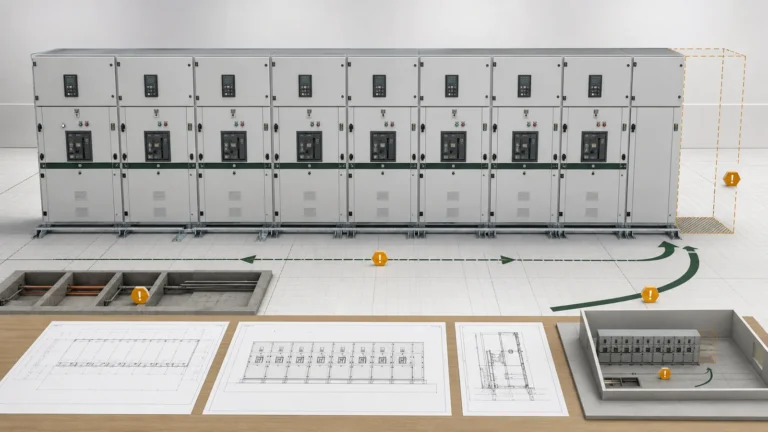
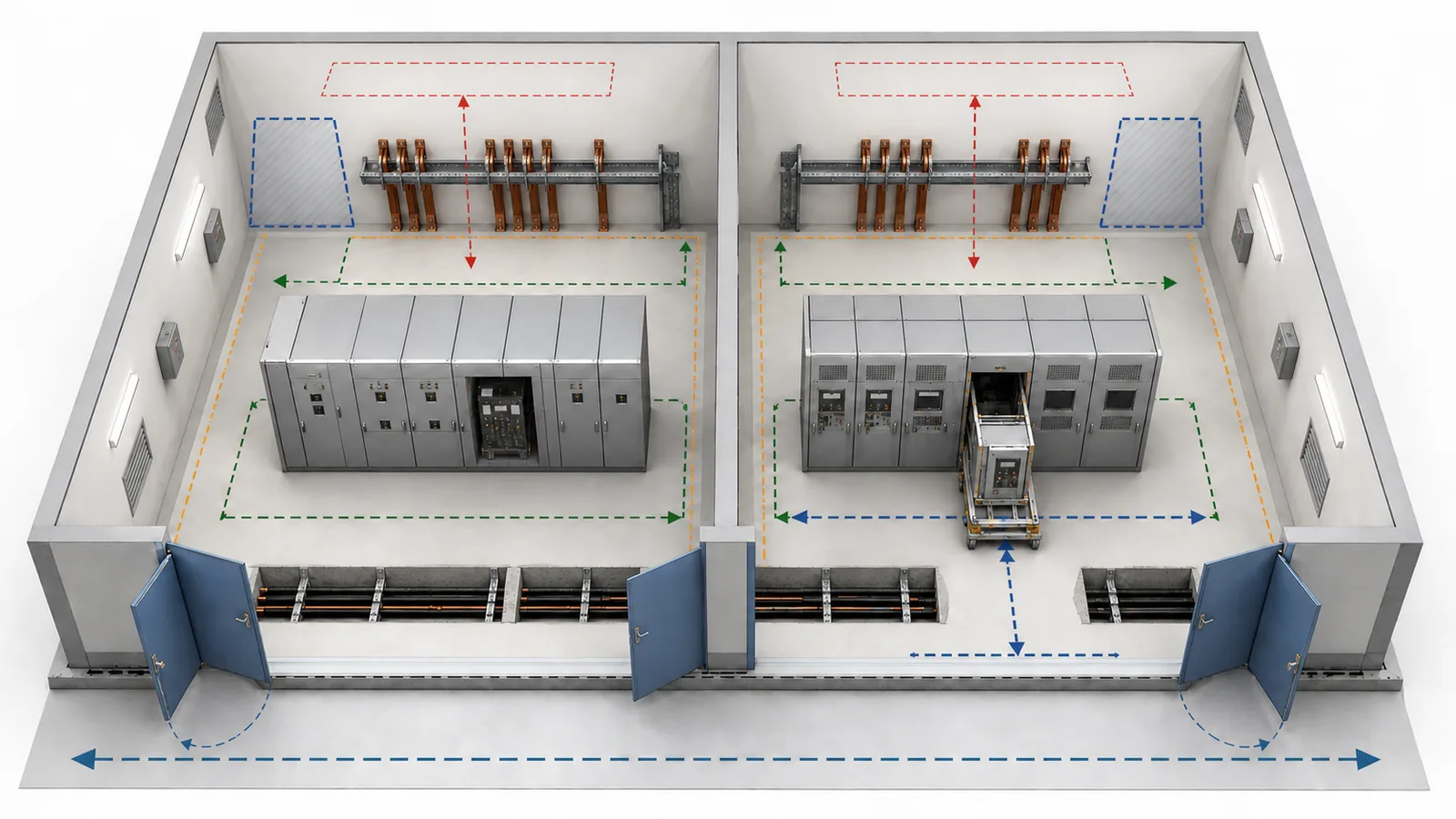
Begin with a coordinated room general arrangement rather than a catalogue outline. Record lineup length, maximum permitted width and depth, finished-floor level, front and rear aisle rules, door openings, transport corridor, lifting limits, wall clearances, ventilation zones, escape routes, and the permitted extension end. The supplier should overlay the exact offered lineup and identify every removable panel, door swing, truck path, component-removal route, and required working zone.
Do not assume fixed-type equipment always saves space. A fixed-device cabinet may avoid a breaker-truck operating envelope but still require rear cable access or a component-removal route. Do not assume KYN28 always requires an impractical room. The actual truck, door, transfer trolley, aisle, lineup depth, and cable-access arrangement decide the envelope. Compare dimensioned offers under the same room rules.
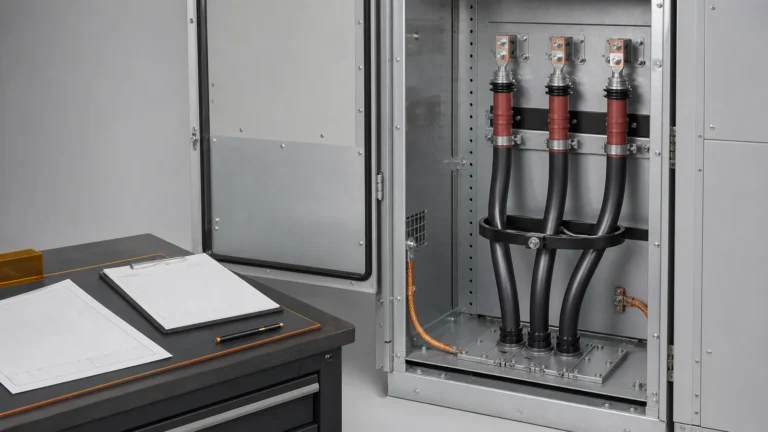
Cable and foundation review remains at interface level here. The RFQ checklist should state incoming direction, number and type of cables, termination level, CT location requirement, gland-plate responsibility, trench or floor opening, anchor points, floor loading, and control-cable route. Require the supplier’s dimensioned return and identify unresolved interfaces. Detailed bending-radius, termination, and gland-plate design belongs to the dedicated cable-interface review.
Future extension also changes the decision. Define the extension end, spare functional unit, bus and enclosure interface, protection/control reserve, civil opening, and whether the future bay must accept the same breaker or truck family. An empty space beside a lineup is not an approved extension provision. Hold technical release when the room GA, foundation drawing, cable interface, or extension boundary conflicts with the offered cabinet.
For fixed-type equipment, ask what must be isolated and opened to inspect, remove, or replace the primary switching device, and which adjacent circuits or compartments are affected. Require the fixed-device removal path, special tools, lifting points, replacement component strategy, access panels, earthing provisions, and post-work verification boundary. A replaceable device is not the same as a withdrawable operating truck.
For KYN28, define every truck position and the interfaces that change with it. The KYN28 switchgear foundation explains the basic compartment and truck boundary; the offer still needs its own position table covering main-circuit engagement, control plug, shutters, breaker close permission, earthing-switch availability, door interlocks, indication, and padlocking provisions. A spare truck is useful only if rating, dimensions, primary contacts, secondary plug, interlocks, control voltage, protection/control allocation, and mechanical coding are compatible.
Connected, test/service, disconnected, isolated, earthed, and safe-to-work are not interchangeable terms. An open breaker, truck position, closed shutter, or earthing indication is one state input, not independent proof of a safe work condition. Switching, isolation, absence-of-voltage verification, grounding, lockout/tagout, and permit-to-work remain governed by approved site procedures and authorized personnel. This article is not a switching, racking, maintenance, or live-work instruction.
The comparison should map feeder criticality and outage philosophy to the offered operating package. Ask what work can occur with which compartments or adjacent feeders energized, but accept the answer only when the declared assembly classification, interlocks, drawings, and evidence support it. Marketing phrases such as maintenance friendly or high continuity are not release evidence.
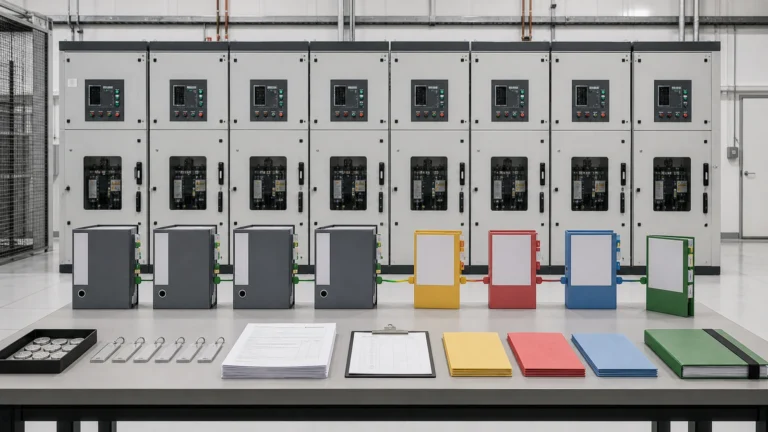
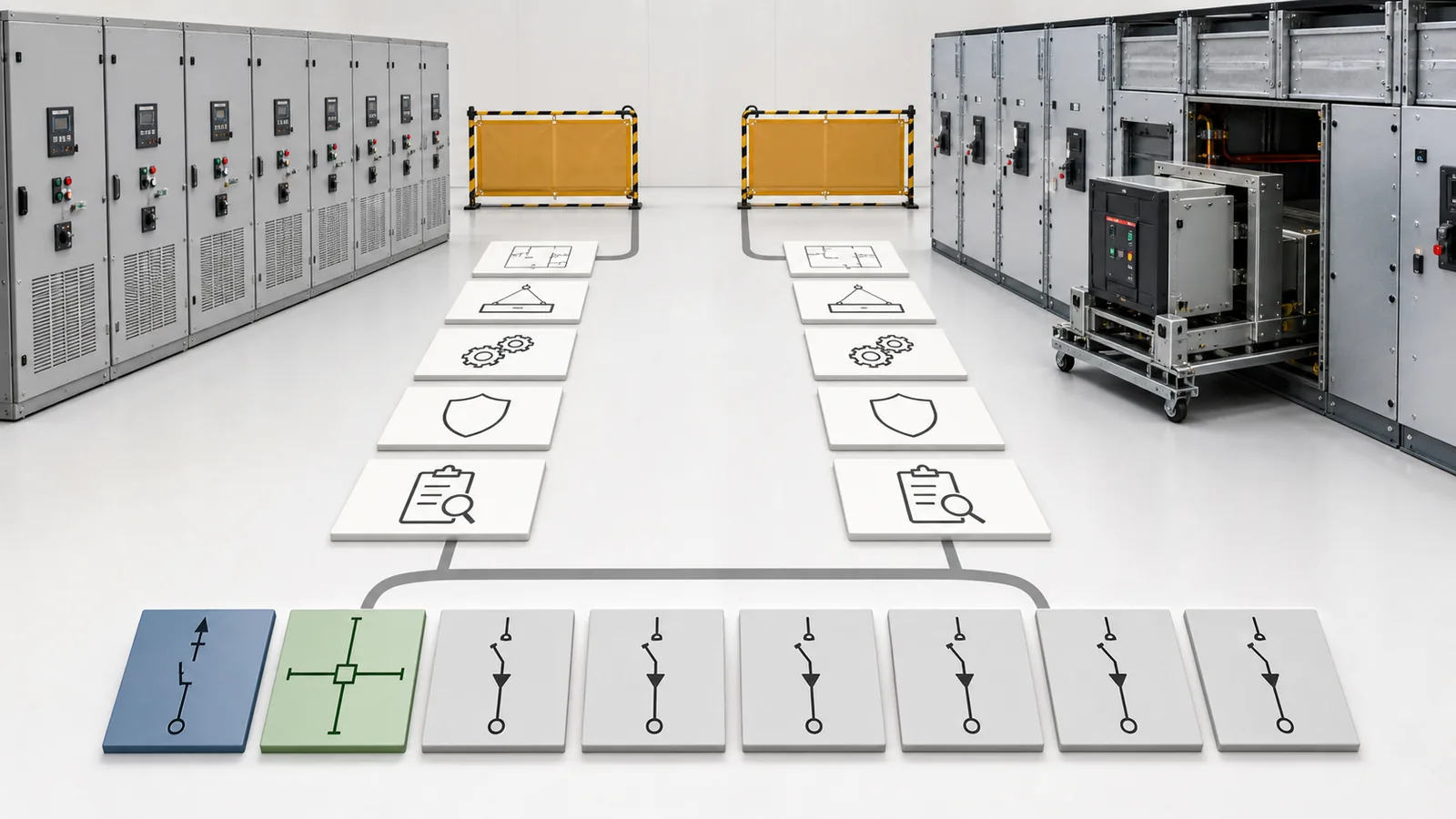
Use the complete switchgear cabinets pillar to establish the cabinet-family and package context, then issue one controlled comparison schedule to both suppliers. At minimum, the schedule should contain:
Every row needs a required input, supplier response, controlled document reference and revision, applicability decision, open deviation, responsible reviewer, and technical-release status. Do not combine a room outline from one variant, a classification report from another, and a breaker compatibility statement from a third into a claimed configuration. Hold release until the final ordered assembly is traceable through the schedule.
When a clarification changes the cabinet width, access side, truck type, cable zone, classification, or extension interface, reopen every affected schedule row. Approval of an earlier drawing revision does not automatically carry forward to the changed assembly.
Representative engineering review only. This is not a XIYA POWER customer, tender, plant, factory, test, FAT, commissioning, field, maintenance, outage, service, or operating case. All values are illustrative and non-universal.
A 12 kV, 50 Hz indoor industrial distribution extension has eight functional units: one incomer, one bus-section position, and six outgoing feeders. The preliminary comparison basis is a 1,250 A main bus and 25 kA for 3 s short-time duty. The project requests front maintenance where practical, controlled rear access, one spare feeder position, future extension at one lineup end, and a documented breaker replacement strategy.
Offer A uses an XGN Fixed-Type Switchgear arrangement and states the headline voltage, current, and short-time values. It does not return the rear-access envelope, fixed-device maintenance boundary, extension interface, or evidence applicable to the offered compartment arrangement. Those gaps prevent review of the room fit, affected service boundary, future bay, and declared classifications.
Offer B uses KYN28 Metal-Clad Withdrawable Switchgear and states the same headline values. It does not return the breaker-truck handling path, service/test-position interlock schedule, spare-truck compatibility basis, door/aisle envelope, or cable/foundation interface drawing. Those gaps prevent review of truck movement, operating states, replacement strategy, and civil fit.
Neither offer maps the headline ratings to the final bay schedule, room GA, internal-arc and service-continuity requirements, and configuration-applicable evidence. Do not declare a winner. Hold both technical releases until the operating philosophy, access and handling paths, GA/civil interfaces, classifications, drawings, and evidence are reconciled. The review records no order, installation, test, or operating outcome.
XGN is reviewed here as a fixed primary-device cabinet arrangement. KYN28 is reviewed as a metal-clad cabinet with a withdrawable breaker truck and declared positions. The exact compartments, access, interlocks, classifications, and evidence remain configuration-specific.
No. Compare the complete dimensioned lineup, doors, aisles, truck or component-removal route, cable access, foundation, and extension space. Family names do not establish the required room envelope.
No. A withdrawable truck may support a replacement strategy, but downtime depends on feeder design, spare compatibility, fault location, compartment condition, interlocks, procedures, and the work scope. Require a documented operating and maintenance basis.
It may be offered to applicable metal-enclosed requirements, but the XGN name is not proof. Review the exact assembly against the adopted standard and project specification, including required classifications and configuration-applicable evidence.
Provide the lineup zone, floor level, front/rear aisle rules, doors, transport and lifting route, wall and ventilation clearances, cable/trench interfaces, foundation, escape requirements, spare position, and permitted extension end.
Approve the one-line and bay schedule, arrangement and interface drawings, operating-state and interlock schedule, room/civil return, spare strategy, required classifications, manufacturer data, applicable test evidence, project-specification mapping, and closed deviation register for the exact offered configuration.